
 dr. Lisa Silvani
 You feel bloated, puffy, tired after meals. Your skin is doing something weird. Your joints ache. You have headaches that come out of nowhere. Or you just do not feel like yourself and you start wondering, is it gluten. Dairy. Eggs. Something I ate.
Then you go online and see 400 different “food sensitivity panels” promising answers. Some are cheap and cheerful. Some cost more than a car payment. Some are blood tests, some are hair tests, some are “energy” tests. And all of them somehow claim to be accurate.
So let’s slow down.
Because the uncomfortable truth is that a lot of food sensitivity testing is… not great. Not useful. Sometimes flat out misleading. But there are a few scenarios where testing can be worth it, and a few types of testing that actually belong in a medical conversation.
This article is here to help you spend your money wisely. And maybe more importantly, avoid wasting months of your life avoiding foods you never needed to avoid.
First, what people mean when they say “food sensitivity”
Most people use “food sensitivity” as an umbrella term for any negative reaction to food that is not a classic, immediate allergy.
But clinically, there are different buckets, and they matter because the tests are totally different.
1) True food allergy (IgE mediated)
This is the classic allergy. Hives. Swelling. Itching. Wheezing. Vomiting. Sometimes anaphylaxis. Usually happens quickly, within minutes to a couple hours.
Testing that can be helpful here includes skin prick testing and blood IgE testing, interpreted with an allergist and your history. This is not the world of Instagram “sensitivity panels.” Different lane.
2) Non IgE immune reactions (delayed immune reactions)
These are trickier. Symptoms can be delayed. The immune system may be involved, but not through IgE. This includes certain conditions like eosinophilic esophagitis (EoE) or other immune mediated GI issues.
Testing here is not a simple mail in kit. It is usually guided by a specialist, sometimes involving endoscopy and biopsies. Again, different lane.
3) Food intolerances (not immune mediated)
This is where a lot of people actually live.
Lactose intolerance. Fructose malabsorption. Histamine intolerance symptoms. FODMAP sensitivity. Reaction to sugar alcohols. Caffeine sensitivity. These are not allergies, and most of them do not show up on “antibody panels.”
These often respond best to targeted diet trials and sometimes breath testing.
4) Food triggers related to gut inflammation or dysbiosis
Sometimes foods are not the root cause, they are just the spark that hits the tinder.
If your gut lining is inflamed, if you have SIBO, if your microbiome is off, if you are constipated, if your bile flow is poor, if you are stressed and your nervous system is stuck in fight or flight… then lots of foods can feel like the “problem.”
This is a huge reason people get long lists of “sensitivities” and then feel worse after cutting everything out. The underlying system never got addressed.
This is also where functional and integrative medicine can be really helpful, when it is done carefully and not as a guessing game.
The big problem with most food sensitivity tests
Here is the core issue.
Many popular food sensitivity tests are measuring markers that do not reliably indicate a clinically meaningful problem with that food.
So you get a report that says you are “highly reactive” to 27 foods you eat all the time. You panic. You cut them all out. You feel better for two weeks because you are eating less processed food and paying attention. Then you feel worse because your diet is tiny, your stress is high, and your gut is still irritated.
Also, a lot of these tests are easy to “game” without realizing it. If you eat a food often, certain antibodies may be higher simply because you have been exposed. Not because it is harming you.
Which brings us to the tests themselves.
Quick scorecard: which food sensitivity tests are worth it?
Let’s go through the common categories you will see online.
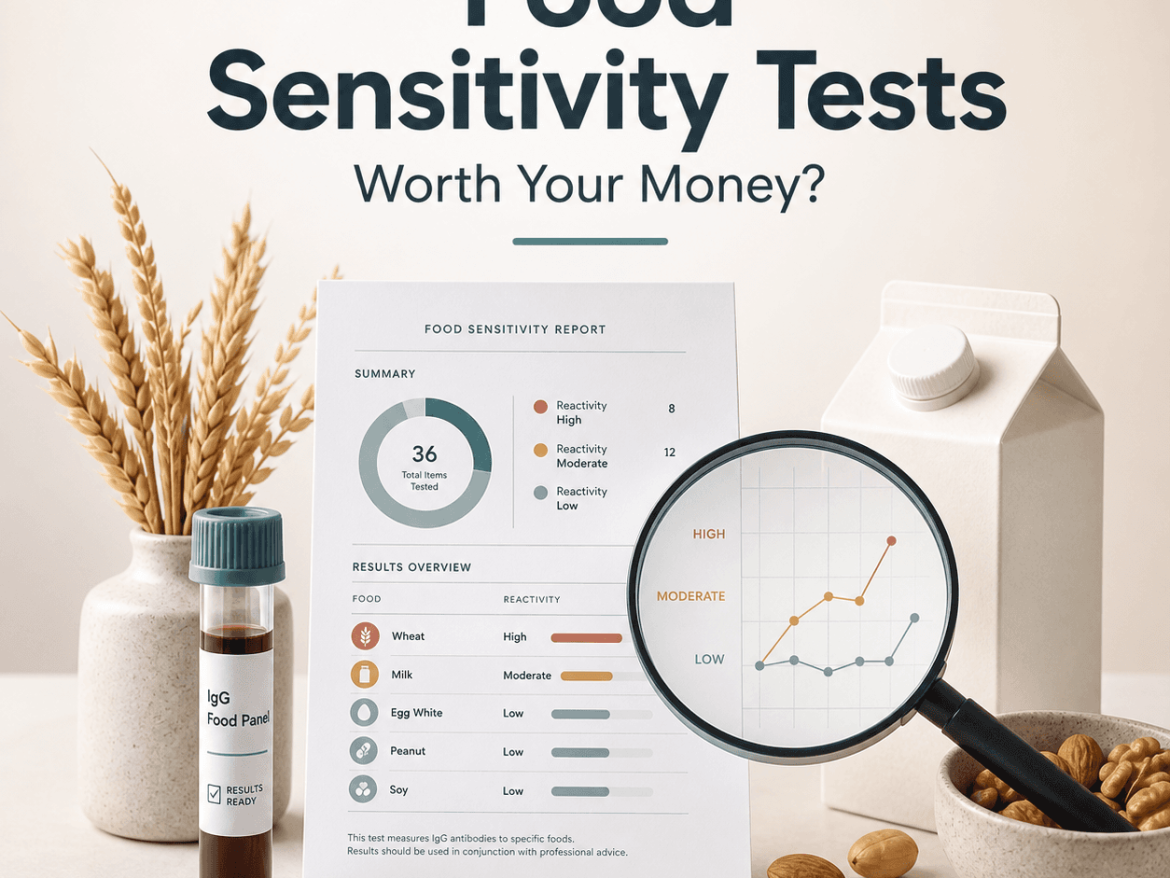
1) IgG food panels (the famous “food sensitivity blood test”)
Worth your money? Usually no.
These are the big ones. They test IgG, sometimes IgG4, to dozens or even hundreds of foods.
Here is the issue. IgG to foods is often a sign of exposure and tolerance, not intolerance. Many allergy organizations have specifically cautioned against using IgG testing to diagnose food allergies or intolerances.
So if you see a panel that says you are “sensitive” to eggs, almonds, chicken, and quinoa… it might just mean you eat those foods.
Now, does that mean IgG panels are never useful? In real world practice, some people use them as a rough starting point for an elimination diet. Not as a diagnosis. More like, “Here are a few foods we might trial removing, if the history lines up.”
But that is the key. History first. Symptoms first. A plan first. If you are buying an IgG panel hoping it will give you the truth, it usually will not.
Also, the bigger the panel, the more likely you get noise. You end up afraid of everything.
If you are going to do any elimination diet, you want it to be targeted, time limited, and followed by reintroduction. Otherwise it turns into food fear and nutritional gaps.
If you already bought one: do not panic. Do not cut 40 foods at once. Use it as a conversation starter with a qualified clinician, ideally one who will zoom out and ask why your gut is reacting in the first place.
2) Hair testing for food sensitivities (and “bioenergetic” tests)
Worth your money? No. Save it.
Hair analysis can have a role in certain mineral or toxic element discussions in specific contexts, with a lot of nuance. But hair testing for food sensitivities, the kind where you mail in a hair sample and get back a list of foods to avoid?
This is not considered a reliable method.
Same category includes many “frequency,” “electrodermal,” or “energy” sensitivity tests sold as certainty. If the test is not grounded in validated physiology and reproducibility, you are basically paying for a fancy list.
And the risk is not just losing money. The risk is you restrict foods unnecessarily, miss the real cause, and delay proper evaluation.
3) MRT (Mediator Release Test)
Worth your money? Maybe, in specific cases.
MRT is marketed as a test that measures mediator release from white blood cells in response to foods and additives. It is often paired with the LEAP diet.
Some patients report improvement using MRT guided elimination, especially in IBS type symptoms or migraine patterns. The evidence base is not as robust as we would like, and different clinicians have different opinions. But if you are someone who has tried a well structured elimination and reintroduction and still cannot identify triggers, MRT can be a tool.
A tool. Not gospel.
If you do MRT, do it with someone who knows how to implement it without turning your diet into a punishment. And who will also look at gut health, motility, stress, sleep, and nutrient status.
4) ALCAT
Worth your money? Generally no, similar concerns.
ALCAT is another leukocyte activation type test. It has been around a long time. It is controversial. Many experts do not consider it validated enough for routine use. If someone is pushing it as the answer, I would pause.
5) Lactose intolerance testing (hydrogen breath test)
Worth your money? Often yes, if symptoms fit.
This is a good example of a targeted test with a clear mechanism.
If you get gas, bloating, diarrhea after dairy, and it is consistent, a lactose breath test can be helpful. Or you can simply do a lactose free trial and see. Sometimes you do not need a test.
But breath testing is at least measuring something real, in a reproducible way.
6) Fructose malabsorption testing (breath test)
Worth your money? Often yes, if symptoms fit.
If fruit, honey, high fructose foods, or certain sweeteners trigger bloating and diarrhea, fructose breath testing can help clarify if malabsorption is part of the picture.
This can also overlap with IBS and SIBO, so interpretation matters.
7) SIBO breath testing (not a food test, but it changes food tolerance)
Worth your money? Sometimes, yes.
Not a food sensitivity test, but it is one of the biggest reasons people develop “sensitivities” to lots of healthy foods, especially high FODMAP foods like onions, garlic, beans, apples, and certain grains.
If you suspect SIBO, testing can be useful. Not perfect. But useful.
If SIBO is present and treated, many people can reintroduce foods they thought they were “sensitive” to.
8) Celiac disease testing (critical before you remove gluten)
Worth your money? Yes. Do this correctly.
If gluten is on your suspect list and you have symptoms like chronic diarrhea or constipation, iron deficiency, fatigue, brain fog, infertility, rash, or autoimmune history… get properly evaluated for celiac disease before removing gluten.
Because once you remove gluten, tests can become falsely negative.
Standard workup typically includes tissue transglutaminase IgA (tTG IgA) plus total IgA, sometimes deamidated gliadin peptide (DGP) antibodies, and if needed, endoscopy with biopsy.
This is not optional if celiac is a possibility. Celiac is not a “sensitivity,” it is an autoimmune disease with real long term risks if missed.
9) Non celiac gluten sensitivity (NCGS)
Worth your money? The “test” is mostly a structured trial.
There is no universally accepted biomarker test for NCGS. The most reliable approach is a gluten elimination trial followed by reintroduction, ideally blinded in research settings but realistically done carefully at home with guidance.
Also important. Many people who think gluten is the problem are actually reacting to fructans (a FODMAP) in wheat. That changes the plan, because then sourdough or low fructan options may work fine.
10) Histamine intolerance testing (DAO, histamine levels)
Worth your money? Maybe, but do not over rely on it.
Histamine issues are real for some people. Symptoms can include flushing, headaches, hives, nasal congestion, insomnia, anxiety, GI symptoms. But testing is messy. DAO levels can be inconsistent and do not always correlate with symptoms. Plasma histamine is tricky.
A low histamine trial can be informative, but should be short term. And the deeper question becomes, why is histamine load high. Gut dysbiosis. Low DAO production. Mast cell activation. Hormone shifts. Medication effects.
So yes, there are labs that might help, but this is an area where a good clinician matters more than a test result.
11) Additive sensitivities (sulfites, dyes, MSG)
Worth your money? Usually handled by history and trials.
There is no perfect blood test for “MSG sensitivity” or dye reactions. If symptoms reliably happen after specific processed foods or wines, a trial removal and then re challenge is often more useful than paying for a panel.
12) Genetic tests for food sensitivities
Worth your money? Usually no, unless it is very specific.
You might see genetic panels claiming to tell you what diet is best for you. Most of that is marketing.
There are exceptions. For example, HLA DQ2/DQ8 can help rule out celiac risk in some contexts, though it does not diagnose it. And some genetic traits can influence caffeine metabolism or lactose persistence. But as a “food sensitivity test,” genetics is rarely the missing piece.
So what should you actually do if you think food is causing symptoms?
Here is the approach that tends to give the best return, with the least chaos.
Step 1: Make sure you are not missing something serious
If you have weight loss without trying, blood in stool, persistent vomiting, anemia, severe pain, trouble swallowing, waking up at night with symptoms, family history of IBD or colon cancer, or symptoms that are escalating. Do not start with a mail in panel. Get evaluated.
Also, screen for celiac before removing gluten if it is on your radar.
Step 2: Track patterns, but do it in a sane way
A simple food and symptom log for 7 to 14 days can be more powerful than it sounds. Not obsessive calorie tracking. Just.
What did I eat. When. What symptoms showed up. How long after. How was sleep, stress, bowel movements, cycle phase (if relevant).
A pattern often emerges. Especially with dairy, alcohol, high FODMAP meals, late night eating, ultra processed foods.
Step 3: Do a targeted elimination diet, not a life sentence
The best elimination diets are:
- Narrow (remove likely triggers, not everything)
- Time limited (usually 2 to 4 weeks)
- Paired with reintroduction (this is where you learn the truth)
- Done while supporting the basics (protein, fiber, hydration, regular meals)
Common targeted trials:
- Dairy free (especially lactose containing dairy)
- Gluten free trial (after celiac testing if indicated)
- Low FODMAP trial (ideally guided, because it is easy to do incorrectly)
- Low histamine trial (short term, symptom guided)
If you remove 18 foods at once, and you feel better, you will not know which change helped. And you will be afraid to add anything back.
Step 4: Ask the deeper question: why is your threshold so low right now?
This is the part that gets skipped when people chase sensitivity lists.
Because if your gut is inflamed, if you are constipated, if your sleep is broken, if stress is high, if you are under eating, if hormones are shifting, if you have SIBO, H pylori, low stomach acid, bile flow issues, pancreatic enzyme insufficiency, chronic infections, mold exposure in some cases… then food reactions are more likely.
This is where a functional medicine approach can be really helpful, when it is grounded and personalized.
On Dr. Lisa Silvani’s site at lisasilvani.com, this is basically the theme running through her work. Looking at gut health, hormones, detox pathways, immune function, energy and metabolism as connected systems. Not just slapping a “sensitivity” label on a food and calling it a day.
If you are stuck and feel like you have tried everything, booking a free consultation through her website can be a good next step. Even just to get clarity on what to test, what to ignore, and what to do first.
When a food sensitivity test can be worth it
There are a few situations where spending money on testing is reasonable.
Scenario A: You suspect a true allergy
Do not DIY this. See an allergist. IgE testing and/or skin testing may be appropriate. Especially if you have hives, swelling, throat symptoms, asthma flares, or rapid reactions.
Scenario B: Your symptoms strongly suggest a specific intolerance
Dairy symptoms. Fructose symptoms. You might not need testing, but breath tests can confirm and prevent unnecessary restriction.
Scenario C: You have IBS and cannot identify triggers despite a well done diet trial
This is where something like a structured low FODMAP approach, SIBO testing, and in some cases MRT (implemented responsibly) can be considered.
Scenario D: You need to rule out celiac disease
Absolutely worth it. But do it while still eating gluten.
Scenario E: You are in a bigger functional workup already, and testing is being used strategically
Not “let’s run every panel because we can.” More like, “Based on your history, these are the two or three most informative data points, and here is what we will do with them.”
That last part is huge. A test is only worth the money if it changes the plan in a meaningful way.
Red flags that a test is not worth it
If you see these, pause.
- The test claims to diagnose 200 food sensitivities with near perfect accuracy.
- The results come back with a massive list of “positives” for common healthy foods.
- The company sells supplements to “treat” the results and the whole thing feels like a funnel.
- There is no plan for reintroduction. Just avoidance forever.
- The test is not reproducible, not transparent, or not biologically plausible.
- Your symptoms are serious, but the test is being used instead of medical evaluation.
What I recommend instead of spending $400 on a giant panel
If you are trying to be smart with money, here is a more grounded way to use that budget.
- Basic labs with your clinician (depending on symptoms): CBC, iron studies, B12, vitamin D, thyroid markers, metabolic markers, inflammatory markers if appropriate.
- Celiac screening if gluten is a suspect and you are still eating it.
- Breath testing if intolerance or SIBO is likely.
- A well structured elimination and reintroduction plan, ideally guided, so you do not end up stuck in restriction.
- Gut foundation work: regular bowel movements, enough fiber for your body, protein, hydration, sleep, stress support, meal timing.
Not glamorous, but it is often what moves the needle.
A simple reintroduction method (so you do not stay afraid of food)
If you did an elimination diet and symptoms improved, reintroduction is where you learn what is real.
A basic approach:
- Pick one food to test.
- Day 1: small amount.
- Day 2: moderate amount.
- Day 3: normal serving.
- Then stop and observe for 48 hours.
Track symptoms. If you react, note what happened and how severe. Then you can decide whether it is a true trigger, a dose issue, or maybe a timing issue (like eating it during a high stress week).
Also, sometimes reactions are not the food itself. It is the form.
Milk vs yogurt. Wheat pasta vs sourdough bread. Fried eggs vs baked egg in a muffin. Raw onion vs cooked onion. This stuff matters.
The bottom line: which tests are actually worth it?
Here is the simple version.
Generally worth considering (depending on symptoms)
- Celiac testing (before going gluten free)
- IgE allergy evaluation when allergy symptoms exist
- Hydrogen breath testing for lactose or fructose malabsorption
- SIBO breath testing in the right context
Sometimes worth it, with guidance
- MRT for stubborn IBS or migraine patterns when other strategies have not worked
- Histamine related labs as part of a bigger clinical picture, not as a standalone answer
Usually not worth your money
- IgG and IgG4 food sensitivity panels as a diagnostic tool
- Hair testing for food sensitivities
- Electrodermal or “energy” food sensitivity tests
- Huge panels that create fear, restriction, and confusion without a clear plan
If you are dealing with fatigue, gut symptoms, weight changes, brain fog, skin issues, or you just feel inflamed and reactive to everything, it is rarely about one magic “bad food.” It is usually about your overall threshold and what is driving it down.
If you want a more personalized, systems based plan, you can explore resources and book a free consult through https://www.lisasilvani.com. Sometimes the most valuable “test” is simply having someone experienced look at the full picture and help you stop guessing.
FAQs (Frequently Asked Questions)
What is the difference between food allergies and food sensitivities?
Food allergies are true immune reactions mediated by IgE antibodies, causing immediate symptoms like hives, swelling, or anaphylaxis. Food sensitivities is an umbrella term for any negative reaction to food that is not a classic, immediate allergy, including delayed immune reactions, intolerances, or gut-related triggers.
Are IgG food sensitivity blood tests reliable for diagnosing food intolerances?
No, IgG food panels often indicate exposure and tolerance rather than intolerance. Many allergy organizations caution against using IgG testing to diagnose food allergies or intolerances. These tests should not be used as definitive diagnosis but can sometimes guide targeted elimination diets when combined with medical history and symptoms.
Can hair testing or bioenergetic tests accurately identify food sensitivities?
No, hair testing and bioenergetic tests for food sensitivities are generally not reliable and are considered a waste of money. They do not provide clinically meaningful information about food reactions.
What should I do if I experience bloating, fatigue, or skin issues after eating certain foods?
Start by tracking your symptoms and dietary intake to identify patterns. Consult a qualified healthcare provider to evaluate your history and possibly perform medically appropriate tests. Avoid relying solely on commercial ‘food sensitivity panels’ without professional guidance.
Why do some people feel worse after eliminating many foods based on sensitivity tests?
Eliminating many foods without proper guidance can lead to a restricted diet causing nutritional gaps, increased stress, and ongoing gut irritation. Often the underlying gut inflammation or dysbiosis is not addressed, which is crucial for symptom improvement.
When is food sensitivity testing worth considering?
Testing may be useful in specific scenarios such as true IgE-mediated allergies evaluated by allergists or in complex immune-mediated conditions guided by specialists. For most people with non-IgE reactions or intolerances, targeted diet trials under professional supervision are more effective than broad commercial panels.
References
- Sicherer, S. H., & Sampson, H. A. (2018). Food allergy: Epidemiology, pathogenesis, diagnosis, and treatment. The Journal of Allergy and Clinical Immunology, 141(1), 41-58.e5. https://doi.org/10.1016/j.jaci.2017.11.003
- Boyce, J. A., Assa’ad, A., Burks, A. W., et al. (2010). Guidelines for the diagnosis and management of food allergy in the United States: Report of the NIAID-sponsored expert panel. The Journal of Allergy and Clinical Immunology, 126(6 Suppl), S1-S58. https://doi.org/10.1016/j.jaci.2010.10.007
- Gibson, P. R., & Shepherd, S. J. (2010). Evidence-based dietary management of functional gastrointestinal symptoms: The FODMAP approach. Journal of Gastroenterology and Hepatology, 25(2), 252-258. https://doi.org/10.1111/j.1440-1746.2009.06149.x
- NHS UK (2023). Lactose intolerance – Diagnosis and tests. Retrieved from https://www.nhs.uk/conditions/lactose-intolerance/diagnosis/
- Sapone, A., Bai, J.C., Ciacci, C., et al. (2012). Spectrum of gluten-related disorders: Consensus on new nomenclature and classification. BMC Medicine, 10(13). https://doi.org/10.1186/1741-7015-10-13
- Di Sabatino, A., & Corazza, G.R. (2009). Coeliac disease: Pathogenesis and clinical implications.BMJ, 338:b1515 https://doi.org/10.1136/bmj.b1515
- Pimentel M., Saad R.J., Long M.D., Rao S.S.C., & Chey W.D.(2022). Food intolerances and sensitivities: Mechanisms and management in functional gastrointestinal disorders.American Journal of Gastroenterology, 117(5), 688–705 https://doi.org/10.14309/ajg0000000000001755
- Camilleri, M., Lasch, K., & Zhou, W.(2012). Irritable bowel syndrome: Methods, mechanisms, and pathophysiology.The Journal of Clinical Investigation, 122(3), 928-938 https://doi.org/10.1172/JCI59889
- Fitzgerald K.T., & Gurley B.J.(2014). Food sensitivity testing: What is the evidence? Journal of the American Academy of Nurse Practitioners, 26(5), 238-249 https://doi.org/10.1002/2327-6924.12048
- 10.Hyman M.(2020). Food sensitivities: Testing options and clinical guidance.MindBodyGreen. Retrieved from https://www.mindbodygreen.com/articles/how-to-test-for-food-sensitivities


