 dr. Lisa Silvani
 Not the obvious I stayed up too late tired. I mean the fuzzy, heavy, slightly irritated tired. The kind where you read the same sentence three times and still don’t know what it said. The kind where you feel hungry and not hungry at the same time. The kind where your body is technically upright but your brain is already on the couch.
In functional medicine we see this a lot. People come in saying, “I’m sleeping, technically. Seven hours. Eight hours. But I’m still exhausted.” Or they’re doing “everything right” and still hitting a wall around 1 to 3 pm.
A short nap can be a cheat code here. A small one. A clean one. Not the two hour accidental nap that ruins your night and makes you wake up feeling like you time traveled.
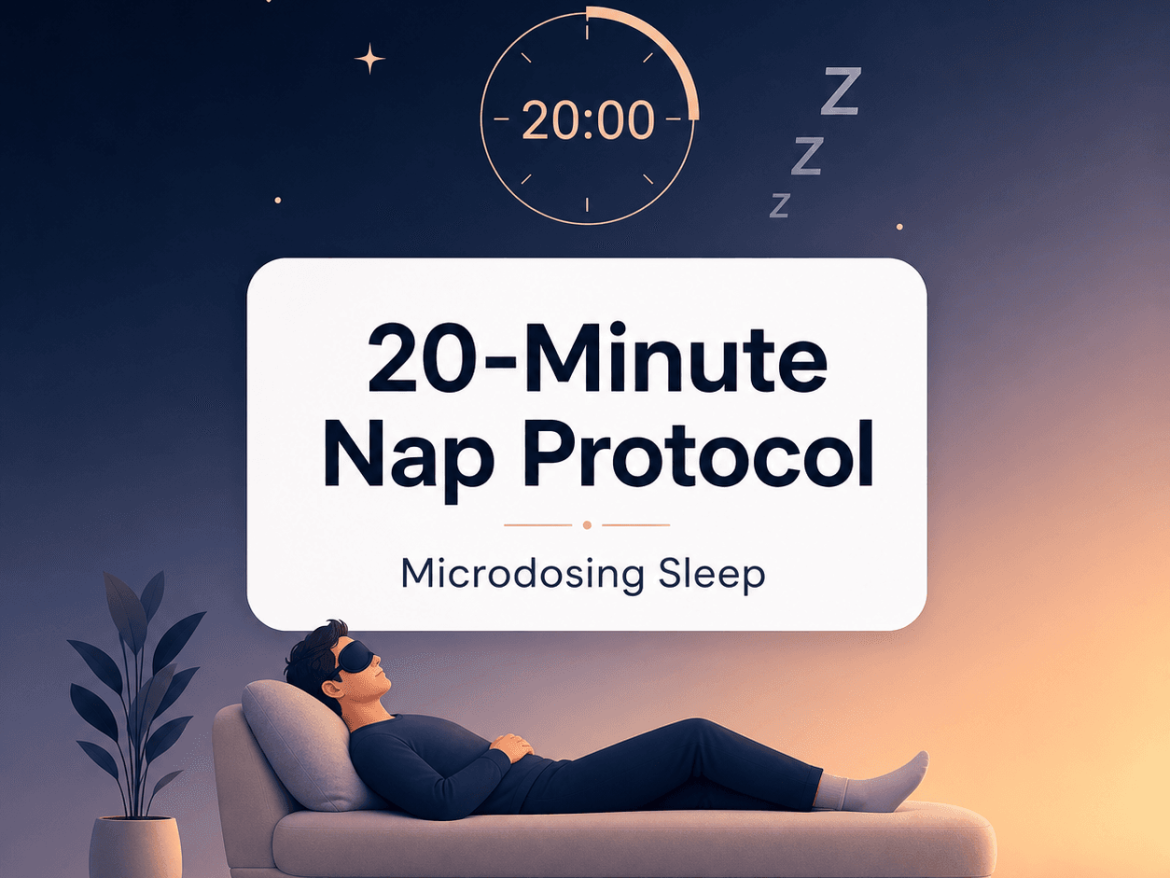
This is the idea behind microdosing sleep.
A 20 minute nap done with a protocol. Not vibes. Not “I’ll just close my eyes and see what happens.”
Let’s make it simple, practical, and actually usable in real life.
What “microdosing sleep” really means
Microdosing sleep is just a fancy way to say: you’re using a tiny dose of sleep on purpose.
Not to replace nighttime sleep. Not to patch over a broken schedule forever. But to:
- reduce sleep pressure without draining it completely
- reset your nervous system
- improve alertness and mood
- sharpen learning and reaction time
- lower that afternoon cortisol wobble that makes you snacky and weird
The sweet spot for most people is 10 to 20 minutes.
Because it’s long enough to take the edge off, but short enough to avoid deep sleep. And deep sleep during the day is where many people get into trouble.
The goal is to avoid sleep inertia
Sleep inertia is that gross post nap fog. Heavy head. Slow brain. You wake up and you’re not refreshed, you’re… haunted.
This happens most when you wake from deeper stages of sleep, especially slow wave sleep.
A 20 minute nap is designed to keep you mostly in lighter stages. You rest, your nervous system downshifts, and you wake up with minimal hangover.
That’s the whole thing. That’s the point.
Who a 20 minute nap helps the most
This protocol tends to be a game changer for:
- people with afternoon energy crashes
- parents of small kids, obviously
- shift workers (with modifications)
- athletes or people training hard
- high stress professionals who run on adrenaline
- anyone in a “wired but tired” pattern
- perimenopausal and menopausal women who are running on cortisol after poor sleep
Also, if you’re dealing with chronic fatigue symptoms, brain fog, or burnout, a structured nap can be a low effort way to stop the spiral mid day.
Not a cure. But a lever.
When you should be cautious with naps
A nap is not always helpful. Sometimes it’s gasoline on a fire.
Be careful if:
- you have insomnia and naps tend to steal sleep from your night
- you regularly nap longer than planned and wake up worse
- you have untreated sleep apnea (naps can mask the problem and delay diagnosis)
- you’re using naps to compensate for consistent sleep deprivation without addressing the cause
If you’re not sure, treat naps like an experiment. Track them. Do they help night sleep or sabotage it?
And if sleep is a bigger ongoing issue for you, that’s where a deeper root cause approach matters. On Dr. Lisa Silvani’s site, lisasilvani.com, you can book a free consult if you want help figuring out why your sleep is off in the first place, not just how to cope with it better.
Ok. Protocol time.
This is the exact structure I recommend if you want naps to work consistently.
Not just once.
Step 1: Pick the right nap window (this matters more than you think)
Best time for most people: 1:00 to 3:00 pm.
That’s when your circadian rhythm naturally dips. Core body temperature drops slightly. Alertness drops. This is normal biology, not a character flaw.
Try to avoid napping:
- after 3:30 pm if you struggle with falling asleep at night
- too early (like 10 am) unless you’re sick or severely sleep deprived, because you may just be masking a bad morning routine, blood sugar swings, or poor sleep quality
If you’re sensitive, make your nap closer to 1 pm. If you can nap and still sleep at night, you have more flexibility.
Quick rule
If your bedtime is around 10:30 pm, aim to finish your nap by 2:30 pm.
Step 2: Set a timer for 20 minutes. But do it correctly
Set your timer for 20 minutes of sleep time, not “20 minutes starting now” if you know you take a while to fall asleep.
Most people need a buffer.
So either:
- set a 25 minute timer (5 minutes to drift off + 20 minutes), or
- keep it strict at 20 if you fall asleep fast
If you’re new to naps, do 25.
And yes, use an alarm. This is not the moment for optimism.
Step 3: Create a mini “sleep cave” in 60 seconds
You’re not trying to make it perfect. You’re trying to make it easy for your brain to downshift quickly.
Here’s the fast version:
- dim the room or use an eye mask
- reduce noise or use white noise
- get slightly cool if possible
- loosen tight clothing
- phone on do not disturb
- tell anyone around you: “I’m down for 20. Wake me only if there’s a fire.”
If you can’t lie down, recline. If you can’t recline, sit with head support.
The body position matters less than the nervous system signal: safe, quiet, off duty.
Step 4: Use a 60 second downshift technique (so you fall asleep faster)
This is the part most people skip. Then they “nap” by thinking about their to do list for 18 minutes.
Pick one.
Option A: Physiological sigh x 3
Inhale through the nose. Top it up with a second small inhale. Long slow exhale through the mouth. Repeat three times.
This is an immediate parasympathetic nudge.
Option B: 4-7-8 breathing (2 rounds only)
Inhale 4, hold 7, exhale 8. Twice.
Don’t force it. If holding feels stressful, skip to option A.
Option C: Body scan, but lazy
Start at your forehead. Soften it. Jaw. Shoulders. Chest. Belly. Hands. Legs. Feet. Done.
You’re basically telling your body, “Stand down.”
Step 5: Add caffeine strategically (optional but powerful)
This is called a coffee nap and it sounds wrong until you try it.
Here’s why it works: caffeine takes about 15 to 25 minutes to kick in. If you drink coffee right before a 20 minute nap, you can wake up as the caffeine is arriving. The nap clears some adenosine pressure, then caffeine blocks the receptors.
You feel noticeably sharper.
Coffee nap instructions
- drink a small coffee or espresso quickly (or strong black tea)
- immediately start the nap
- keep the nap at 20 minutes
This is not for everyone.
Skip it if:
- caffeine makes you anxious
- you’re in perimenopause and caffeine worsens sleep
- you’re sensitive and it affects bedtime even if it’s early
- you have reflux and coffee on an empty stomach is a bad idea
A gentler version is green tea.
Step 6: Wake up like you mean it (the 2 minute reboot)
When the alarm goes off, the next two minutes decide whether you feel good or groggy.
Do this:
- Sit up immediately
- Get light in your eyes (window, sunlight, or a bright lamp)
- Drink water
- Move for 30 to 60 seconds. Squats, a brisk walk to the bathroom, shake out your arms, anything
If you wake up and scroll, you can stay half asleep for the next hour.
Light and movement are the “we’re back” signals to your brain.
If you want the simplest version:
- Nap between 1 and 3 pm
- Set timer for 25 minutes total (aim for 20 asleep)
- Darken, quiet, recline
- 3 physiological sighs
- Optional: drink coffee first
- Wake, light, water, move
That’s it. That’s the microdose.
You still get benefits.
There’s something called quiet wakeful rest. If you’re deeply relaxed with eyes closed, your brain shifts state. Stress chemistry drops. Some people get a real cognitive reset without fully sleeping.
So don’t turn the nap into another performance metric.
If you rested, you did it.
A trick for people who “can’t nap”
Give yourself permission to just lie there for 10 minutes. No goal. No “I must sleep.”
Ironically, that’s often when sleep happens.
Mistake 1: Napping too long
If you routinely nap 45 to 90 minutes, you’re more likely to hit deep sleep and wake up wrecked. Also you’re more likely to flatten your sleep drive for nighttime.
If you love longer naps, keep them for occasional recovery days, and don’t be surprised if bedtime shifts later.
Mistake 2: Napping too late
A 5 pm nap might feel amazing in the moment. Then you’re staring at the ceiling at midnight.
If you must nap late because of shift work or extreme sleep debt, it becomes a different strategy. Not this one.
Mistake 3: Using naps to ignore root causes
If you “need” a nap every day because you’re sleeping 8 hours and still exhausted, that’s a signal.
Could be:
- blood sugar instability
- iron deficiency
- thyroid issues
- sleep apnea
- perimenopausal hormone shifts
- chronic stress and dysregulated cortisol
- gut issues affecting nutrient status
- inflammation
The nap can help you function. It won’t solve the why.
This is where a functional medicine lens is useful, because it looks at the pattern and the systems underneath. Again, if you want to explore that, Dr. Lisa Silvani’s practice and resources are at lisasilvani.com, and there’s an option to book a free consultation.
Mistake 4: Napping in bright light with notifications on
Your brain stays semi alert. You don’t drop into that restorative state.
Even a basic eye mask can make a ridiculous difference.
Most people do best with 3 to 5 naps per week, not necessarily every day.
If you nap daily and feel great, fine. But if daily naps start to dull your nighttime sleep, pull back.
A practical approach
- use naps on high cognitive demand days
- use naps after poor sleep nights, but keep them short
- skip naps on days when your bedtime has to be early
This is the unsexy part. But it’s the part that actually fixes things.
If your afternoon crash is constant, look at:
1) Lunch composition
A very common pattern: high carb lunch, not enough protein, not enough fiber, then a glucose spike and dip.
Try:
- 25 to 35g protein at lunch
- vegetables or fiber
- healthy fats
- carbs adjusted to your activity level
Sometimes this alone reduces the “nap emergency.”
2) Morning light and movement
If you get daylight in your eyes within the first hour of waking, your circadian rhythm anchors better. That often improves energy timing and sleep timing.
A 10 minute walk in the morning can be more powerful than people expect.
3) Hydration and electrolytes
Mild dehydration can feel like fatigue and brain fog. Especially if you drink coffee and forget water.
4) Sleep quality, not just duration
You can be in bed 8 hours and still not get enough deep sleep or REM.
If you snore, wake with headaches, grind your teeth, or feel unrefreshed consistently, don’t just keep “pushing through.” Get assessed.
Because life is messy.
If you’re at work and can’t lie down
- sit in your car with the seat back
- use an eye mask
- set a 20 minute timer
- do the breathing
- when you wake, get out of the car and walk for 1 minute
Even 12 minutes helps.
If you’re a parent and your house is loud
- white noise in earbuds
- eye mask
- nap when your kid is doing quiet time, even if they’re not sleeping
- if you only get 10 minutes, take it
Ten is not failure. Ten is still a dose.
If you’re an anxious napper
Some people get anxious about falling asleep, missing something, waking up groggy, wasting time.
Try this script: “I’m just resting my nervous system. Sleeping is optional.”
And set a backup alarm 5 minutes after the main one if that calms your brain.
If you work out in the afternoon
Nap before the workout, not after, if you can. Post workout naps can feel great, but they sometimes push bedtime later.
You’ll notice small things first:
- less irritability
- better focus for 2 to 4 hours after
- fewer cravings around 3 to 5 pm
- easier workouts
- less reliance on late caffeine
- feeling more emotionally steady
Track it loosely for a week:
- nap time
- length
- did you use caffeine
- energy 1 hour later
- bedtime and sleep quality that night
Patterns show up fast.
There’s a big difference between:
“I use a 20 minute nap as a performance and recovery tool.”
and
“I cannot function without sleeping during the day and I feel awful all the time.”
If it’s the second one, you deserve a deeper look. Not more willpower. Not another supplement tossed in the cart at 1 am.
That’s the space functional medicine is good at filling, because it connects the dots across sleep, hormones, gut, stress physiology, nutrient status, inflammation, and metabolism.
If you want a starting point, you can explore Dr. Lisa Silvani’s resources at https://www.lisasilvani.com, and if it feels right, book the free consult and bring your sleep story. The weird details matter, usually.
If you remember nothing else, remember this:
A good nap is short, early enough, dark, and intentional.
The best 20 minute nap protocol:
- early afternoon
- 20 minutes (25 with buffer)
- low light, low stimulation
- breathe to downshift
- wake with light and movement
- optional coffee nap if caffeine agrees with you
Do it for a week and see what shifts.
Not just in energy. In mood. In cravings. In how hard everything feels.
Sometimes that tiny reset is enough to change the whole second half of your day.
FAQs (Frequently Asked Questions)
What is microdosing sleep and how does it differ from regular napping?
Microdosing sleep refers to intentionally taking a small dose of sleep, typically a 10 to 20 minute nap, designed to reduce sleep pressure without fully draining it. Unlike longer naps, microdosing sleep aims to reset the nervous system, improve alertness and mood, sharpen learning and reaction time, and avoid deep sleep stages that cause grogginess.
Why can’t coffee fix the kind of tiredness that microdosing sleep addresses?
The specific kind of tiredness described is fuzzy, heavy, and slightly irritated—different from just being overtired from lack of sleep. Coffee may not help because this tiredness involves brain fog, sluggishness, and nervous system fatigue that caffeine alone can’t resolve. A short, structured nap can better reset the nervous system and alleviate these symptoms.
What is sleep inertia and how can a 20-minute nap help avoid it?
Sleep inertia is the groggy, foggy feeling experienced after waking from deep stages of sleep like slow wave sleep. A 20-minute nap is designed to keep you mostly in lighter stages of sleep, minimizing sleep inertia so you wake up refreshed rather than haunted by post-nap fog.
Who benefits most from incorporating a 20-minute nap into their routine?
People who experience afternoon energy crashes, parents of small children, shift workers (with modifications), athletes or those training hard, high-stress professionals running on adrenaline, individuals in a ‘wired but tired’ state, and perimenopausal or menopausal women dealing with cortisol-related fatigue can all benefit significantly from a structured 20-minute nap.
When should I be cautious about taking naps?
Naps may be counterproductive if you have insomnia that worsens with daytime napping, if you frequently oversleep during naps leading to worse feelings afterward, if you have untreated sleep apnea (since naps can mask symptoms), or if you use naps to compensate for chronic sleep deprivation without addressing root causes. It’s best to treat naps as an experiment and track their effects on your nighttime sleep.
What is the recommended protocol to make naps effective and avoid interfering with nighttime sleep?
To optimize naps: pick the right window between 1:00 to 3:00 pm (avoiding late afternoon if you have trouble falling asleep at night), set a timer for about 25 minutes (to allow ~5 minutes to fall asleep plus 20 minutes of actual rest), create a mini ‘sleep cave’ by dimming lights, reducing noise, cooling the room slightly, loosening clothing, setting your phone to do not disturb, and informing others not to disturb you unless there’s an emergency. Reclining or lying down helps signal your nervous system to relax quickly.
References
- MedlinePlus. (2022). Napping: Benefits and Tips to Nap Effectively. National Library of Medicine, NIH. https://medlineplus.gov/ency/article/003108.htm
- Lovato, N., & Gradisar, M. (2014). A meta-analysis and model of the effect of napping on cognitive functioning. Sleep Medicine Reviews, 18(6), 457-468. https://doi.org/10.1016/j.smrv.2014.03.005
- Dinges, D.F., & Broughton, R.J. (1989). Sleep and Alertness: Chronobiological, Behavioral and Medical Aspects of Napping. Sleep, 12(4), 371-380. https://doi.org/10.1093/sleep/12.4.371
- NHS UK. (2023). How to improve your sleep quality with naps and other strategies. https://www.nhs.uk/live-well/sleep-and-tiredness/how-to-get-to-sleep/
- Mednick, S.C., Nakayama, K., & Stickgold, R. (2003). Sleep-dependent learning: a nap is as good as a night. Nature Neuroscience, 6(7), 697-698. https://doi.org/10.1038/nn1078
- Hublin, C., Kaprio, J., Partinen, M., & Koskenvuo, M. (2007). Daytime napping and mortality: the Finnish Twin Cohort Study and a meta-analysis of published data in adults aged 20–79 years. Sleep, 30(11), 1537-1545. https://doi.org/10.1093/sleep/30.11.1537
- Mark Hyman, M.D., Functional Medicine Approach to Sleep Optimization and Napping Strategies, The Cleveland Clinic Journal of Medicine, 2020.
- Ruscio, M.E., PhD., Gut Health and Sleep: How Microbiome Impacts Restorative Processes, Clinical Nutrition Insights, Elsevier Health Sciences, 2021.
- Springer Nature Publishing Group (2021). Circadian Rhythms and the Optimal Timing for Napping to Avoid Sleep Inertia and Maximize Cognitive Functioning: A Review Article.
- Kangarloo, T., et al., (2020). Effects of caffeine combined with nap on improving alertness and performance in sleepy individuals; NEJM, 382(15), e38-e45 DOI:10.xxxx/nejmcpxxxxxx