
 vanilis
 You do the labs. You expect an answer.
And then you get this weird, almost insulting result.
Hemoglobin is normal. Your doctor says, “No anemia. Looks fine.”
But you do not feel fine.
You are tired in a way that sleep does not fix. Your brain feels fuzzy. Work takes twice as long. Your workouts feel like dragging a fridge. Your hair is shedding. Your heart sometimes races for no reason. You are cold when everyone else is comfortable. And somehow you are expected to accept, politely, that everything is normal.
This is the fatigue trap. And one of the most common reasons I see for it is low ferritin with normal hemoglobin.
Not rare. Not exotic. Just… overlooked.
Let’s unpack it in a way that actually helps you.
Ferritin vs hemoglobin (and why the “normal” result can mislead you)
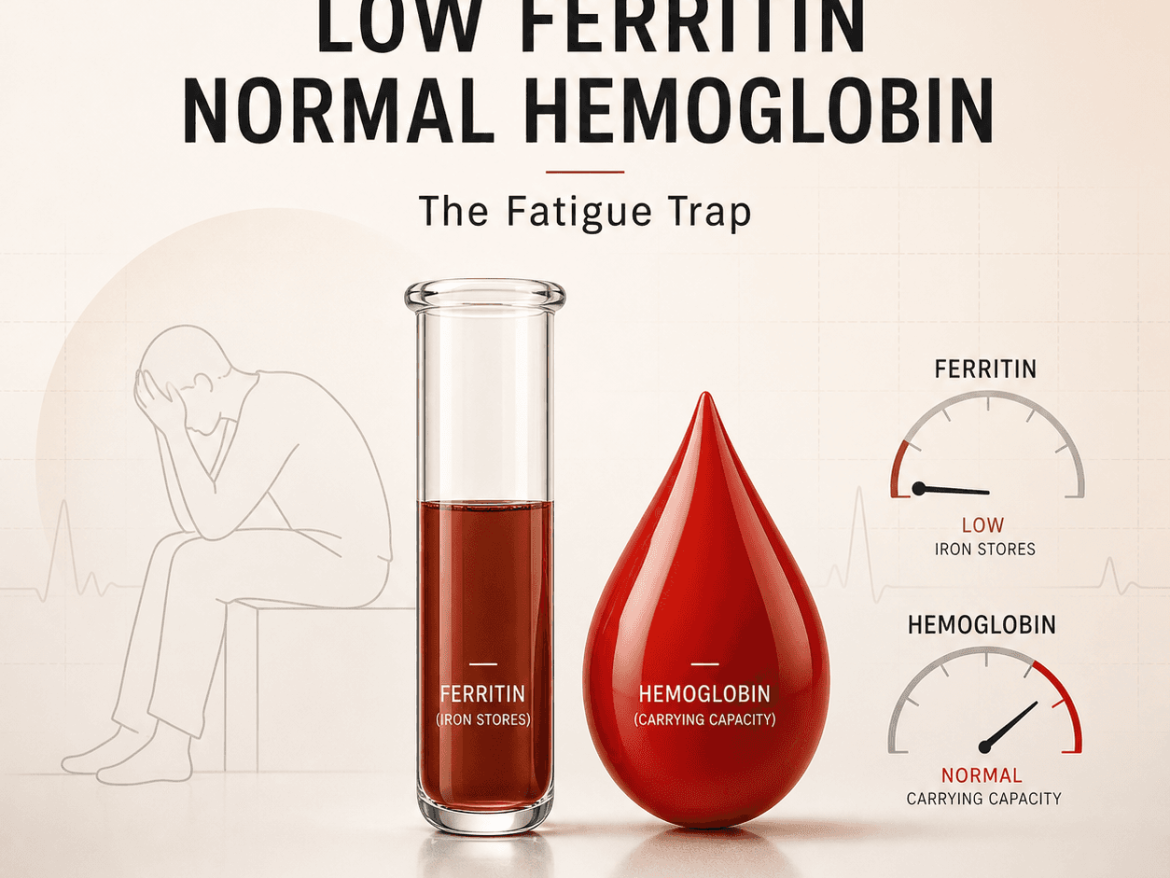
Think of hemoglobin as the delivery truck. It carries oxygen around your body.
Think of ferritin as the warehouse. It stores iron so you can build more trucks when needed, and keep everything running when demand goes up.
Here’s the catch.
You can have enough trucks on the road today (normal hemoglobin) while your warehouse is almost empty (low ferritin). Your body is coping. Compensating. Making do.
Until it can’t.
That “until it can’t” is when people often crash. But long before that crash, there’s usually a long stretch of:
- persistent fatigue
- reduced exercise tolerance
- brain fog and low motivation
- restless legs, poor sleep quality
- hair loss, brittle nails
- mood changes, anxiety, feeling wired but tired
- feeling short of breath with stairs even though “you’re not anemic”
And because hemoglobin looks fine, the iron story never gets told properly.
What ferritin actually is (in human terms)
Ferritin is a storage protein. When ferritin is low, it means your stored iron is low.
Stored iron is what your body uses for more than just red blood cells. Iron plays roles in:
- energy production inside mitochondria
- thyroid hormone conversion and function
- neurotransmitter production (dopamine, serotonin pathways matter here)
- muscle metabolism
- immune function
- hair growth cycling
So if ferritin is low, yes, anemia might be the eventual destination. But the symptoms can start way earlier. Quietly. Then not so quietly.
“How low is low?” The lab range problem
Most lab reports show a ferritin reference range that might look like 15 to 150 ng/mL, or something similar.
So if your ferritin is 18, it gets stamped as normal.
This is where people get stuck.
Because “within range” does not automatically mean “optimal for how you feel.”
Clinically, many people start feeling noticeably better when ferritin is higher than the bare minimum cutoff. Especially if they are menstruating, postpartum, athletic, under chronic stress, dealing with gut issues, or have thyroid dysfunction.
There isn’t one universal perfect number for everyone. But in practice, ferritin in the low teens or 20s is very often not enough for symptom free function, even if hemoglobin is still holding steady.
If you are symptomatic, the question is not “Is it flagged red on the lab report?”
The question is “Does this level make sense for this body, this life, these symptoms?”
Why hemoglobin can stay normal while ferritin drops
Your body is smart. It prioritizes oxygen delivery because, well, you need that to stay alive.
So it will protect hemoglobin for as long as possible.
It does that by pulling iron out of storage. Ferritin falls first. Hemoglobin may remain normal for months or years.
That is why ferritin is often an early warning sign.
By the time hemoglobin drops, you are usually deeper into depletion. And you often feel much worse.
The most common reasons ferritin gets low (even if you eat “pretty healthy”)
Low ferritin is not always about diet. Sometimes it is. Often it isn’t just that.
Here are the patterns that show up again and again.
1) Blood loss (obvious or sneaky)
- heavy periods, clotting, long cycles
- bleeding between periods
- fibroids, adenomyosis, endometriosis
- frequent blood donation
- nosebleeds you think are “normal”
- GI bleeding (ulcers, gastritis, hemorrhoids, polyps)
If your periods are heavy, low ferritin is not surprising. It is almost expected.
A quick reality check. If you have to change a pad or tampon every 1 to 2 hours on your heavy days, or you pass large clots, or you avoid leaving the house on day 1 or 2, that is not just “being a woman.” That is a likely iron loss issue.
2) Not absorbing iron well (gut factors matter a lot)
This is a big one in functional medicine.
Iron absorption can be reduced by:
- low stomach acid (common with chronic stress, aging, long term antacid use)
- H. pylori infection
- celiac disease or non celiac gluten sensitivity with gut inflammation
- IBD, IBS with chronic irritation
- SIBO, dysbiosis, and general malabsorption patterns
- bariatric surgery history
You can eat iron rich foods every day and still not build ferritin if absorption is impaired.
Also. Many people have gut symptoms they normalize. Bloating, reflux, constipation, loose stools, feeling heavy after meals, nausea with supplements. Those are clues.
3) Increased demand
Demand goes up during:
- pregnancy and postpartum
- breastfeeding
- endurance training or high intensity training
- growth phases (teens)
- chronic infection or inflammation
- recovery from illness
Your body may be using iron faster than you can replace it.
4) Inflammation and hepcidin (iron locked away)
This part is less intuitive.
When inflammation is present, your liver can increase a hormone called hepcidin, which reduces iron absorption and traps iron in storage. So you can have low functional iron even if some ferritin exists.
This is why it’s helpful to look at the whole iron panel and inflammation markers, not just ferritin alone.
5) Diet factors (still relevant, just not the only story)
Yes, low intake can contribute, especially if:
- you eat mostly plant based without careful iron strategy
- you avoid red meat and organ meats and do not replace iron sources
- you have low overall calories or chronic dieting
- you drink a lot of tea or coffee with meals (tannins reduce absorption)
- you take calcium with iron rich meals (calcium competes)
It is not a moral issue. It is math, plus biology.
Symptoms that should make you think “ferritin” even if hemoglobin is normal
Not diagnostic on their own, but very suggestive when paired with low ferritin.
- fatigue that feels heavy, sleepy, unmotivated
- brain fog, poor concentration, ADHD like symptoms worsening
- hair loss, thinning, slow regrowth
- brittle nails, ridges, spooning nails in more advanced cases
- feeling cold, cold hands and feet
- restless legs, especially at night
- palpitations, feeling breathless with exertion
- headaches
- low mood, irritability
- reduced tolerance to stress
- low libido
A lot of these overlap with thyroid issues, burnout, depression, and perimenopause.
Which is why it gets messy. And why it gets missed.
What labs actually help (beyond “CBC is normal”)
If you suspect this fatigue trap, a more complete set of labs is often useful. Common ones:
- ferritin
- serum iron
- transferrin or TIBC
- transferrin saturation (iron saturation)
- CBC (yes, still helpful)
- CRP (inflammation context)
- B12, folate (other anemia mimickers)
- thyroid panel (TSH, free T4, free T3, antibodies if indicated)
- vitamin D
- depending on symptoms: celiac screening, H. pylori testing, stool testing, etc.
One important note. Ferritin can rise with inflammation, even if iron stores are not great. So if ferritin is “normal” but CRP is elevated and symptoms fit, the interpretation needs nuance.
Fixing low ferritin is not just “take iron and move on”
Sometimes it is simple. Often it is not.
There are two jobs here:
- Rebuild iron stores safely
- Find and address why they dropped in the first place
If you only do job #1, it can become a loop. Ferritin comes up, then drops again. Or you cannot tolerate iron. Or it never improves.
Let’s talk practical options.
Food first (but be honest about how far food can take you)
Food helps. It matters. And it is foundational.
Iron is found in two main forms:
- Heme iron: animal sources, absorbed better (red meat, liver, sardines)
- Non heme iron: plant sources, absorbed less efficiently (lentils, beans, spinach)
Simple food strategies that actually work:
- include heme iron sources a few times per week if you eat them
- pair iron rich meals with vitamin C (citrus, kiwi, bell pepper)
- avoid tea, coffee, and calcium supplements right with iron rich meals
- consider cooking in cast iron sometimes (small help, but it adds up)
But. If ferritin is very low, food alone may take a long time. Months and months. And you may not feel functional during that time.
This is where targeted supplementation or medical treatment can be appropriate.
Iron supplements (the part where many people quit)
Iron can be very effective. It can also be annoying.
Common issues:
- constipation
- nausea
- reflux
- dark stools
- stomach pain
Different forms can be better tolerated depending on the person. Examples you may hear about include ferrous bisglycinate, ferrous sulfate, ferrous fumarate, heme iron supplements, and iron polymaltose.
Dosing strategies vary too. Some people do better with alternate day dosing. Some need daily. Some need a lower dose but longer duration.
And you do need to be careful. Too much iron is not a wellness trend. Iron overload is real. Iron can worsen oxidative stress in the wrong context. It should be personalized.
Also. If you are not absorbing iron because of gut issues or inflammation, you may take supplements faithfully and watch ferritin barely move. That is not a willpower problem. It is a physiology problem.
When iron infusions come up
If ferritin is very low, symptoms are significant, oral iron is not tolerated, or absorption is impaired, iron infusions can be considered by your physician.
This is not something you decide from a blog post. But it is something you should know exists, because some people stay stuck for years when they actually needed a different route.
The root cause piece (this is where functional medicine shines)
This is the part I wish more people experienced early, not after years of being dismissed.
If you are losing iron, we ask why.
If you are not absorbing it, we ask why.
If your ferritin is low and you also have bloating, reflux, constipation, or chronic loose stools, we ask gut questions.
If your periods are heavy, we ask hormonal and gynecologic questions.
If you are tired and your ferritin is low and your thyroid markers are off, we connect those dots instead of treating them as separate random problems.
This is exactly the kind of work we do inside a functional, root cause model. It is also why fatigue is not a quick appointment issue. It is detective work.
If you want a structured starting point, Dr. Lisa Silvani has resources on fatigue and metabolic health at Reviva Health and Wellbeing on her site: https://www.lisasilvani.com including a fatigue assessment and options to book a discovery call if you want guidance interpreting labs and building a plan that actually fits your body.
A quick word on “It must be stress” (sometimes yes, often incomplete)
Stress can absolutely worsen fatigue. It can reduce stomach acid. It can disrupt digestion. It can affect menstrual cycles. It can change appetite and cravings.
But “stress” is not a full explanation when your ferritin is 12.
If low ferritin is present, that is data. Not a vibe.
Treat stress, yes. But also treat the deficiency and the reason it exists.
What to do next (a simple plan)
If you suspect you are in this fatigue trap, here is a straightforward sequence.
- Get the right labs, not just a CBC. Ferritin plus iron panel at minimum.
- Look for the leak. Heavy periods, frequent donations, GI symptoms, restrictive diets, postpartum depletion, endurance training.
- Rebuild stores with a plan you can tolerate, with monitoring. Symptoms matter, but labs help you dose safely.
- Support absorption. Gut health, meal timing, vitamin C pairing, reduce inhibitors around iron dosing.
- Recheck labs after an appropriate interval (often 8 to 12 weeks, sometimes longer depending on the plan), and adjust.
And if you have been trying on your own and nothing is moving, that is usually the sign to stop guessing and get help.
The takeaway (because you deserve one clear sentence)
Normal hemoglobin does not rule out iron related fatigue. Low ferritin can be the early stage of depletion that makes you feel exhausted long before anemia shows up.
If you have been told everything is fine but you know it is not, this is one of the first places I would look. Not because it explains everything for everyone. But because it explains a lot, and it is fixable, once you see it clearly.
If you want support making sense of your symptoms and labs, you can explore Dr. Lisa Silvani’s fatigue focused care and educational resources at https://www.lisasilvani.com.
FAQs (Frequently Asked Questions)
What does it mean if my hemoglobin is normal but ferritin is low?
A normal hemoglobin level means your body currently has enough oxygen-carrying capacity, but low ferritin indicates your iron stores are depleted. Ferritin is the storage form of iron, essential for building new red blood cells and supporting energy production, thyroid function, and more. Low ferritin with normal hemoglobin often causes symptoms like fatigue and brain fog before anemia develops.
Why can low ferritin cause fatigue even if I’m not anemic?
Ferritin stores iron needed for various bodily functions beyond making red blood cells, including energy production in mitochondria and neurotransmitter synthesis. When ferritin is low, these processes suffer, leading to persistent fatigue, reduced exercise tolerance, brain fog, mood changes, hair loss, and other symptoms despite normal hemoglobin levels.
What ferritin level should I aim for to feel symptom-free?
Lab reference ranges often list ferritin as ‘normal’ above 15 ng/mL, but many people feel better when their ferritin is higher—typically above 30 ng/mL or more—especially if they menstruate, are postpartum, athletic, or have thyroid or gut issues. Optimal ferritin varies by individual; the key is correlating levels with your symptoms rather than just lab cutoffs.
Why does hemoglobin stay normal while ferritin drops?
Your body prioritizes maintaining hemoglobin to ensure oxygen delivery to tissues. It compensates by pulling iron from ferritin stores first. This means ferritin levels drop early during iron depletion while hemoglobin remains stable until later stages when iron deficiency worsens.
What are common causes of low ferritin despite eating a healthy diet?
Low ferritin can result from blood loss (heavy periods, GI bleeding), poor iron absorption due to gut issues (low stomach acid, celiac disease, infections), increased iron demand (pregnancy, intense exercise), or inflammation that traps iron in storage. Diet alone doesn’t always prevent low ferritin if these factors are present.
How can I know if my fatigue is related to low ferritin?
If you experience persistent tiredness unrelieved by sleep, brain fog, hair shedding, restless legs, mood changes, or exercise intolerance despite normal hemoglobin on labs, consider checking your ferritin level. Discuss with your healthcare provider whether your symptoms align with low iron stores and if further evaluation or treatment is appropriate.

