 vanilis
 And then, about 30 seconds later, it’s.
“I feel puffy after eating literally anything.”
“My head feels full of cotton.”
“My skin is acting up.”
“My mood is weird, I’m anxious for no reason.”
And the classic one. “I’m tired, but wired.”
If that sounds familiar, there’s a particular pattern I see over and over in functional medicine.
It’s not always just IBS. It’s not always “just stress.”
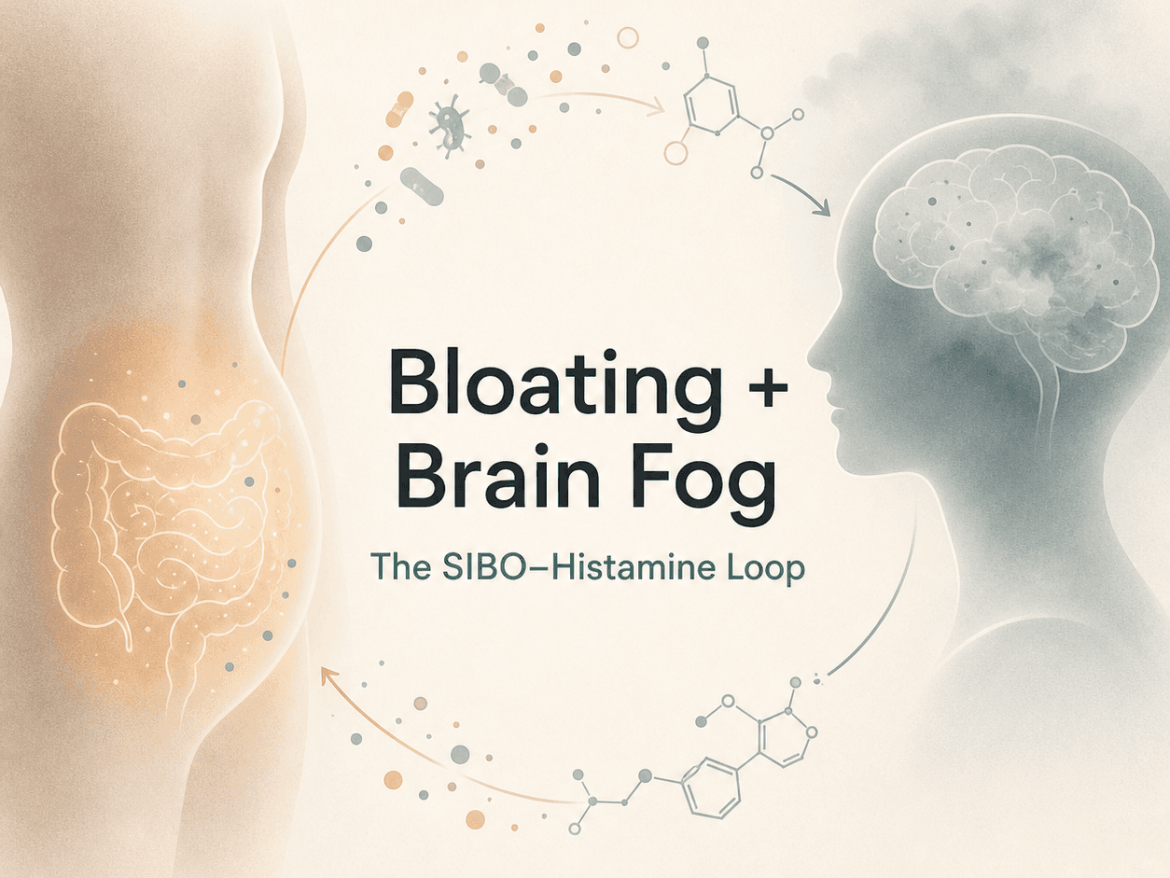
It’s often a loop. A self feeding cycle between SIBO and histamine that keeps people stuck in bloating plus brain fog mode.
Let’s break it down in a way that actually makes sense.
First, what we mean by SIBO (in plain language)
SIBO stands for Small Intestinal Bacterial Overgrowth.
Normally, your small intestine has relatively low bacteria compared to your colon. That’s by design. You want digestion and absorption to happen up there without a bunch of microbes fermenting everything too early.
With SIBO, bacteria move into the small intestine, and they start doing what bacteria do.
They ferment food.
Especially carbohydrates. Sometimes fiber. Sometimes even “healthy” foods like apples, garlic, onions, lentils, cauliflower. The foods you were told to eat to be healthy, and then you eat them and you blow up like a balloon. Fun.
Common SIBO symptoms include:
- Bloating, pressure, distension, often worse after meals
- Excess gas, belching
- Constipation, diarrhea, or the fun alternating combo
- Food sensitivities that seem to multiply over time
- Reflux, nausea, poor appetite
- Fatigue after eating
And then there are the symptoms that don’t scream “gut” at first.
Brain fog. Lightheadedness. Sleep issues. Palpitations. Anxiety spikes. Itchy skin. Flushing. Headaches.
Which brings us to histamine.
Histamine is not the enemy. But too much is a problem.
Histamine is a natural chemical in your body.
It’s involved in:
- immune responses
- stomach acid production
- neurotransmitter signaling in the brain
- sleep wake regulation
- blood vessel dilation
So histamine is not inherently bad. You need it.
The issue is when you have more histamine coming in or being produced than your body can break down.
That’s when people start reacting to foods, supplements, alcohol, stress, heat, exercise, and sometimes… life in general.
People call it “histamine intolerance,” but it’s not a true allergy. It’s more like a bucket.
If your histamine bucket is full, it overflows and symptoms happen.
Common high histamine symptoms can look like:
- headaches or migraines
- flushing, redness, hives, itching
- post nasal drip, congestion
- anxiety, irritability, panic like sensations
- heart racing, palpitations
- insomnia, especially waking around 2 to 4 am
- nausea, reflux, cramping
- brain fog, “floaty” feeling
- worsening symptoms around your cycle (very common)
Now here’s where it gets interesting.
SIBO can fill the histamine bucket. And high histamine can worsen SIBO.
That’s the loop.
The SIBO–Histamine Loop (what’s actually happening)
Here’s the basic cycle.
1) SIBO increases histamine load
Certain gut bacteria can produce histamine or influence histamine signaling. When you have overgrowth in the small intestine, you can end up with:
- more histamine being produced locally
- more inflammation in the gut lining
- more permeability (yes, “leaky gut” mechanisms)
- more immune activation
That can make you more reactive to foods, especially high histamine foods.
And it can make meals feel like a gamble.
2) SIBO damages digestion, which reduces histamine breakdown
Histamine is broken down primarily by enzymes, especially:
- DAO (diamine oxidase) in the gut
- HNMT inside cells
DAO is a big one clinically because it works in the digestive tract. If the gut lining is inflamed or damaged, DAO production can drop.
SIBO can contribute to that lining irritation, and also to nutrient depletion that impacts enzyme function, like:
- vitamin B6
- vitamin C
- copper
- zinc
So now you’re not breaking histamine down effectively.
Bucket gets fuller.
3) Histamine driven inflammation can worsen motility
Motility is the wave like movement that sweeps food and bacteria through the digestive tract. If motility slows, SIBO is more likely to persist or recur.
Histamine can influence:
- inflammation and mast cell activation in the gut
- nervous system signaling through the gut brain axis
- sleep disruption, which impacts vagal tone and motility
- stress hormone patterns
So high histamine can indirectly contribute to slower, more chaotic digestion.
And slower motility gives bacteria more time to overgrow.
Loop continues.
4) Food restriction starts, and the gut ecosystem gets even more stressed
This part is subtle, but important.
When people start reacting to everything, they often reduce their diet to like 7 foods.
Chicken. Rice. Zucchini. Blueberries. Maybe eggs but then eggs are suddenly a problem too.
The problem is not that short term simplification is always bad. Sometimes it’s necessary.
It’s that long term restriction can reduce microbial diversity, reduce fiber intake, and make the gut ecosystem more fragile. It also creates fear around food, which is its own nervous system trigger.
So we want strategy. Not panic.
Why bloating and brain fog so often travel together
Bloating is easier to explain. Fermentation, gas, distension.
Brain fog is where people feel dismissed, because it sounds vague. But in this loop, brain fog can happen for a few reasons at once:
- histamine affects neurotransmitters and can create that wired, buzzy, anxious fog
- inflammation can increase fatigue and cognitive dullness
- poor sleep from histamine surges worsens focus the next day
- nutrient malabsorption (iron, B vitamins, magnesium) impacts cognition
- SIBO can produce metabolites that make you feel off, heavy, not clear
So yes, it’s real. And no, you are not making it up.
Signs you might be in the SIBO–Histamine pattern
Not a diagnosis, just pattern recognition.
You might suspect this loop if you have several of these:
- bloating within 30 to 90 minutes after meals
- reactions to leftovers, fermented foods, aged meats, alcohol
- headaches or flushing after certain meals
- anxiety spikes that feel chemical, not situational
- insomnia, especially middle of the night waking
- worsening around ovulation or before your period
- you tried probiotics and felt worse (this is common, not universal)
- you did low FODMAP and it helped short term but you relapsed
- you feel better when you barely eat, then worse when you eat normally again
Again. Not a diagnosis. But it’s a familiar picture.
The tricky part: “Healthy” gut foods can backfire here
This is where people get confused.
They read that kimchi is healthy. Yogurt is healthy. Kombucha is healthy. Bone broth is healing. Spinach is nutrient dense. Avocados are great.
And then they eat those foods and feel terrible.
Because many “gut health” staples are also high histamine or histamine liberators, including:
- fermented foods (sauerkraut, kimchi, kombucha)
- aged cheeses, cured meats
- wine and beer
- vinegar heavy foods
- leftover fish or meats (histamine builds as food sits)
- bone broth (long simmer can increase histamine)
- spinach, tomatoes, eggplant (often problematic for some)
And if SIBO is in the mix, certain fibers and carbs can add more fermentation on top.
So you can be doing “all the right things” and still feel worse.
That’s usually a clue that we need sequencing. Timing. Root cause work.
Testing that actually helps (and what it tells us)
In a functional medicine setting, we usually want to confirm what’s driving what.
Common tools include:
- SIBO breath testing (lactulose or glucose, depending on the case), looking at hydrogen and methane, sometimes hydrogen sulfide markers depending on the lab
- nutrient markers (iron studies, B12, folate, vitamin D, zinc, magnesium, sometimes copper)
- inflammation and gut markers if indicated
- sometimes mast cell or histamine related markers, though histamine intolerance is often clinical and pattern based, not one perfect lab value
The point of testing is not to collect data for fun.
It’s to stop guessing. And to tailor the plan.
If you want a structured, root cause approach and you’re not sure where to start, Dr. Lisa Silvani’s virtual practice at Reviva Health and Wellbeing offers consults designed for exactly this kind of chronic, overlapping picture. You can explore options and book a discovery call at https://www.lisasilvani.com.
Treatment is usually not one supplement. It’s a sequence.
This is important because a lot of people get stuck in supplement roulette.
They try DAO. Quercetin. A probiotic. Magnesium. Digestive enzymes. Berberine. A binder. Then something else.
Sometimes you need some of those. But order matters.
Here’s the general logic, and this is intentionally broad because your case might differ.
Step 1: Calm the histamine bucket enough to function
If the bucket is overflowing, people can’t sleep, can’t eat, can’t tolerate treatment.
So we often start with short term supports like:
- a temporary lower histamine approach (not forever)
- focusing on freshness of food (histamine rises in leftovers)
- stabilizing blood sugar (big swings can worsen symptoms)
- gentle gut soothing supports as appropriate
- targeted antihistamine like supports if clinically appropriate and safe for you
This is not about living in fear of histamine. It’s about getting some breathing room.
Step 2: Address SIBO drivers, not just bacteria
Killing bacteria without addressing why they overgrew is why people relapse.
Root drivers can include:
- slow motility, constipation, low migrating motor complex activity
- low stomach acid (very common, especially with stress and aging)
- bile flow issues
- adhesions, endometriosis, structural factors
- hypothyroid patterns
- chronic stress, poor sleep, nervous system dysregulation
- certain medications that slow motility
So yes, antimicrobials or prescription therapies may be part of the plan. But we’re also looking at the terrain.
Step 3: Rebuild digestion and barrier function
If DAO is low because the lining is inflamed, we care about repairing that environment.
This might include:
- supporting protein digestion and stomach function when appropriate
- addressing nutrient deficiencies
- carefully reintroducing tolerated fibers to rebuild resilience
- rebuilding without triggering symptoms
This is where people tend to rush. And then flare.
Slow is often faster.
Step 4: Reintroduce foods strategically (so your world doesn’t shrink)
The goal is not a perfect elimination diet.
The goal is flexibility.
That usually means:
- testing small portions at the right time, when symptoms are calmer
- rotating foods instead of eating the same thing daily
- supporting motility so food doesn’t sit and ferment
- expanding variety over time
And yes, some people do better with fermented foods later, not early. That’s normal.
A few practical tweaks that help right away (often)
Not medical advice, just low risk patterns that tend to help many people in this loop.
- Eat freshly cooked meals when possible. Freeze leftovers in single portions if you need meal prep.
- Don’t stack triggers. For example, kombucha plus leftover chicken plus stressful day plus poor sleep is a perfect storm.
- Focus on constipation if it’s there. Slow transit keeps fermentation and histamine cycling.
- Simplify for a short window. Not forever. Just long enough to calm symptoms.
- Look at sleep like treatment. Histamine issues and 2 am waking are common. Stabilizing sleep stabilizes everything else.
And if you’re doing “all the gut things” and still flaring, consider that you may be treating the wrong layer first.
Where this ties into Gut N Glow (and why people feel better fast)
A lot of the marketing language around gut health is about glowing skin. Which is true, sometimes. But the deeper point is this.
When you reduce gut irritation and stabilize immune signaling, people often notice:
- less puffiness
- less redness, fewer random rashes
- better energy in the morning
- calmer mood
- clearer thinking
That’s why short challenges can be powerful. Not because 7 days “fixes” chronic SIBO. It doesn’t.
But 7 days can interrupt the loop enough for your body to exhale.
If you’re someone who resonates with bloating, brain fog, low energy, and that sense that your gut is running the whole show, you might like the kind of structured reset work Dr. Lisa Silvani teaches through her programs and resources at Reviva Health and Wellbeing. You can check what’s currently available at https://www.lisasilvani.com.
The bottom line
Bloating plus brain fog is not a random pairing.
For many people, it’s a sign of an underlying feedback loop. SIBO increases histamine burden. Histamine driven inflammation worsens gut function. And the cycle keeps going.
The good news is that once you see the loop, you can stop blaming yourself.
You can stop thinking you’re “just sensitive.”
And you can start taking a stepwise approach that actually matches what your body is doing.
Not more hacks. Not more restriction forever.
Just the right sequence. And a plan you can stick with long enough to get real traction.
FAQs (Frequently Asked Questions)
What is SIBO and how does it affect digestion?
SIBO stands for Small Intestinal Bacterial Overgrowth, a condition where bacteria that normally belong in the colon move into the small intestine. This causes fermentation of foods, especially carbohydrates and some fiber, leading to symptoms like bloating, gas, constipation or diarrhea, food sensitivities, reflux, nausea, and fatigue after eating.
How does histamine contribute to symptoms like brain fog and skin issues?
Histamine is a natural chemical involved in immune responses and neurotransmitter signaling. When histamine levels become too high—due to increased production or decreased breakdown—it can cause symptoms such as headaches, flushing, itching, anxiety, palpitations, insomnia, nausea, brain fog, and worsening symptoms around hormonal cycles.
What is the connection between SIBO and histamine intolerance?
SIBO can increase histamine load by producing histamine through certain gut bacteria and causing gut inflammation that impairs histamine breakdown enzymes like DAO. High histamine levels can in turn worsen gut motility and promote bacterial overgrowth. This creates a self-feeding loop where SIBO and histamine intolerance perpetuate each other.
Why do people with SIBO often experience both bloating and brain fog?
Bloating results from bacterial fermentation producing gas and distension in the gut. Brain fog is linked to high histamine levels affecting neurotransmitter signaling and inflammation. Since SIBO increases histamine production and damages the gut lining reducing histamine breakdown, both bloating and brain fog frequently occur together in this condition.
How can long-term food restriction impact gut health in SIBO?
Long-term restrictive diets aimed at avoiding reactive foods can lead to reduced microbial diversity and lower fiber intake, making the gut ecosystem more fragile. It can also create fear around eating which triggers the nervous system negatively. Therefore, strategic dietary management rather than panic-driven restriction is important for healing.
What are common symptoms indicating someone might have the SIBO-histamine loop?
Symptoms include persistent bloating after meals; excessive gas; alternating constipation and diarrhea; food sensitivities increasing over time; reflux; fatigue after eating; brain fog; headaches; skin issues like itching or flushing; anxiety or mood changes without clear reasons; palpitations; insomnia especially waking between 2 to 4 am; and worsening symptoms related to hormonal cycles.
References
- Pimentel, M., & Chow, E. J. (2018). Small Intestinal Bacterial Overgrowth: Clinical Features and Therapeutic Management. The New England Journal of Medicine, 378(18), 1777-1785. https://doi.org/10.1056/NEJMra1700450
- Rea, K., Dinan, T. G., & Cryan, J. F. (2020). The microbiome: A key regulator of stress and neuroinflammation. Nature Reviews Gastroenterology & Hepatology, 17(12), 701–715. https://doi.org/10.1038/s41575-020-0333-6
- Schnedl, W. J., et al. (2021). Histamine intolerance: The current state of the art. Alimentary Pharmacology & Therapeutics, 53(6), 628-635. https://doi.org/10.1111/apt.16235
- NHS UK. (2023). Small intestinal bacterial overgrowth (SIBO) – Symptoms and causes. Retrieved from https://www.nhs.uk/conditions/sibo/
- Ghoshal, U.C., Shukla, R., & Ghoshal, U.C. (2017). Small intestinal bacterial overgrowth and irritable bowel syndrome: A bridge between functional organic dichotomy? Gut and Liver, 11(2), 196–208. https://doi.org/10.5009/gnl16079
- FitzGerald, K., & Hyman, M. (2020). The role of gut health in histamine intolerance and SIBO: An integrative approach to treatment strategies. Functional Medicine Insights, 15, 1178638820932365.
- Michael Ruscio, D.N.C., C.D.N., F.A.C.N., & Pimentel M., M.D., (2019). Current understanding and treatment strategies for SIBO-related gastrointestinal disorders: A clinical review. Journal of Clinical Gastroenterology, 53(5), e198-e205.
- De Palma, G., et al. (2019). Gut microbiota composition and metabolic changes in histamine intolerance patients with SIBO: Implications for treatment strategies using dietary modulation and probiotics.BMC Gastroenterology, 19(1), 146.
- Quigley, E.M.M., et al. (2015). Small intestinal bacterial overgrowth: Diagnosis and treatment update – consensus from the American College of Gastroenterology Task Force on SIBO.American Journal of Gastroenterology,110(8), 1159-1174.
- Science Direct Editorial Team (2022). Impact of dietary restriction on gut microbial diversity in gastrointestinal disorders: Mechanisms and clinical implications.Trends in Food Science & Technology, 117, 311-322.

