
 vanilis
 Not the obvious tired where you flop on the couch and scroll for three hours. More like… you’re still doing the things. You’re still replying. Still hitting deadlines. Still being “reliable”. But inside, it feels like you’re running on fumes and your personality got replaced with a to do list.
And then you start wondering the scary question.
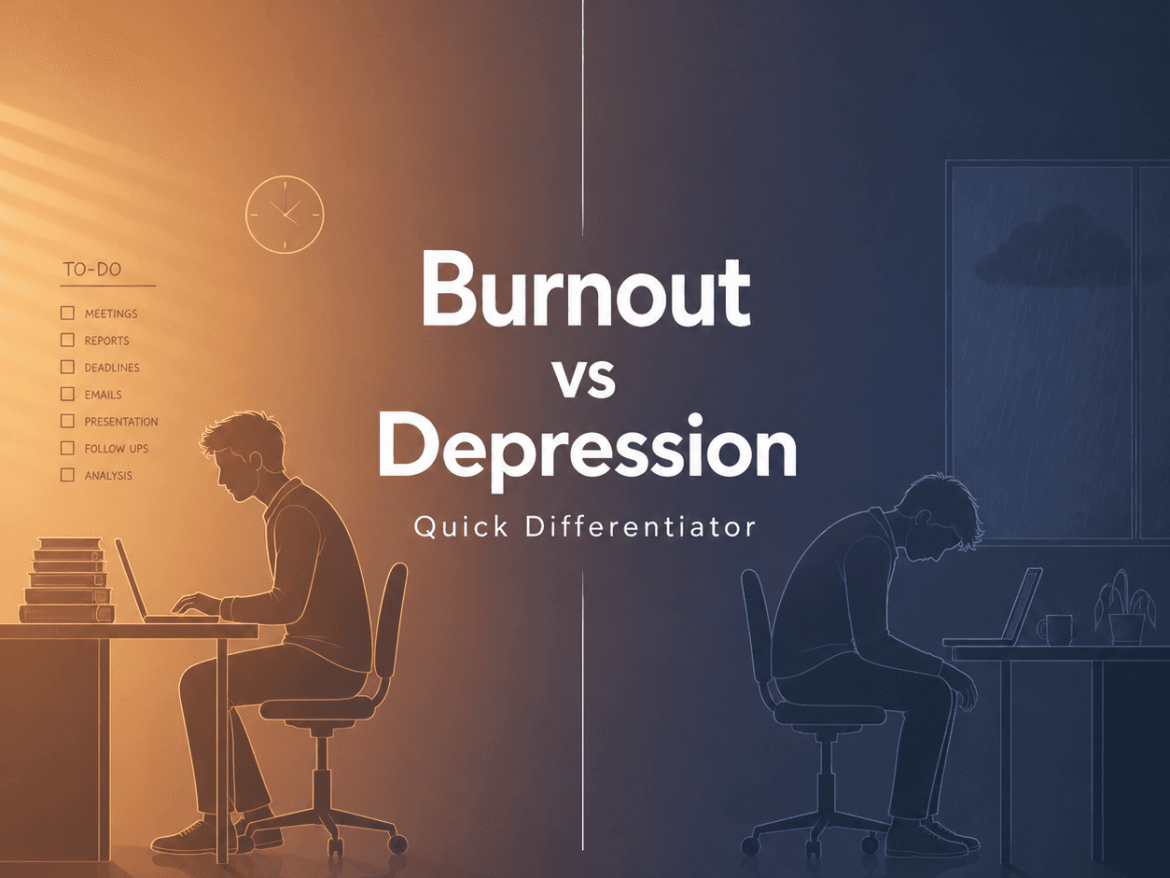
Is this burnout. Or is this depression.
They can look weirdly similar from the outside. Less motivation, brain fog, irritability, lower performance, pulling away socially, sleep changes. Sometimes even tears out of nowhere, over something small. Like a normal email that suddenly feels like an attack.
But the difference matters. Because the next step is different.
This is a quick differentiator. Not a diagnosis. If you’re having thoughts of self harm, can’t function, or feel unsafe, treat that as urgent and get immediate support in your area. Depression is real, and it’s treatable. Same with burnout. But we need to name what’s happening.
Why high achievers get stuck in the gray zone
If you’re the type who has always pushed through, you’ve probably built an identity around coping.
You don’t “fall apart”. You optimize. You research. You do productivity hacks. You drink more coffee, add more supplements, buy a new planner, push a little harder.
So when your body starts throwing warning lights, you interpret it as a personal failure. Or laziness. Or a mindset issue.
Except it’s often biology plus psychology, tangled together.
Burnout and depression can overlap. And chronic burnout can slide into depression over time. Also, you can be depressed and still perform at a high level for a while, especially if your nervous system has learned that achievement equals safety.
So. Let’s make this practical.
The quickest differentiator (the one I use most)
Here’s the simplest question.
If I removed the stressor for two weeks, would I start to feel like myself again. Even 20% more like myself.
- If the honest answer is yes, you’re leaning more toward burnout (or stress exhaustion).
- If the honest answer is no, or “I can’t even imagine feeling better”, that leans more toward depression (or something deeper than workload alone).
Burnout tends to be more situational. Depression tends to be more pervasive.
Not always. But it’s a good first sort.
Now let’s go deeper, in a way that actually fits high achievers.
Burnout: the pattern (especially in high performers)
Burnout is often a combo of:
- emotional exhaustion
- cynicism or detachment
- reduced efficacy (things feel harder, you doubt yourself)
For high achievers, it usually shows up like this:
1) You can still care. You just can’t access the fuel
Burnout doesn’t always remove your ambition. It blocks your capacity.
You might still care about your work, your family, your goals. But you feel like your internal battery will not charge. Sleep doesn’t fix it. Weekends don’t fix it. Even vacations can feel… oddly flat, because you spend half the time recovering and the other half dreading the inbox waiting at home.
2) Your symptoms spike around work, responsibility, or performance pressure
Burnout is typically worse on Sunday night. Worse before meetings. Worse when the calendar looks packed.
Your mood may lift when you’re away from the environment that’s draining you. Not instantly, but noticeably.
3) You feel irritable, numb, or “not myself”, but you can still laugh sometimes
This is important.
In burnout, moments of relief still break through. A funny show, a good meal, a walk, a friend. Your nervous system still has access to little sparks of pleasure, even if they’re inconsistent.
4) You fantasize about escape, not disappearance
Burnout daydreams sound like:
- “I want to quit.”
- “I want to move to a cabin.”
- “I want to disappear for a month and let someone else handle everything.”
That’s not nothing. But it’s often a desire to escape the demands, not life itself.
5) Your body gets loud
Burnout is not just emotional. It’s physical.
Common high achiever burnout body signs:
- waking up tired even after “enough” sleep
- afternoon crashes, needing sugar or caffeine
- reflux, bloating, constipation or diarrhea
- more headaches, tight jaw, neck pain
- getting sick more often
- hormonal symptoms ramping up (PMS, cycle changes, libido drop)
- feeling wired but tired at night
And yes, gut symptoms matter here. Stress changes digestion fast. The gut and brain talk constantly. When someone tells me they feel anxious, flat, exhausted, and also bloated all the time… I’m not surprised. It’s a pattern.
Depression: the pattern (and how it can hide in achievers)
Depression is more than sadness. A lot of high functioning depressed people don’t feel “sad”. They feel empty. Or numb. Or like life lost its color.
Here are the flags that lean more depressive:
1) The low mood is everywhere, not just around stressors
Work might trigger it. But it’s not only work.
Even when things are “fine”, you feel heavy. Even during rest, you don’t recover. Even with supportive people, the fog stays.
2) Pleasure is gone, not just postponed
This one is big.
In depression, the ability to feel enjoyment often drops. It’s called anhedonia. Food tastes like cardboard. Shows don’t hit. Hobbies feel pointless. Even things you used to love feel like effort with no payoff.
Burnout can look similar, but usually there are still pockets of enjoyment when pressure drops.
3) Your self story turns harsh and global
Burnout thoughts often sound like:
“I’m overwhelmed. I can’t keep up.”
Depressive thoughts often sound like:
“I’m failing. I’m a burden. Nothing will change. I’m not good enough.”
Notice the difference. Depression makes it personal and permanent.
4) You feel slowed down. Or agitated. But either way, it’s not you
Some people get psychomotor slowing. Everything takes longer. Getting dressed feels like lifting weights.
Others get agitation. Pacing, restlessness, skin crawling discomfort.
Either can be depression. And both can be misread as anxiety or just “stress”.
5) Hopelessness shows up
Burnout says: “I need a break.”
Depression says: “A break won’t matter.”
If that’s you, please take that seriously. It’s treatable. But it needs support.
A simple side by side (save this)
Burnout tends to be:
- tied to a role, environment, workload, or chronic stress
- better with true rest, boundaries, reduced demands
- marked by exhaustion, irritability, detachment
- still has some ability to enjoy things when pressure lifts
- often comes with strong body symptoms (sleep, gut, immune, hormones)
Depression tends to be:
- pervasive across contexts
- not reliably relieved by rest or time off
- marked by hopelessness, numbness, loss of pleasure
- self worth takes a hit
- may include suicidal thoughts, worthlessness, “what’s the point”
And again. You can have both.
The “burnout that looks like depression” trap
Here’s where high achievers get confused.
Chronic burnout can lead to:
- social withdrawal
- low motivation
- flat mood
- cognitive issues (memory, focus)
- sleep disruption
- appetite changes
Which can mimic depression.
But in many of these cases, the driver is nervous system dysregulation, sleep debt, blood sugar instability, inflammation, nutrient depletion, hormones, gut disruption. Not just “mindset”.
I’m not saying depression is “just biology”. I’m saying biology is part of the picture and it’s often ignored, especially in women and high performers.
If you’ve been told “everything is normal” because basic labs looked fine, and you still feel awful, you’re not imagining it. Basic labs miss a lot.
This is where functional medicine can be helpful. Not because it’s magic. Because it’s thorough.
At Reviva Health and Wellbeing (Dr. Lisa Silvani), the whole model is root cause care. That means looking at patterns like fatigue, metabolic health, gut function, inflammation, stress hormones, and nutrient status together. Not in isolation. If you want that kind of support, you can start with the resources on https://www.lisasilvani.com or book a free discovery call if it feels like the right next step.
Quick self check: 12 questions that clarify the picture
Grab a notes app. Answer fast. Don’t overthink.
- If I had two weeks away from my main stressor, do I believe I would improve?
- Do I still have moments of genuine enjoyment, even briefly?
- Do I feel hopeless, like nothing will help?
- Is my inner voice mostly “I’m overwhelmed” or “I’m worthless”?
- Is my fatigue mostly physical, mostly emotional, or both?
- Do I feel worse before work and better away from it?
- Am I withdrawing because I’m exhausted, or because I don’t want to exist around people?
- Has my sleep changed. Falling asleep, staying asleep, waking too early?
- Have my gut symptoms changed. Bloating, constipation, diarrhea, reflux?
- Has my cycle changed, libido dropped, or PMS worsened?
- Am I using more caffeine, sugar, alcohol, or scrolling to cope?
- Have I had any thoughts of self harm, or that others would be better off without me?
If you answered yes to 3 or 12, that’s not a “power through” moment. That’s a get support now moment.
What to do next (based on which one fits more)
If it’s more likely burnout
You need load reduction and recovery, not just more mindset work.
Start here:
- Stop adding new habits. Add rest first.
- Make your stress visible. List the top 5 drains. Not everything, just the big ones.
- Choose one boundary you can hold for 7 days. One. Like no meetings before 10am, or phone off at 9pm.
- Stabilize blood sugar. Protein at breakfast. Regular meals. This matters for mood and energy.
- Move gently. Walks, light strength, stretching. Burnout bodies usually do worse with punishing workouts.
- Check the basics you keep ignoring. Iron, B12, vitamin D, thyroid markers, glucose and insulin trends, sleep apnea risk. Especially if fatigue is intense.
Also, if your gut is a mess while you’re burned out, you’re not alone. Stress changes the microbiome, motility, stomach acid, permeability. The gut becomes a amplifier for brain symptoms.
This is why short structured challenges can help some people get traction again. Not because a challenge fixes your life, but because it gives your nervous system a script. Step one, step two, done.
If it’s more likely depression
You deserve real care, not just self help.
The best next steps usually include:
- talk therapy (CBT, ACT, psychodynamic, trauma informed approaches)
- medical evaluation to rule out contributors (thyroid dysfunction, anemia, deficiencies, inflammatory conditions)
- medication may be appropriate for some people, and it can be life saving
- community support, not isolation
And please. Tell someone. A friend, partner, clinician. Depression lies to you. It says you’re alone and you’re stuck. You’re not.
If it’s both
This is common.
Treat both sides:
- reduce the external load (burnout)
- treat the internal state (depression)
- address physiology that can be worsening symptoms (sleep, hormones, gut, metabolic health)
It’s not either or. It’s layers.
A note about “functional burnout” and why your gut keeps showing up
You shared background about gut health content. So let me connect a dot that a lot of people miss.
Many high achievers run on:
- caffeine
- cortisol
- adrenaline
- willpower
Eventually the body pushes back. And the gut is often one of the first places it shows up because digestion is expensive. Your body will downshift it when you’re under chronic stress.
So you get:
- bloating even when you “eat clean”
- constipation that won’t budge
- reflux out of nowhere
- skin changes, breakouts, dullness
- anxiety that spikes after meals
- fatigue that feels worse after eating
That gut skin mood triangle is real. Not in a trendy way. In a physiology way.
If you want a gentle starting point, something like a short gut reset can be useful as an experiment. Not to “fix everything in 7 days”, but to notice what shifts when you support digestion, hydration, fiber, protein, sleep, and stress regulation consistently. That’s the kind of foundation Dr. Lisa Silvani builds on in her programs and educational resources at lisasilvani.com, especially for fatigue recovery and metabolic restoration.
The bottom line
Burnout usually says: I can’t keep going like this.
Depression usually says: Nothing matters anyway.
Both are serious. Both deserve support. And neither is a personal failure.
If you’re a high achiever reading this and quietly thinking, “I don’t know which one it is, I just know I’m not okay,” that’s enough information to act.
Start small. Get help. Let someone look at the whole picture with you. Not just your productivity. Not just your mindset. Your whole system.
FAQs (Frequently Asked Questions)
What are the key differences between burnout and depression for high achievers?
Burnout is often situational, linked to stressors like workload, and symptoms improve with rest or removal of the stressor. It includes emotional exhaustion, cynicism, and reduced efficacy but moments of relief still occur. Depression is more pervasive, with low mood present even without stressors, persistent anhedonia (loss of pleasure), and a sense of emptiness or numbness that doesn’t improve easily.
How can high achievers tell if they’re experiencing burnout or depression?
A simple way is to ask: If I removed the stressor for two weeks, would I feel at least 20% more like myself? If yes, it leans toward burnout; if no or it’s unimaginable to feel better, it leans toward depression. Burnout symptoms typically spike around work or pressure, while depression affects mood more broadly and persistently.
Why do high achievers often get stuck in the ‘gray zone’ between burnout and depression?
High achievers tend to push through challenges by optimizing and coping strategies. They may interpret warning signs as personal failure or mindset issues rather than biological or psychological factors. Burnout and depression can overlap, and chronic burnout may progress into depression over time, making it hard to distinguish between them.
What physical symptoms might indicate burnout in high performers?
Common physical signs include waking up tired despite enough sleep, afternoon energy crashes needing caffeine or sugar, digestive issues like reflux or bloating, frequent headaches, muscle tension (jaw or neck pain), increased illness frequency, hormonal changes such as PMS intensification or libido drop, and feeling wired yet tired at night.
How does burnout manifest emotionally in high achievers?
Burnout may cause irritability, numbness, feeling ‘not myself,’ yet individuals can still experience moments of laughter or pleasure. There’s usually a strong desire to escape demands (e.g., wanting to quit or take a break) rather than life itself. Emotional exhaustion coexists with continued caring about work or goals but lacking internal energy.
When should someone seek immediate support regarding burnout or depression?
If you experience thoughts of self-harm, inability to function daily, or feelings of being unsafe, treat this as an urgent situation requiring immediate professional help. Both depression and burnout are real and treatable conditions but recognizing severity early is crucial for safety and recovery.
References
- Maslach, C., & Leiter, M. P. (2016). Understanding the burnout experience: recent research and its implications for psychiatry. World Psychiatry, 15(2), 103-111. https://doi.org/10.1002/wps.20311
- Schaufeli, W. B., & Taris, T. W. (2014). A meta-analysis of the job demands-resources model: Implications for burnout and engagement. Journal of Applied Psychology, 99(2), 380–412. https://doi.org/10.1037/a0035665
- American Psychiatric Association. (2013). Diagnostic and Statistical Manual of Mental Disorders (5th ed.). Arlington, VA: American Psychiatric Publishing.
- Melamed, S., Shirom, A., Toker, S., Berliner, S., & Shapira, I. (2006). Burnout and risk of cardiovascular disease: evidence, possible causal paths, and promising research directions. Psychological Bulletin, 132(3), 327–353. https://doi.org/10.1037/0033-2909.132.3.327
- World Health Organization (WHO). (2019). Burn-out an “occupational phenomenon”: International Classification of Diseases.
- Hammen, C. (2005). Stress and depression. Annual Review of Clinical Psychology, 1, 293-319. https://doi.org/10.1146/annurev.clinpsy.1.102803.143938
- NHS UK. (2023). Depression – Symptoms and causes: https://www.nhs.uk/conditions/depression/
- Ruscio, M., & Holtzman, T., et al. (2020). Functional Medicine Approaches to Fatigue and Mood Disorders in High Achievers: A Review in Frontiers in Psychiatry. https://doi.org/10.3389/fpsyt.2020.00554
- Fitzgerald, K., & Hyman, M., (2018). The Role of Lifestyle Interventions in Managing Burnout and Depression in High Performers: Journal of Alternative and Complementary Medicine, 24(8), 741-749.
- Rotenstein, L.S., Torre, M., Ramos, M.A., Rosales, R.C., Guille, C., Sen, S., & Mata, D.A.(2018). Prevalence of Depression, Depressive Symptoms, and Suicidal Ideation Among Medical Students: A Systematic Review and Meta-Analysis; JAMA, 316(21), 2214–2236; https://doi.org/10.1001/jama.2016
