
 vanilis
 But a lot of the time, the thing that quietly fixes the day is way less exciting.
It is protein. And not just how much. When you get it.
Protein timing is not some bodybuilder only concept. It can be a very normal person tool for steadier energy, fewer crashes, and better appetite control. Especially if your mornings are coffee, your lunch is kind of random, and by 3 pm you are looking around for something sweet and fast.
So let’s make this simple and usable.
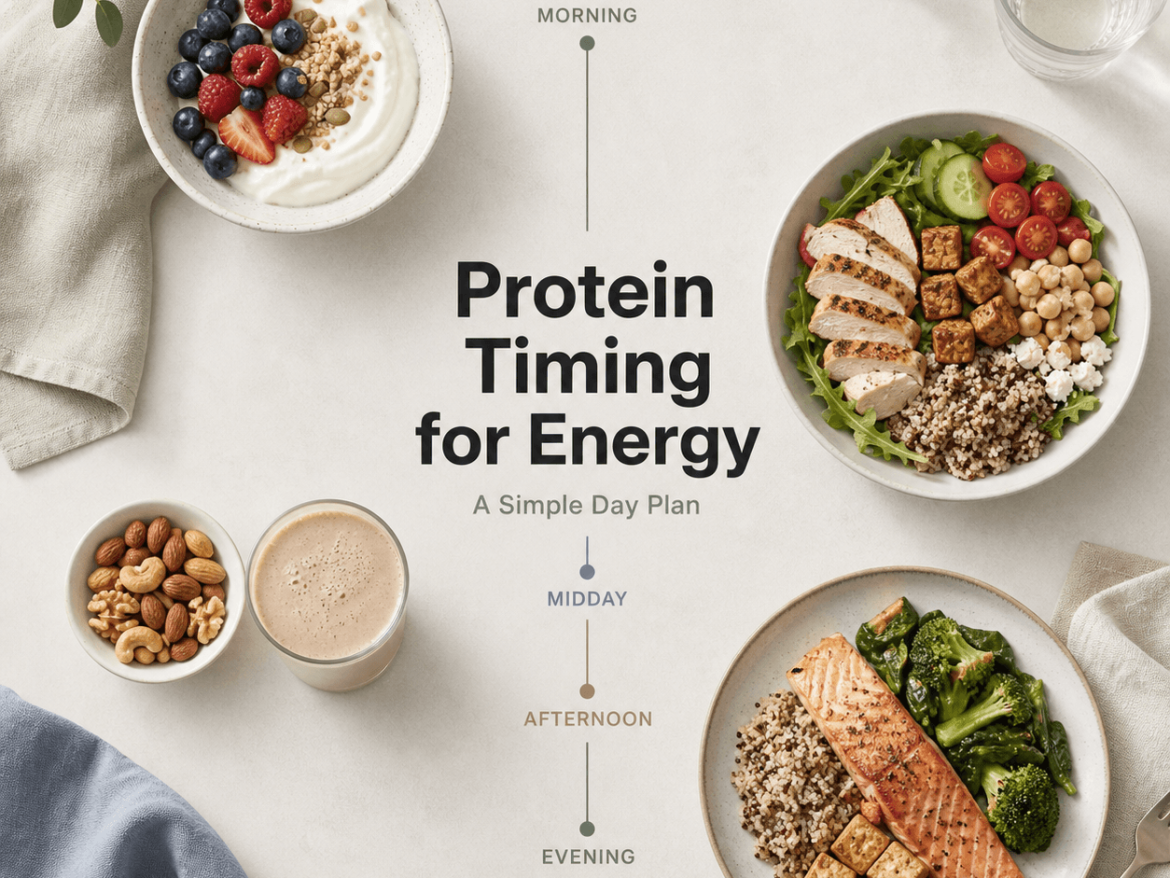
This is a practical day plan you can copy, with options, and the why behind it. No perfection required.
Why protein timing affects energy (more than people think)
Energy is not just calories. It is also stability.
When protein is too low early in the day, a few things tend to happen:
- Blood sugar is more likely to swing up and down, especially if breakfast is mostly carbs or you skip it.
- Hunger hormones get louder later, so you end up chasing food at night.
- You may feel wired then tired. That mid morning jitter, then the slump.
- Muscle protein breakdown is higher, which matters because muscle is a big player in metabolic health and glucose handling.
Protein helps because it slows digestion when paired with carbs and fat, supports neurotransmitters, and gives you amino acids for repair. It also tends to create a “calmer” energy. Not a spike.
And if you are someone reading Dr. Lisa Silvani’s work, you are probably already thinking in terms of cellular energy and mitochondria. Protein is not the only lever for mitochondrial health, but stable blood sugar, adequate amino acids, and not running on stress hormones all day. Those things matter. A lot.
The big idea: distribute protein, do not “save it for dinner”
Most people who feel fatigued do one of these patterns:
- Low protein breakfast, medium protein lunch, huge protein dinner.
- Skip breakfast, snack through afternoon, dinner becomes the first real meal.
- Protein is “occasionally present” but not reliably.
A better pattern for energy is protein earlier, then evenly spaced.
Not because you must eat every 3 hours. You do not. But because your body does better when it is not going long stretches without amino acids and then getting a massive dump at night.
A simple target for many adults is 25 to 40 grams of protein per meal, depending on body size, age, activity, and goals.
If that feels too specific, use the hand method:
- One palm of protein at a meal is often a decent starting point.
- Two palms if you are tall, active, building muscle, or older and working on maintaining muscle.
And yes, there are medical exceptions. Kidney disease, certain metabolic conditions, and so on. If that is you, you already know you need personalized guidance.
A simple protein timing day plan (for steadier energy)
Here is the structure:
- Breakfast: 25 to 35 g
- Lunch: 30 to 40 g
- Afternoon: 10 to 20 g (optional, strategic)
- Dinner: 25 to 40 g
- Before bed: 0 to 20 g (optional, only for certain people)
Let’s walk it like a real day.
7:00 to 9:00 am: Breakfast protein first, even if it is small
If mornings are hard, or appetite is low, the win is not a perfect breakfast. The win is getting a real protein dose in the first few hours of being awake.
Starting with protein helps with fewer cravings later, better focus, and less of a stress hormone driven morning.
Choose one of these breakfast anchors (25 to 35 g of protein):
Greek yogurt bowl
- 1 to 1.5 cups plain Greek yogurt (check the label for protein)
- Add berries, chia, and cinnamon
- Add a small handful of nuts if you want it more filling
Eggs plus extra
- 2 to 3 eggs alone sometimes is not enough for 30 g, so add a protein side
- Good additions: cottage cheese, turkey slices, or smoked salmon
Protein smoothie that is not just fruit
- Whey or pea protein powder, frozen berries, spinach, and milk or soy milk
- Add nut butter if you need more staying power
Leftovers breakfast (underrated)
- Chicken and rice from last night, salmon and roasted veggies, or taco meat and eggs
- It feels weird until it does not
Small but important note: If you do coffee first, try to get protein in before the second cup. Not a rule. Just a helpful experiment for people who feel shaky or anxious on caffeine.
12:00 to 2:00 pm: Lunch that prevents the 3 pm crash
The classic energy crash lunch is: large carb portion, low protein, low fiber, eaten quickly. Then you are sleepy, then you need something sweet, then your day is basically a snack chain.
So lunch is where protein timing does a lot of heavy lifting. Aim for 30 to 40 g here.
Big salad, real protein
- 4 to 6 oz chicken, tuna, salmon, turkey, tofu, tempeh, or beans plus extra
- Dress with olive oil and vinegar
- Add quinoa or sweet potato if you want carbs
- Make it big enough to count as a full meal
Bowl style
- Protein base: ground turkey, lentils, tofu, or shrimp
- Fiber base: greens, cabbage, peppers, or onions
- Carb: rice, potatoes, beans, or fruit
- Fat: avocado, olive oil, or tahini
Sandwich, but upgraded
- Use enough meat — not the “two slices of turkey” situation
- Add cheese if it works for you
- Add a side of Greek yogurt or a boiled egg if protein is still low
- Add crunchy veg for volume and micronutrients
Soup plus protein
- Soup alone is often not enough — pair it with cottage cheese, a tuna packet, a chicken side, or a protein shake
If you still get sleepy after lunch even when you do this right, that can be a sign to look deeper. Meal size, carb type, sleep debt, stress, and underlying metabolic issues all matter. Dr. Lisa Silvani talks a lot about distinguishing “normal tired” from cellular fatigue. This is one of those moments where that distinction can become very real.
3:00 to 5:00 pm: The strategic protein snack (only if you need it)
Not everyone needs a snack. But if you are dealing with fatigue, stress, or long gaps between meals, a small protein snack can keep your energy from sliding into that late afternoon fog.
Target 10 to 20 g.
This is not the time for “protein bars that are basically candy.” Sometimes they are fine, but you know what I mean.
Good options:
- cottage cheese with fruit
- a protein shake (half serving if full serving feels too much)
- beef or turkey jerky plus an apple
- edamame
- hummus plus a higher protein cracker, or add turkey slices
- tuna packet on cucumber slices
- string cheese plus nuts
This snack is especially helpful if dinner is late, or if you exercise after work and you are trying not to show up starving.
6:00 to 8:00 pm: Dinner that supports recovery, not a food coma
Dinner is where most people finally get enough protein. That is fine. The goal is just to not make dinner the only protein event of the day.
Aim for 25 to 40 g.
Dinner templates that work:
- salmon, roasted vegetables, potatoes
- chicken thighs, rice, big mixed veg
- tofu stir fry with lots of veg, noodles or rice
- lean beef, beans, peppers, tortillas
- lentil pasta with meat sauce or tofu crumble, side salad
If you tend to eat dinner and then want dessert every night, that can be partly habit, partly stress, but also sometimes a sign your earlier meals did not have enough protein and fiber. Fixing breakfast and lunch often reduces night cravings without you “trying harder.”
9:00 to 10:30 pm: Optional pre bed protein (for specific situations)
This is not mandatory. Some people sleep better with nothing close to bedtime.
But pre bed protein can help if:
- you wake up hungry at night
- you are trying to build or maintain muscle (especially as you get older)
- you train in the evening and dinner is light
- you wake up with that early morning cortisol spike feeling
Target 10 to 20 g, and keep it easy.
Options:
- Greek yogurt
- cottage cheese
- a small protein shake
- warm milk or soy milk (not huge, just enough)
If it disrupts sleep or causes reflux, skip it. Sleep comes first.
The simplest “protein timing rules” that actually help
If you want a short list to stick on your fridge:
- Do not wait until dinner to get your first real protein.
- Aim for 25 to 40 g at breakfast and lunch.
- Use a protein snack only to prevent a crash, not because you “should.”
- Pair protein with fiber and some fat for steadier energy.
- Keep it boring and repeatable on weekdays. Save novelty for weekends.
What if you do not know how much protein you are eating?
Most people underestimate. So do this for just one day:
- Look at labels.
- Estimate meat portions.
- Add it up.
You might find you are getting 60 g total when you thought you were getting 120 g. That happens a lot.
If you want an easy benchmark, many active adults do well somewhere around 1.2 to 1.6 g protein per kg body weight per day. That is not a prescription, just a common evidence based range.
If math makes your eyes glaze over, use this instead:
- 3 meals with 30 g each gets you to about 90 g/day.
- Add a snack, you are at 100 to 110 g/day.
For many people, that is enough to notice a change in energy and appetite.
A sample day plan (copy and paste style)
Here is a simple example day, nothing fancy.
Breakfast (8:00 am)
- 1.5 cups plain Greek yogurt
- berries
- chia seeds
- coffee after eating
Lunch (1:00 pm)
- big salad with 5 oz chicken
- olive oil dressing
- side of fruit
Snack (4:00 pm, optional)
- cottage cheese or a small protein shake
Dinner (7:00 pm)
- salmon or tofu
- roasted vegetables
- rice or potatoes
Before bed (10:00 pm, optional)
- small bowl Greek yogurt if you wake up hungry at night
That is it. This is not a “diet.” It is just timing and distribution.
Common problems (and quick fixes)
“I am not hungry in the morning.”
Start smaller. Even 15 to 20 g is a win. Or do a smoothie you can sip. Appetite often adapts after a week or two.
“Protein makes me feel heavy.”
Check the type and the speed. Lean meat plus no fiber can feel weird. Try yogurt, eggs, tofu, fish, or a smaller portion paired with fruit and oats.
“I am plant based.”
You can absolutely do this. You just need a bit more planning because plant protein is often less concentrated. Good anchors: tofu, tempeh, edamame, seitan, lentils, chickpeas, soy milk, higher protein yogurts, and a quality plant protein powder if needed.
“I do intermittent fasting.”
You can still time protein well inside your eating window. The key is that your first meal should not be low protein. Break the fast with a real protein meal, not a pastry.
“I eat enough protein but still feel exhausted.”
Then protein is not the whole story. Sleep quality, iron status, thyroid, blood sugar regulation, stress load, inflammation, and mitochondrial function can all be in play. This is exactly where a root cause framework helps. If you have not already, you can check out the resources on Reviva Health and Wellbeing (Dr. Lisa Silvani) at https://lisasilvani.com/, especially the fatigue focused education and tools like the Fatigue Root Cause quiz. Sometimes the pattern you see on paper is the thing that finally connects the dots.
Wrap up (keep it simple)
Protein timing for energy is mostly about one shift: stop letting protein be an afterthought until dinner.
Get a solid hit at breakfast, a solid hit at lunch, and use an afternoon protein snack only if it prevents the crash. Do that for 7 to 10 days and pay attention to the boring wins. Fewer cravings, steadier mood, less fog, more consistent energy.
If you want a next step beyond food timing, and you are trying to understand your fatigue through a bigger energy lens, Dr. Lisa Silvani’s resources at https://lisasilvani.com/ are a good place to start. It is practical, not fluffy. Which is honestly what most of us need.
FAQs (Frequently Asked Questions)
Why is protein timing important for maintaining steady energy throughout the day?
Protein timing is crucial because it helps stabilize blood sugar levels, reduces hunger hormone spikes, prevents mid-morning jitters and afternoon slumps, and supports muscle health. Consuming protein evenly spaced during the day provides a calmer, more sustained energy rather than sharp spikes and crashes.
How much protein should I aim to consume at each meal for better energy?
A practical target for many adults is 25 to 40 grams of protein per meal, depending on factors like body size, age, activity level, and goals. You can use the hand method as a guide: one palm-sized portion of protein per meal is a good starting point, increasing to two palms if you are tall, active, building muscle, or older.
What are some effective breakfast options that provide enough protein to start the day right?
Effective breakfast options with 25 to 35 grams of protein include a Greek yogurt bowl with berries and nuts, eggs paired with cottage cheese or turkey slices, a protein smoothie made with whey or pea protein powder plus spinach and nut butter, or reheated leftovers like chicken and rice or salmon with roasted veggies.
Why should I avoid low-protein breakfasts or skipping breakfast altogether?
Low-protein breakfasts or skipping breakfast can lead to unstable blood sugar levels, increased hunger hormones later in the day causing overeating at night, feeling wired then tired (mid-morning jitters followed by slumps), and higher muscle protein breakdown which negatively impacts metabolic health and glucose handling.
How can lunch be structured to prevent the common 3 pm energy crash?
To prevent the 3 pm crash, aim for a lunch containing 30 to 40 grams of protein combined with fiber-rich vegetables and healthy fats. Examples include big salads with chicken or tofu, bowl meals with ground turkey and greens plus carbs like quinoa or sweet potato, upgraded sandwiches with ample meat and cheese plus crunchy vegetables, or soups paired with cottage cheese or tuna packets.
Is it necessary to eat protein every three hours for optimal energy?
No, eating every three hours is not required. The key is distributing adequate amounts of protein throughout the day without long gaps between meals. This helps maintain steady amino acid availability for muscle repair and stable blood sugar levels but does not mean you must eat frequently; personalized timing based on your routine works best.
References
- Paddon-Jones, D., & Rasmussen, B. B. (2009). Dietary protein recommendations and the prevention of sarcopenia. Current Opinion in Clinical Nutrition and Metabolic Care, 12(1), 86-90. https://doi.org/10.1097/MCO.0b013e32831cef8b
- Areta, J. L., Burke, L. M., Ross, M. L., Camera, D. M., West, D. W., Broad, E. M., … & Coffey, V. G. (2013). Timing and distribution of protein ingestion during prolonged recovery from resistance exercise alters myofibrillar protein synthesis. The Journal of Physiology, 591(9), 2319-2331. https://doi.org/10.1113/jphysiol.2012.244897
- Leidy, H.J., Clifton, P.M., Astrup, A., Wycherley, T.P., Westerterp-Plantenga, M.S., Luscombe-Marsh, N.D., … & Mattes, R.D. (2015). The role of protein in weight loss and maintenance. The American Journal of Clinical Nutrition, 101(6), 1320S–1329S. https://doi.org/10.3945/ajcn.114.084038
- Moore, D.R., Robinson, M.J., Fry, J.L., Tang, J.E., Glover, E.I., Wilkinson, S.B., … & Phillips, S.M. (2009). Ingested protein dose response of muscle and albumin protein synthesis after resistance exercise in young men. The American Journal of Clinical Nutrition, 89(1), 161-168. https://doi.org/10.3945/ajcn.2008.26401
- Tang, J.E., Manolakos, J.J., Kujbida, G.W., Lysecki, P.J., Moore, D.R., & Phillips S.M.(2009). Minimal whey protein with carbohydrate stimulates muscle protein synthesis following resistance exercise in trained young men: a dose-response study.Applied Physiology Nutrition and Metabolism, 34(6), 949-956.
- National Health Service (NHS UK). (2023). Protein: why do we need it? Retrieved from https://www.nhs.uk/live-well/eat-well/why-do-we-need-protein/
- Kerksick C.M., et al.(2017). International Society of Sports Nutrition Position Stand: nutrient timing.Journal of the International Society of Sports Nutrition;14:33.
- Nair KS.(2005) Aging muscle.Am J Clin Nutr;81(5):953–963.

