 dr. Lisa Silvani
 And honestly, sometimes it is harmless.
But if it’s a pattern. If it’s happening most nights. If it’s paired with poor sleep, stubborn weight, mood swings, bloating, weird energy crashes, or you wake up feeling puffy and inflamed?
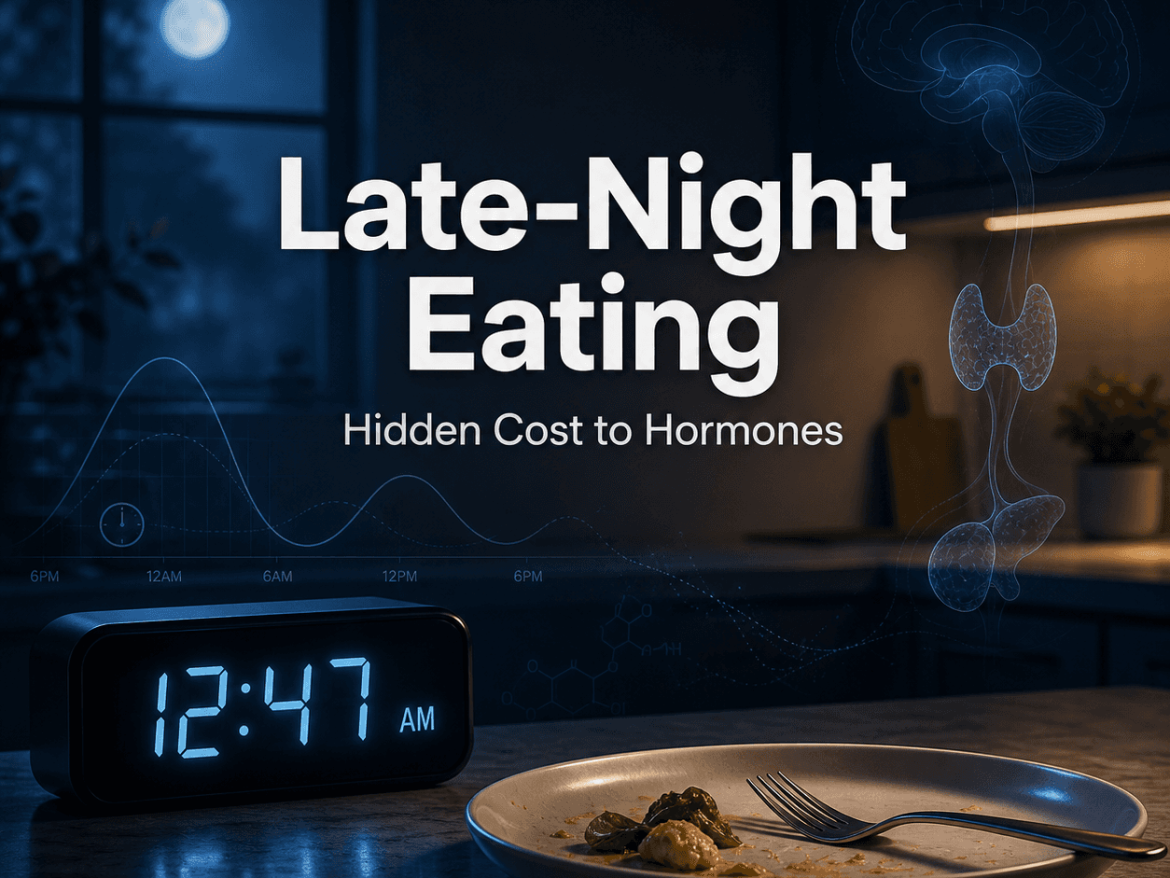
That’s where it gets interesting. Because late night eating does not just affect calories. It affects timing. And timing is basically a language your hormones understand really well.
Functional medicine tends to zoom out and ask, what signals are we sending the body over and over. Light, stress, sleep, movement, food. Especially food timing. Your hormones are listening.
So let’s talk about the hidden cost. Not in a shamey way. In a “oh, that’s why my body feels like it’s fighting me” way.
The body runs on clocks, not just willpower
Your body has a circadian rhythm. A daily cycle, roughly 24 hours, that coordinates things like:
- When cortisol rises and falls
- When melatonin should kick in
- When insulin sensitivity is highest
- When digestion is most efficient
- When growth hormone is released
- When your liver is doing its nighttime cleanup
That rhythm is influenced by light exposure, sleep timing, stress. And also meal timing.
There’s even a term for the food clock. It’s not just your brain’s clock in the hypothalamus. Your organs have clocks too. Liver clock. Gut clock. Pancreas clock. Fat cells have clocks. They respond to when you eat, not just what you eat.
So when you eat late, you are basically telling those clocks, “Hey, stay on daytime mode.” Even though the rest of your environment is getting darker and your body is trying to transition to nighttime repair mode.
That mismatch can show up as hormonal chaos over time.
Late-night eating and insulin: the big one
If we’re going to name a main character here, it’s insulin.
Insulin’s job is to move glucose out of the blood and into cells. It also signals storage. Not evil storage. Normal storage. But the timing matters.
Insulin sensitivity is typically higher earlier in the day and lower in the evening. Meaning, your body generally handles carbs (and total calories) better in the morning and midday compared to late at night.
So what happens when you eat late?
- You get a higher glucose spike than you would have earlier
- You need more insulin to manage it
- You stay in a fed state longer
- Fat burning gets suppressed for longer overnight
- You may wake up with higher fasting glucose or feel hungrier the next day
If you are dealing with PCOS, prediabetes, metabolic syndrome, belly weight that refuses to budge, or you crash after meals, this matters a lot.
And here’s the annoying part. You can eat a “healthy” late night meal and still get this effect. Even if it’s homemade. Even if it’s gluten free. Even if it’s organic.
The body is not only responding to ingredients. It’s responding to timing.
A quick example (because this is common)
Someone eats dinner at 7 pm. Great. Then at 10:30 pm they have “something small” because they’re still a little hungry, or they want something sweet. They go to bed at 11:30.
That snack might keep insulin elevated into the early sleep hours. Which is exactly when you want insulin low so that growth hormone and overnight repair can do their thing.
Over time, this pattern can contribute to:
- Increased insulin resistance
- More cravings the next night (yep, it loops)
- More visceral fat storage
- Higher inflammation markers
- Worse sleep quality, which then worsens insulin sensitivity even more
It’s a perfect little spiral. Quiet, gradual. But real.
Cortisol, stress, and the “revenge snack”
Let’s talk cortisol for a second.
Cortisol should be higher in the morning to help you wake up, then gradually lower throughout the day, and be low at night so melatonin can rise and you can sleep deeply.
But modern life does not care about that.
If you’re working late, doom scrolling, arguing with someone, watching intense shows, training too hard, under-eating all day, or just stressed in general, cortisol can stay elevated into the evening.
Now here’s where late-night eating often comes in.
Sometimes you’re not hungry. You’re wired. You’re tired. Your nervous system is fried. And food becomes the off switch.
Especially carbs and sugar. They can temporarily lower cortisol and increase serotonin. It’s soothing. It works short term. That’s why it happens.
So if you find yourself late night eating, ask this gently:
- Did I eat enough protein and calories earlier today?
- Did I have any real downtime?
- Did I go from stress straight into bed without a buffer?
- Am I using food to come down from the day?
This is not about blaming yourself. It’s about understanding the signal. Late night eating can be a symptom of stress physiology.
And the bigger issue is not always the snack. It’s the chronic cortisol pattern that snack is trying to medicate.
Melatonin and digestion do not love each other
Melatonin is the hormone that helps you fall asleep and stay asleep. It rises at night in response to darkness and circadian cues.
But if you eat late, a few things happen that compete with melatonin:
- Digestion ramps up, which is an activating process
- Blood sugar and insulin responses create metabolic “noise”
- Body temperature can increase after eating, which can impair sleep initiation
- Acid reflux risk increases, especially if you lie down soon after eating
People often say, “I fall asleep fine after I snack.”
Sure. You might pass out. But sleep quality is different.
If you wake up at 2 am. If you wake up hot. If you wake up anxious. If you wake up to pee. If you wake up and your mind is racing.
Late night eating can be part of that picture.
And here’s a weird one people don’t expect
Melatonin also interacts with insulin. There are melatonin receptors on pancreatic beta cells. Eating when melatonin is high (like late at night) can impair glucose tolerance in some individuals.
Meaning, your blood sugar response can be worse simply because it’s nighttime.
So yes, your body might handle the same meal differently at 2 pm vs 10 pm.
Leptin and ghrelin: why late-night eating can make you hungrier
Leptin is a satiety hormone. It signals that you’re fed. Ghrelin is a hunger hormone. It signals that you need food.
Sleep plays a huge role in both.
When sleep quality or duration is poor, leptin tends to decrease and ghrelin tends to increase. You feel hungrier, less satisfied, and cravings hit harder. Usually for carbs and salty snack foods. Because of course.
Late night eating can worsen sleep quality, which then disrupts leptin and ghrelin, which then drives more late night eating.
Again. Loop.
And if you’re skipping breakfast because you’re not hungry from eating at 11 pm, you might end up under-eating earlier, then getting ravenous at night. Another loop.
A lot of people think they have a “night appetite.” Sometimes they do. But sometimes they have a circadian misalignment appetite. The pattern is learned and reinforced.
Thyroid and metabolism: subtle, but it adds up
Thyroid hormone influences metabolic rate, energy, temperature regulation, bowel motility, and even mood. Thyroid function is also affected by stress, inflammation, insulin resistance, and sleep.
So late night eating is not directly “destroying your thyroid.” I want to be clear. That’s internet drama.
But it can contribute indirectly by worsening:
- Insulin resistance
- Inflammation
- Sleep disruption
- Cortisol dysregulation
- Gut issues (reflux, bloating, constipation)
And those are all common drivers that show up in functional medicine thyroid cases.
If someone tells me they’re exhausted, gaining weight, constipated, and they eat most of their calories after 8 pm, my brain goes… okay. We have a rhythm issue here. A stress issue. Possibly blood sugar instability. Maybe low protein during the day. Maybe sleep quality is poor. Let’s start there.
Because sometimes supporting circadian rhythm helps thyroid signaling more than yet another supplement.
Estrogen, progesterone, and the PMS connection
This part gets missed a lot.
Late night eating can influence estrogen and progesterone balance indirectly through liver detox pathways, insulin, and inflammation.
A few connections:
- Insulin resistance can increase ovarian androgen production and disrupt ovulation. That can lower progesterone.
- Poor sleep can disrupt the HPA axis, impacting sex hormone production.
- Late night alcohol plus late night snacks (a common combo) increases estrogen burden and liver workload.
- Inflammation can worsen PMS, breast tenderness, cramps, headaches, and mood swings.
If you deal with PMS, heavy periods, hormonal acne, or perimenopausal symptoms, it’s worth asking if your nights are giving your body enough space to do repair and hormone clearance.
Because a big chunk of hormone metabolism happens in the liver and gut. Overnight. In a fasted state.
And if the body is digesting, producing bile, managing glucose, and clearing triglycerides at midnight, it has less capacity for the other jobs.
Growth hormone and overnight repair: the cost of never being “fasted”
Growth hormone is released in pulses, with a big one shortly after you fall asleep. It supports tissue repair, muscle maintenance, fat metabolism, and overall recovery.
You do not need to be an athlete for this to matter.
But that growth hormone pulse is blunted when insulin is high. And late night eating can keep insulin elevated into the early sleep window.
So what can happen over time?
- Slower recovery from workouts
- More muscle loss with age
- Easier fat gain, harder fat loss
- Skin looking more tired
- Feeling “puffy” or inflamed
Again, not because one snack ruined you. But because the body never gets a true fasting window at night.
If you eat dinner late, snack late, then wake up and eat early, your body is basically always processing food. No real rest period.
That can be a problem.
Gut health: reflux, bloating, and the microbiome rhythm
Your digestive system also has a rhythm.
Gut motility slows at night. Stomach emptying can be slower. Acid reflux risk can go up when you lie down with food in the stomach. And the migrating motor complex, which helps “sweep” the small intestine between meals, needs fasting windows to function well.
Late night eating can contribute to:
- Reflux and heartburn
- Bloating the next morning
- Poor bowel movements
- Small intestinal bacterial overgrowth patterns in susceptible people (not always, but it can worsen things)
And the microbiome has circadian behavior too. Late night eating can shift microbial patterns in ways that promote inflammation and metabolic dysfunction.
This is one of those “your body is not designed for 24 hour food access” truths.
So why do people crave food at night?
Let’s be real. This is the part that matters.
Late-night eating is often not random. It’s usually one or more of these:
1) You under-ate during the day
Not enough protein. Not enough calories. Skipping meals. Too much coffee, not enough food. By 9 pm your body is like, hello. We need fuel.
2) Your blood sugar is unstable
If breakfast is sweet, lunch is light, dinner is rushed, then your glucose swings. The cravings at night can be your body trying to stabilize.
3) Stress and emotional decompression
Food becomes comfort. A transition ritual. A reward. Sometimes the only pleasure in the day. That’s not trivial. That’s information.
4) Poor sleep schedule or circadian drift
If you stay up late with bright screens, your melatonin rhythm shifts. Hunger signals can shift with it.
5) Habit and environment
If your routine is TV plus snack every night, your brain starts pairing them. Even if you’re not physically hungry.
6) Alcohol
Alcohol can lower inhibitions, worsen sleep, and trigger hunger. Also it affects blood sugar, which can drive cravings.
Most people have a mix of these. Which is why “just stop snacking” usually fails.
What to do instead (without turning your life into a wellness punishment)
You do not need to be perfect. You need a plan that your nervous system will actually tolerate.
Here are practical steps that tend to work.
1) Start with a realistic cutoff, not an extreme rule
If you currently eat at 11 pm, jumping to “no food after 6” will likely backfire.
Try this instead:
- Pick a nightly kitchen close time that feels doable, maybe 9 pm.
- Hold it for 7 to 10 days.
- Then move it earlier if needed.
Sometimes a 60 to 90 minute buffer between last bite and bed is enough to improve sleep.
2) Make dinner more satisfying (protein, fiber, healthy fat)
A lot of late night cravings are just an unsatisfying dinner.
Aim for:
- A solid protein portion (chicken, fish, tofu, lentils, eggs, etc.)
- Fiber from veggies or beans
- Healthy fat (olive oil, avocado, tahini)
- And yes, carbs if your body does well with them. Especially if skipping carbs makes you binge later.
If you have insomnia and wake at 2 to 3 am, sometimes a moderate complex carb at dinner helps. Not always. But often.
3) If you need a planned snack, make it intentional and earlier
Some people genuinely do better with a small snack. Especially if they eat an early dinner or have higher activity.
Try to keep it:
- Protein forward
- Not a sugar bomb
- And have it 1.5 to 2 hours before bed if possible
Examples (simple, not fancy):
- Greek yogurt with cinnamon
- Cottage cheese with berries
- A small protein smoothie
- Almond butter on apple slices
- Turkey roll ups
- Chia pudding
If you want a sweet taste, fine. But pair it with protein to soften the glucose spike.
4) Build a decompression ritual that isn’t food
This matters more than people think.
If food is your transition from stress to rest, you need a new transition.
Ideas:
- 10 minute walk after dinner
- Shower, skincare, change into sleep clothes early
- Magnesium glycinate (if appropriate for you, check with your clinician)
- Herbal tea
- Breathing exercise for 3 minutes
- Journaling a brain dump
- Legs up the wall for 5 minutes
It can feel silly at first. But it works because your body learns, okay, we are shutting down now.
5) Check your light environment
Bright light at night suppresses melatonin. That can make you feel awake and snacky.
Try:
- Dim lights after 8 pm
- Warm lighting
- Avoid intense screens the last hour, or at least use a blue light filter and lower brightness
This is one of those boring tips that actually changes hormones.
6) Don’t ignore sleep apnea or reflux
If you snore, wake up choking, have morning headaches, or feel exhausted despite “sleeping,” get evaluated.
If reflux is driving you to eat or drink late (or you eat late and get reflux), address that too. Raising the head of the bed, avoiding trigger foods, and changing timing can help. But sometimes it needs deeper gut support.
7) If late night eating feels compulsive, zoom out
Sometimes it’s not a habit issue. It’s a deeper stress, trauma, or nervous system issue. Or disordered eating patterns. Or both.
In that case, the solution is not stricter rules. It’s support. A different approach. Sometimes therapy. Sometimes structured meals. Sometimes getting enough food consistently for weeks so the body trusts you again.
A simple self-check: Is your late-night eating hormonal or just schedule?
Ask yourself:
- If I ate a balanced dinner, would I still snack?
- Am I hungry in my stomach, or restless in my mind?
- Does the craving hit after something stressful, or after I sit down to relax?
- Do I wake at night when I eat late?
- How do I feel the next morning?
No judgment. Just pattern recognition.
Where functional medicine fits in (because sometimes it’s not just behavior)
If late night eating is paired with fatigue, weight gain, stubborn belly fat, mood swings, brain fog, insomnia, irregular cycles, or digestive issues, it might be time to look deeper.
In functional medicine, we might explore:
- Blood sugar patterns (fasting glucose, insulin, A1c, sometimes CGM data)
- Cortisol rhythm and stress physiology
- Thyroid markers (not just TSH)
- Gut health and reflux drivers
- Nutrient deficiencies that affect cravings (magnesium, zinc, chromium, etc.)
- Sex hormone patterns, especially in perimenopause or PCOS
Because late night eating is sometimes the symptom, not the root cause.
If you want a structured way to start connecting the dots, Dr. Lisa Silvani has a resource on her site that can help you map your metabolism patterns. You can also book a free consultation through lisasilvani.com if you want guidance that’s personalized, not generic.
The bottom line
Late night eating is not just about discipline.
It’s about biology. Circadian rhythm. Insulin sensitivity. Cortisol. Sleep quality. Gut motility. Hormone clearance. The body’s need for a real overnight repair window.
Sometimes adjusting food timing is the missing piece that makes everything else finally work. Energy improves. Cravings calm down. Sleep deepens. Weight starts moving. PMS gets less intense. Not overnight, but steadily.
And if late night eating is your only quiet moment in the day, I get it. Many people are living like that. Start small. Build a better evening routine. Feed yourself well earlier. Give your hormones a chance to do what they were designed to do.
Quietly. In the dark. While you sleep.
FAQs (Frequently Asked Questions)
Why does late night eating affect more than just calorie intake?
Late night eating impacts not only calories but also the timing of food intake, which interferes with your body’s circadian rhythm. This rhythm regulates hormones like cortisol, melatonin, and insulin, so eating late sends mixed signals to your body’s internal clocks, potentially leading to hormonal imbalances and issues like poor sleep, weight gain, and inflammation.
How does eating late at night influence insulin and blood sugar levels?
Eating late causes higher glucose spikes and requires more insulin to manage blood sugar because insulin sensitivity is naturally lower in the evening. This prolongs the fed state, suppresses fat burning overnight, and can lead to increased insulin resistance, cravings, visceral fat storage, and elevated fasting glucose levels the next day.
Can healthy foods eaten late at night still disrupt my metabolism?
Yes. The timing of when you eat matters as much as what you eat. Even healthy, homemade, gluten-free, or organic foods consumed late at night can cause metabolic disruptions because your body’s organs respond to meal timing. Eating late keeps your body in ‘daytime mode’ when it should be transitioning to nighttime repair mode.
What role does cortisol play in late night snacking habits?
Cortisol, a stress hormone that should decrease by evening to allow melatonin-driven sleep, can remain elevated due to stress or lifestyle factors. Elevated cortisol at night can trigger ‘revenge snacking’ where carbs and sugars are used to temporarily lower cortisol and increase serotonin for comfort. This pattern indicates stress physiology rather than just hunger.
How does late night eating interfere with melatonin production and sleep quality?
Eating late activates digestion and raises blood sugar and insulin levels, creating metabolic noise that competes with melatonin’s role in promoting sleep. Additionally, food intake increases body temperature and acid reflux risk if lying down soon after eating—all factors that impair falling asleep and maintaining deep sleep.
What are some signs that my late night eating is affecting my health negatively?
If you frequently eat late at night along with symptoms like poor sleep quality, stubborn weight gain (especially belly fat), mood swings, bloating, energy crashes during the day, or waking up feeling puffy and inflamed, these could indicate that late night eating is disrupting your hormonal balance and overall health.
References
- Scheer, F. A., Hilton, M. F., Mantzoros, C. S., & Shea, S. A. (2009). Adverse metabolic and cardiovascular consequences of circadian misalignment. Proceedings of the National Academy of Sciences, 106(11), 4453-4458. https://doi.org/10.1073/pnas.0808180106
- Johnston, J. D. (2014). Physiological responses to food intake throughout the day: importance of circadian rhythms in metabolism and health. Nutrition Research Reviews, 27(1), 1-21. https://doi.org/10.1017/S0954422414000022
- Van Cauter, E., & Knutson, K. L. (2008). Sleep and endocrine function: implications for metabolism and diabetes risk. Endocrine Reviews, 29(5), 603-628. https://doi.org/10.1210/er.2007-0030
- St-Onge, M.-P., Mikic, A., & Pietrolungo, C. E. (2016). Effects of diet on sleep quality. Advances in Nutrition, 7(5), 938-949. https://doi.org/10.3945/an.116.012336
- Reutrakul, S., & Van Cauter, E. (2018). Interactions between sleep, circadian function, and glucose metabolism: implications for risk and severity of diabetes. Annals of the New York Academy of Sciences, 1411(1), 15-31. https://doi.org/10.1111/nyas.13401
- Spiegel, K., Tasali, E., Penev, P., & Van Cauter, E. (2004). Sleep curtailment in healthy young men is associated with decreased leptin levels, elevated ghrelin levels, and increased hunger and appetite. Annals of Internal Medicine, 141(11), 846-850.
- NHS England & Improvement (2022). Healthy eating and your hormones: how diet affects hormonal balance and well-being – NHS.uk [https://www.nhs.uk/live-well/eat-well/how-diet-affects-hormones/]
- Fitzgerald, K., & Hyman, M.M.D., M.D., M.P.H.. Functional Medicine Approach to Circadian Rhythms and Metabolic Health: Insights from Clinical Practice (2020). Integrative Medicine: A Clinician’s Journal, 19(6), 24–32.
- Ruscio, M.D., M.P.H., Michael G., et al., Gut microbiome rhythm disruptions as a factor in metabolic disease development: a review from functional medicine perspectives (2021). Gut Microbes, 13(1), 1–14.
- Gupta, N., & Radhakrishnan, J.C.E.D.S.M.. Late-night eating: Effects on metabolism and weight regulation – A review from a sleep-medicine perspective (Sleep Medicine Reviews). Elsevier; 2020; Volume 49:101224 DOI:10.1016/j.