
 dr. Lisa Silvani
 You wake up, you check your numbers, and your heart drops a little.
HRV is down. Resting heart rate is up. Recovery says “yellow” or “red.” Your brain instantly starts writing a story. I slept terribly. I’m getting sick. My training is ruined. My body is failing. Today is going to be a mess.
And then the weird part happens.
You feel stressed because the data says you are stressed.
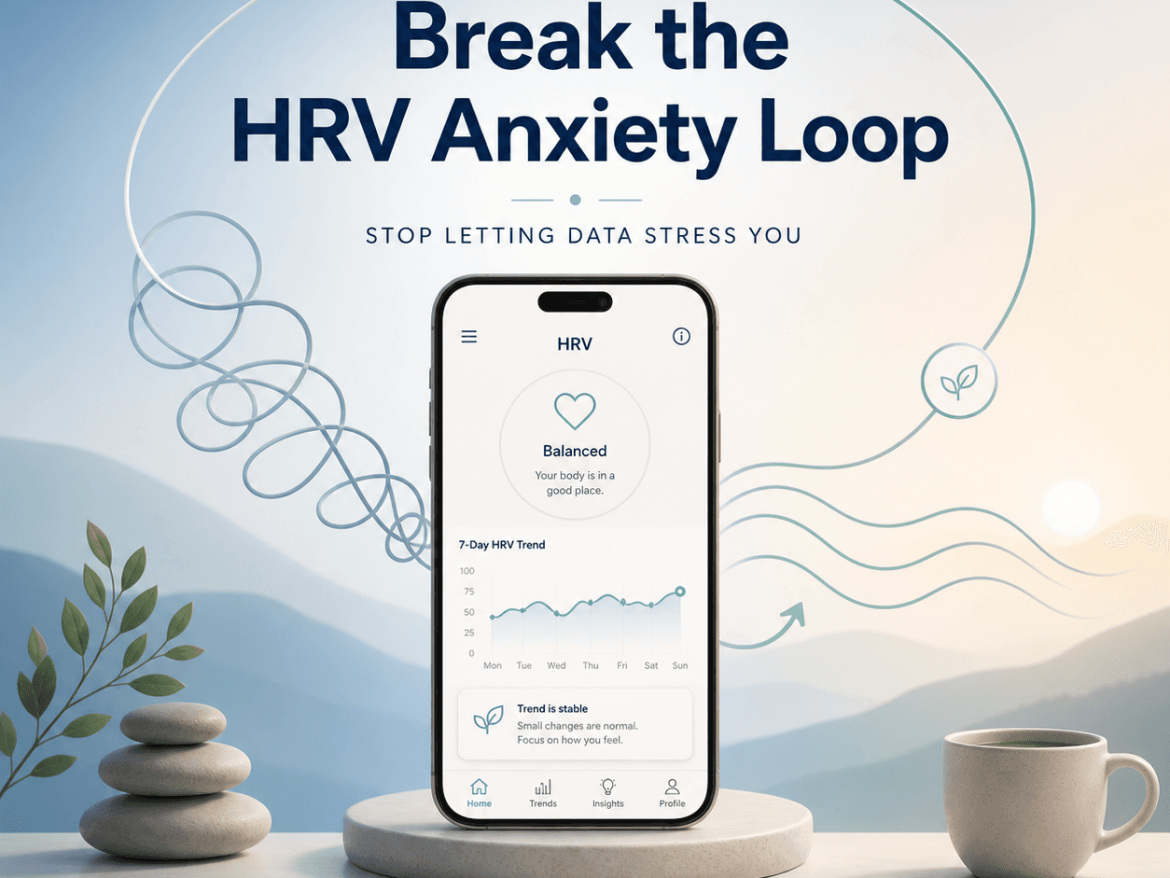
That is the HRV anxiety loop. It is real, it is common, and it can quietly make your health worse, even though the whole point of tracking was to make it better.
This article is here to help you step out of that loop, without throwing your wearable in a drawer. Unless you want to. That is also allowed.
First, what HRV actually is (in plain English)
HRV is heart rate variability. It is not your heart rate. It is the tiny variations in time between heartbeats.
A simplified way to think about it:
- Higher HRV often suggests your nervous system has more flexibility. More ability to shift between stress and calm.
- Lower HRV often suggests your system is under more load. That load can be physical, mental, inflammatory, hormonal, nutritional, sleep related. Or just life.
HRV is basically a proxy for how your autonomic nervous system is doing. That is the system that runs the background stuff. Digestion. Temperature. Stress response. Recovery. Sleep. Heart rate. All the things you do not consciously control.
But. And this matters.
HRV is not a moral score. HRV is not a report card. HRV is not a diagnosis.
It is one signal. In a very noisy environment.
Why HRV is so easy to get obsessed with
Because it feels objective.
Your mood can lie. Your motivation can lie. Your brain is dramatic. But the numbers. The numbers feel like they are telling the truth.
Except… numbers don’t always mean what you think they mean.
Wearables estimate HRV differently depending on the device, the sensor, the algorithm, and when the measurement happens. Some take HRV during sleep. Some do spot checks. Some average it. Some smooth it. Some show RMSSD. Some show SDNN. A lot of people have no idea what they are even looking at. They just know “higher is better.”
And even if the measurement is consistent, HRV still swings for tons of reasons that have nothing to do with whether you are “healthy” or “doing it right.”
HRV can drop because:
- You had alcohol, even just one drink for some people
- You ate late
- You ate a lot more carbs than usual or a lot less than usual
- You trained hard
- You trained in a new way
- You did a long walk in heat
- You had an argument
- You had a stressful workday
- You were excited about something
- You are ovulating or in the luteal phase
- You are under fueled
- You are dehydrated
- You are fighting a virus and don’t feel symptoms yet
- You slept in a different position
- You woke up to pee
- You got less deep sleep
- You got more deep sleep but had fragmented REM
- You changed your bedtime
- You traveled
- You are in a calorie deficit
- You are over caffeinated
- You are constipated
- You have low iron
- You have blood sugar swings
- You are in a high inflammation phase of something chronic
- You are just having a normal human fluctuation
So when people tell me, “My HRV tanked, what does it mean,” I usually want to ask, “Compared to what, and over how long, and what else is happening.”
Because a single day HRV dip is not a verdict. It is a breadcrumb.
The HRV anxiety loop, step by step
Here is how it tends to go.
- You check HRV first thing.
- You see a lower number than you expected.
- Your brain labels it as danger.
- You start scanning your body for proof.
- You interpret normal sensations as something is wrong.
- You change your behavior based on fear.
- Your stress response increases.
- Your sleep gets worse that night.
- HRV is lower again.
- Now the data “confirms” the story.
And that loop can run for days.
Sometimes the loop starts because you are genuinely under-recovered. But it continues because of the psychological response to the metric. That’s what makes it sneaky.
It can also flip into the opposite.
HRV is high, you feel invincible, you overdo it, and then you crash. That is a different loop, but still a loop.
The biggest myth: “High HRV means I’m healthy”
Higher HRV tends to correlate with better resilience, yes.
But context matters.
Sometimes HRV rises because you are in a parasympathetic dominant, shut-down state. Some people see higher HRV when they are under-eating, overtraining, or burnt out in a way that pushes the body into a kind of conservation mode. Not always. But sometimes.
Also, your HRV is personal.
A “good” HRV for you might be 35. For someone else it might be 90. Comparing yourself to strangers online is a guaranteed way to get stressed.
The only comparison that is useful is you versus you.
And not you versus you yesterday, necessarily.
More like you versus your baseline trend.
Baseline is everything. Trends over snapshots.
If you do one thing after reading this, do this:
Stop reacting to single day HRV numbers.
Look at:
- 7 day trend
- 14 day trend
- 30 day trend
- Your typical range
- Whether your HRV is steadily drifting down over weeks
- Whether it rebounds after rest
- Whether dips line up with travel, alcohol, training blocks, cycle phase, work stress
One bad night does not mean you are broken. It might mean you had a bad night.
But a consistent trend. That is different. That is information you can act on in a calm way.
A quick reality check: your wearable cannot see your whole life
Wearables are impressive. I like data. I use data with patients all the time. It can be very helpful.
But it cannot measure:
- The emotional load you are carrying
- Grief
- Relationship stress
- Feeling unsafe
- The mental effort of masking anxiety all day
- Chronic inflammation in detail
- Micronutrient deficiencies directly
- Hormone patterns accurately without labs
- Gut dysbiosis
- The difference between “I pushed myself and feel great” and “I pushed myself and I’m running on fumes”
It sees heart rhythm patterns and movement and temperature. That’s it.
So if you are using HRV as your primary source of truth, you are basically letting a tiny window decide what the whole house looks like.
The sneaky issue: checking HRV can condition anxiety
This is important and I want to say it plainly.
If checking HRV makes you anxious, your brain can learn to associate the act of checking with danger.
So even before you see the number, you get a stress response.
That means:
- You check
- Cortisol spikes
- Heart rate changes
- Breathing changes
- Your whole morning tone changes
And then you live inside that.
Some people start checking multiple times a day. Like refreshing the weather app during a hurricane.
If that is you, you are not failing. Your nervous system is trying to regain control. It just picked the wrong tool.
So what do you do instead? A practical plan.
Here are a few ways to break the HRV anxiety loop without abandoning tracking altogether.
1) Change the time you look at HRV
If you check HRV first thing in the morning, you are letting it set the emotional thermostat for your day.
Try this for two weeks:
- Do your morning routine first. Bathroom, water, sunlight, a few minutes of movement, coffee, whatever.
- Then check your metrics later. After your nervous system is already more regulated.
A lot of people notice the number “matters less” when they are not half asleep and immediately vulnerable.
2) Limit how often you check
You do not need to check HRV 10 times a day. Honestly, most people do not even need to check daily.
Options that work well:
- Check 3 times per week
- Check only the weekly trend view
- Check only after a training block
- Check only if you feel “off” and you want context
- Take a 30 day break from HRV and just track sleep and steps
Yes, you will feel itchy at first. That is part of the loop breaking.
3) Create a neutral script for low HRV mornings
When your HRV is lower than usual, your brain wants to catastrophize.
So give it a script.
Something like:
“Interesting. My body might be under more load. I’ll support recovery today. I don’t need to panic.”
Then pair it with one action.
Not ten actions. Not a whole day of spiraling. One action.
Examples:
- Add a 20 minute walk
- Eat a real breakfast with protein
- Hydrate with electrolytes
- Move your workout to zone 2 instead of intervals
- Go to bed 30 minutes earlier
You are telling your nervous system, “We saw it. We responded. We’re safe.”
4) Stop trying to “hack” HRV
People start doing weird stuff to force HRV up. Breathing protocols for hours. Cold plunges when they hate cold plunges. Supplements they don’t need. Skipping training even though movement helps them.
Here is the truth.
If you have to white-knuckle your life to get a higher HRV number, you are missing the point.
HRV is an output. Not a job.
Yes, supportive habits help. But if the tracking turns into performance, it becomes another stressor. Which lowers HRV anyway. It is almost funny.
5) Use a two question filter before making any decision
Before you change your plan for the day based on HRV, ask:
- How do I actually feel in my body today?
- Do I have a trend over several days, or just one dip?
If you feel great and it is one dip, you probably do not need to cancel your life. If you feel awful and it is a 7 day downward trend, okay. That is a different conversation.
6) Pair HRV with basics that matter more
If you want data that is often more actionable than HRV, track these alongside it:
- Total sleep time and sleep consistency
- Resting heart rate trend
- Energy levels mid morning and mid afternoon
- Mood and irritability
- Appetite and cravings
- Menstrual cycle phase
- Alcohol frequency
- Caffeine timing
- Training volume and intensity
- Digestion (bloating, constipation, reflux)
- Blood sugar stability (even just symptom based if you don’t use a CGM)
HRV is like one instrument in an orchestra. Stop letting it do a solo every morning.
When low HRV is actually a helpful red flag
Sometimes the data is pointing at something real. And this is where a calm, functional medicine lens helps. Not panic. Just pattern recognition.
A more concerning pattern looks like:
- HRV steadily trending down for weeks
- Resting heart rate trending up
- Sleep quality getting worse
- You’re more wired at night and tired in the morning
- Workouts feel harder at the same intensity
- You’re more anxious, more reactive
- Digestion is off
- More frequent illness
- Crashes after meals
- New or worsening fatigue
This is often where we start thinking about root causes that wearables cannot name, but they can hint at.
Stuff like:
- Overtraining or under-recovery
- Under-eating, especially low protein or too aggressive calorie deficit
- Sleep apnea or poor breathing at night
- Iron deficiency, B12 deficiency
- Thyroid dysfunction
- Blood sugar dysregulation
- Chronic gut inflammation
- Perimenopause hormone shifts
- High chronic stress with low recovery capacity
- Mold exposure or other environmental load (in some cases)
- Post viral syndromes
If that list made you feel overwhelmed. Pause. Not all of those apply to you. It is just to show that the answer is not “do more box breathing and hope.”
Sometimes you need an actual plan.
If you are noticing that kind of persistent pattern, that is a good time to talk with someone who can look at the whole picture, not just a dashboard. This is the kind of work Dr. Lisa Silvani does in her functional and integrative practice. If you want a next step that is not guesswork, you can start at https://www.lisasilvani.com and book a free consultation. Even that first conversation can help you sort “normal fluctuation” from “something we should investigate.”
Nervous system basics that raise HRV without turning it into a project
I’m going to keep this practical. Not perfect. Not Instagram-y.
These are the big levers that tend to help HRV for most people, because they improve recovery capacity.
Sleep, but specifically consistency
You can do everything “right,” but if you sleep at random times, HRV usually suffers.
Aim for:
- Same bedtime and wake time most days
- A wind-down that is boring on purpose
- Morning light in your eyes within an hour of waking
- Cooler bedroom
- Less alcohol, especially close to bedtime
And if you suspect sleep apnea. Snoring, waking up unrefreshed, morning headaches, dry mouth, gasping. Get that checked. HRV data sometimes nudges people to finally take sleep breathing seriously. Which is a win.
Eat enough. Especially enough protein.
Under-eating is a huge HRV killer for a lot of high achievers. People who train, work, parent, and basically run on adrenaline.
You do not need a perfect diet. But you do need:
- Enough calories to match your output
- Enough protein to repair and stabilize blood sugar
- Enough carbs for your activity level (yes, for many people)
If your HRV is low and you are also cold all the time, losing hair, missing periods, obsessing about food, or always sore. That is not a “more discipline” moment. That is a recovery moment.
Hydration and electrolytes
Dehydration increases cardiovascular strain. Your heart works harder. HRV can drop.
If you wake up with a higher resting heart rate than usual, or you trained the day before, or it is hot out. Try water plus electrolytes earlier in the day. Not as a magic trick. Just as basic physiology.
Zone 2 movement and walking
Gentle aerobic work often improves HRV over time because it supports mitochondrial function, cardiovascular fitness, and stress resilience.
If your HRV is low and you are tempted to do nothing all day, sometimes a 20 to 40 minute walk is the best thing you can do. It shifts the nervous system without hammering it.
Strength training. But dose it well.
Strength training is stress. Good stress. But still stress.
If you are in an HRV dip and also feeling run down, consider:
- Shorter session
- Fewer sets
- Lower RPE
- More rest between sets
- Swap max effort for technique work
Still move. Just don’t turn it into a fight.
Caffeine timing
Caffeine can lower HRV for some people, especially if it pushes them into a wired state.
Try:
- No caffeine for the first 60 to 90 minutes after waking
- Avoid caffeine after noon (or earlier if sensitive)
- Make sure caffeine is not replacing breakfast
Breathing, but make it normal
Breathwork can help. But you do not need to turn it into a sport.
Try 2 to 5 minutes of slow breathing:
- Longer exhales than inhales
- Through the nose if possible
- Shoulders down
Do it because it feels good, not because you are trying to win at HRV.
Reframing HRV so it stops controlling you
This part is more mindset, but it matters.
HRV is feedback, not a forecast
A low HRV does not mean your day will be bad. It means your body is signaling higher load.
You can still have a great day with low HRV. You can still have a rough day with high HRV.
HRV is not you
You are not a number. You are a whole organism. With relationships, memories, stressors, hormones, immune function, microbiome, sleep patterns. All of it.
Sometimes your HRV is low because you are human and life is heavy.
That is not failure. That is information.
You can choose what you do with the information
The goal is not to stop caring.
The goal is to respond like an adult, not like a panic alarm.
See the number. Notice the urge to spiral. Do one supportive thing. Move on.
That is nervous system training, in the real sense.
A simple 7 day reset if you’re stuck in the loop
If you are deep in HRV anxiety right now, do this for one week. It is intentionally simple.
Day 1: Turn off HRV notifications.
No recovery alerts. No readiness alerts. No morning judgment.
Day 2: Only check sleep duration and bedtime.
That’s it.
Day 3: Add a 20 minute walk.
Do it even if you do not feel like it.
Day 4: Eat protein at breakfast.
Not perfect macros. Just protein.
Day 5: No alcohol.
Just for the week. Let your body exhale.
Day 6: Go to bed 30 minutes earlier.
Even if sleep is not perfect, give the window.
Day 7: Look at the weekly trend, not the daily score.
Ask: Did I feel better this week? Did I recover better? Did I stress less about the data?
Then decide how you want to use HRV going forward.
A lot of people realize they do better with less frequent checking. Or they keep tracking, but they stop letting it run the day.
When it’s time to dig deeper (and not DIY it)
If you have persistent low HRV plus symptoms like:
- Chronic fatigue that doesn’t improve with rest
- Insomnia or waking at 2 to 4 am often
- Palpitations
- Anxiety that feels physical and “stuck”
- Digestive issues that won’t quit
- Weight gain or weight loss that doesn’t make sense
- Irregular cycles, heavy cycles, perimenopause swings
- Frequent infections
- Exercise intolerance, you crash after workouts
…then it might not be a “do more yoga” situation.
This is where a functional medicine approach can help connect the dots. Labs, history, lifestyle, environment, nutrition, nervous system. The whole picture.
If you want that kind of support, you can explore resources and next steps at https://www.lisasilvani.com. There’s also a free consultation option, and resources like the Metabolizm quiz if you want a starting point that feels less intense than “tell me everything wrong with me.” Which, fair.
Let’s wrap it up
The HRV anxiety loop happens when you let a metric decide your story about your body.
HRV is useful. But only when you use it with context, trends, and a little emotional distance. The moment it starts making you more stressed, it stops being a health tool and becomes a stress trigger.
So here is the new rule.
Your wearable works for you. Not the other way around.
Look at trends. Support recovery. Stop chasing perfect numbers. And if your data and your symptoms have been waving a flag for a while, get a bigger view of what’s going on. Your nervous system will thank you for it.
FAQs (Frequently Asked Questions)
What is HRV and how does it differ from heart rate?
HRV stands for heart rate variability, which measures the tiny variations in time between your heartbeats. Unlike heart rate, which counts beats per minute, HRV reflects the flexibility of your autonomic nervous system to shift between stress and calm states.
Why does my HRV sometimes drop even if I feel fine?
HRV can fluctuate due to many factors unrelated to illness or poor health, such as alcohol consumption, late meals, training intensity, stress, hormonal changes, sleep quality, hydration, and even normal daily variations. A single day dip is often just a normal human fluctuation.
What is the HRV anxiety loop and how can it affect my health?
The HRV anxiety loop occurs when you see a lower HRV number and immediately interpret it as a sign of danger or poor health. This triggers stress and behavioral changes that worsen sleep and recovery, causing further drops in HRV and reinforcing negative feelings. This cycle can quietly harm your health despite your tracking efforts.
Does a higher HRV always mean I am healthy?
Not necessarily. While higher HRV often correlates with better resilience, context matters. Sometimes elevated HRV can indicate a parasympathetic dominant shut-down state caused by overtraining or burnout. Everyone’s baseline is different; what is high for one person may be normal for another.
How should I interpret my HRV data effectively?
Instead of reacting to single-day numbers, focus on long-term trends over 7, 14, or 30 days. Compare your current values to your personal typical range and observe whether dips align with factors like travel, alcohol intake, training changes, or stress. Consistent trends provide actionable insights without unnecessary worry.
Can wearable devices like Oura, Whoop, Garmin help me understand my recovery without causing stress?
Yes. Wearables provide valuable data on HRV and recovery but it’s important not to obsess over daily fluctuations. Use the data as a guide for overall trends rather than immediate judgments. Understanding that numbers are one signal among many helps prevent the stress response known as the HRV anxiety loop.
References
- Shaffer, F., & Ginsberg, J. P. (2017). An Overview of Heart Rate Variability Metrics and Norms. Frontiers in Public Health, 5, 258. https://doi.org/10.3389/fpubh.2017.00258
- Billman, G. E. (2011). Heart rate variability–a historical perspective. Frontiers in Physiology, 2, 86. https://doi.org/10.3389/fphys.2011.00086
- Kim, H.-G., Cheon, E.-J., Bai, D.-S., Lee, Y. H., & Koo, B.-H. (2018). Stress and Heart Rate Variability: A Meta-Analysis and Review of the Literature. Psychiatry Investigation, 15(3), 235-245. https://doi.org/10.30773/pi.2017.08.17
- Task Force of The European Society of Cardiology and The North American Society of Pacing and Electrophysiology (1996). Heart rate variability: Standards of measurement, physiological interpretation and clinical use. Circulation, 93(5), 1043-1065.
- Thayer, J.F., Åhs, F., Fredrikson, M., Sollers III, J.J., & Wager, T.D. (2012). A meta-analysis of heart rate variability and neuroimaging studies: implications for heart rate variability as a marker of stress and health. Neuroscience & Biobehavioral Reviews, 36(2), 747-756.
- NHS UK (2023). Heart rate variability – what your HRV tells you about stress and health. Retrieved from https://www.nhs.uk/live-well/exercise/heart-rate-variability-what-it-means-for-stress-and-health/
- Fitzgerald, K., & Hyman, M.D., M.P.H (2020). Functional Medicine Perspective on HRV: Clinical Applications in Stress Management and Recovery – Integrative Medicine Insights.
- Ruscio, M.E., & Ruscio, J.S.M.D (2021). How to Use Heart Rate Variability to Improve Your Health Without Anxiety – DrMichaelRuscio.com.
- Kleiger, R.E., Stein, P.K., & Bigger Jr., J.T (2005). Heart rate variability: Measurement and clinical utility. Annals of Noninvasive Electrocardiology, 10(1), 88-101.
- Shaffer F., McCraty R., Zerr C.L (2014). A healthy heart is not a metronome: an integrative review of the heart’s anatomy and heart rate variability literature for the cardiologist and neuroscientist. Frontiers in Psychology, 5:1040 https://doi.org/10.3389/fpsyg.2014.01040