
 dr. Lisa Silvani
 Not dramatic tired, either. Not the kind where you are obviously sick.
More like…
You wake up and you are already negotiating with the day.
You need coffee just to become a person.
Your brain feels foggy, your legs feel heavy, your motivation is gone, and you keep thinking, What is wrong with me?
Then labs come back “normal.”
TSH is fine. CBC is fine. Vitamin D is fine. Your doctor says, “Everything looks good.”
And you go home feeling slightly embarrassed for even asking.
This is where ferritin shows up. Or more accurately, ferritin hides.
Because low ferritin is one of the most common “normal” labs that can absolutely wreck energy, mood, exercise tolerance, hair growth, and even your ability to think clearly. And it gets missed all the time because the reference range is wide… and because we tend to treat anemia as the only iron problem that matters.
But ferritin is not just about anemia.
Let’s talk about it.
Ferritin in plain English
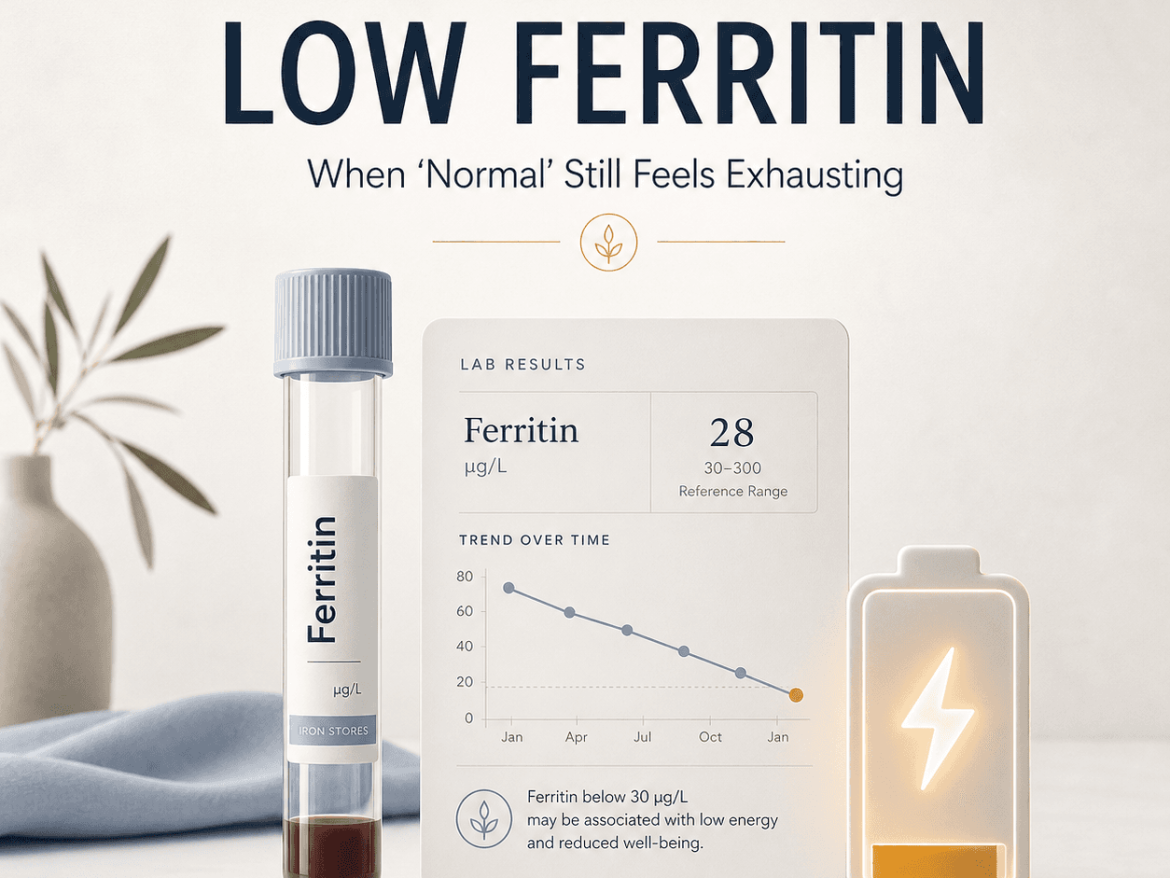
Ferritin is basically your iron storage marker.
Think of iron like cash you spend every day. You need it for a lot of things, but especially for oxygen delivery and energy production. Ferritin is the savings account. It tells you how much iron you have stored away for future use.
Hemoglobin is more like what is in your checking account right now. It can look fine for a long time while your savings quietly drains.
So you can have:
- Normal hemoglobin
- Normal hematocrit
- Normal RBC count
- No anemia on a CBC
…and still have low ferritin.
And still feel awful.
That’s the trap.
Why “normal” ferritin can still be a problem
Most lab ranges for ferritin are built from population averages. Not from “this is the level where humans thrive.”
So the range might say something like:
- Ferritin “normal”: 15 to 150 (or 200, depending on the lab)
That lower end is where things get messy.
Ferritin of 15 might be “normal” on paper. But functionally, it can be associated with symptoms for a lot of people. Especially menstruating women, postpartum women, endurance exercisers, vegetarians, and anyone with gut absorption issues.
Many people start feeling noticeably better when ferritin is higher than the bare minimum. Not sky high. Just not scraping the bottom.
And yes, there is nuance here. Ferritin is also an inflammatory marker. It can be falsely elevated in inflammation. Which means you can look “fine” on ferritin while still being iron deficient.
So ferritin can be:
- Too low (true low stores)
- “Normal” but low for you (functional deficiency)
- Falsely normal or high because inflammation is pushing it up
That’s why interpreting ferritin in isolation is risky. More on that in a bit.
The low ferritin symptom list that people don’t connect to iron
When ferritin is low, people often don’t feel “anemic.” They just feel… off.
Here are the patterns I see over and over in real life:
1. Fatigue that does not match your life
You are not pulling all nighters. You are not partying. You are doing the responsible adult stuff.
And still you feel drained.
Low ferritin fatigue can feel like:
- heavy limbs
- needing naps you don’t have time for
- feeling wiped out after basic errands
- crashing mid afternoon hard
2. Shortness of breath or poor exercise tolerance
Even walking up stairs feels harder than it should.
You might notice:
- you get winded easily
- your heart rate jumps faster during workouts
- you cannot recover like you used to
- you feel “weak” even though you are trying
Iron is part of oxygen delivery. And it is part of mitochondrial energy production. So when iron stores are low, you can feel it in your muscles, your lungs, your whole system.
3. Brain fog and low motivation
This one messes with people emotionally because it starts to look like depression, ADHD, burnout, or “lazy.”
But low ferritin can show up as:
- poor focus
- forgetting words
- staring at your screen and getting nothing done
- low drive, low spark
- irritability, edgy mood
4. Hair shedding or thinning
Not everyone, but a lot of people with low ferritin notice:
- increased hair shedding
- ponytail feels thinner
- hair not growing back well
- brittle hair or nails
Hair is not essential for survival, so the body deprioritizes it when resources are low.
5. Restless legs, weird crawling sensations, poor sleep
Restless legs syndrome has a well known association with low iron stores. Some people say it feels like:
- itching inside the legs
- a need to move
- a buzzing sensation
- sleep that is light and unrefreshing
And then the cycle continues. Low ferritin worsens sleep. Poor sleep worsens everything.
6. Cold intolerance
You are the person in a sweater when everyone else is fine.
Low iron can overlap with thyroid symptoms. Sometimes thyroid labs are “normal” too. And ferritin is part of that bigger energy story.
7. Cravings for ice or weird non food items
This is called pica. Ice chewing is the classic one.
Not everyone has it. But when it is there, it is a huge clue.
How low ferritin happens (and why it keeps happening)
Iron deficiency is not always “you don’t eat enough iron.”
Sometimes it is, sure. But often it is one of these.
Heavy menstrual bleeding
This is the big one.
If your period is heavy, long, clotty, or you need to change protection frequently, you may be losing iron faster than you can replace it.
And many women normalize this because they have been told it is just what a period is like.
It is common. It is not necessarily normal.
Pregnancy and postpartum depletion
Pregnancy is a huge iron demand. Postpartum recovery also is. Add breastfeeding, sleep deprivation, and sometimes back to back pregnancies and it is easy to end up with depleted stores.
Low intake or limited diet
Vegetarian, vegan, low meat, picky eating, low calorie dieting, or just not enough protein overall.
Heme iron from animal foods is generally absorbed better than non heme iron from plants. You can absolutely get iron on a plant based diet, but you have to be intentional.
Gut absorption problems
This is a functional medicine classic because it is so underappreciated.
Iron absorption happens primarily in the small intestine. Things that can interfere:
- celiac disease or gluten sensitivity
- H. pylori
- low stomach acid (common with chronic stress, aging, or acid blockers)
- inflammatory bowel disease
- dysbiosis, chronic gut inflammation
- bariatric surgery history
If you are taking iron and it is not moving the needle, this is where we look.
Frequent blood donation
Generous people. Tired people. Sometimes the same people.
Blood donation can significantly deplete iron stores, especially if done regularly.
Endurance exercise
Runners, cyclists, HIIT lovers. Iron can be lost through sweat, micro bleeding in the GI tract, and mechanical breakdown of red blood cells in high impact sports.
Also, athletes often have higher iron needs.
Chronic inflammation hiding the problem
If inflammation is present, ferritin can rise as an acute phase reactant. That means your ferritin can look “normal” or even high while iron is not actually available to your tissues.
This pattern is sometimes called functional iron deficiency.
So someone can feel iron deficient, have low saturation, and still be told, “Your ferritin is fine.”
The lab pattern that actually tells the truth (most of the time)
If you only check ferritin, you can miss things.
A more complete iron assessment usually includes:
- Ferritin
- Serum iron
- TIBC (total iron binding capacity)
- Transferrin saturation (often calculated from iron and TIBC)
- CBC (hemoglobin, MCV, RDW, etc)
- Sometimes reticulocyte hemoglobin, soluble transferrin receptor
- Inflammatory markers like CRP (helpful context)
Here is the general idea:
Ferritin
Low ferritin usually means low iron stores. Clear.
But “normal” ferritin does not always mean good stores if inflammation is present.
Transferrin saturation
This is a big clue. It tells you how much of the iron transport system is actually loaded with iron.
Low saturation can suggest iron is not getting where it needs to go, even if ferritin is not low.
MCV and RDW
MCV can drop when iron deficiency progresses. RDW can rise earlier.
But again, you can feel symptoms before the CBC flags anything.
CRP
If CRP is elevated, ferritin may be artificially higher. That changes how we interpret it.
This is one reason functional and integrative medicine clinicians tend to look at patterns, not single numbers.
“So what ferritin level should I want?”
This is where I have to be careful, because I am not your personal physician and this is not individualized medical advice.
Also, optimal ranges vary by person, by symptoms, by age, by inflammation status, by pregnancy status, by underlying conditions, and by risk factors like hemochromatosis.
But conceptually:
- Ferritin at the very bottom of the lab range may be “normal” but still correlate with symptoms for many people.
- Many clinicians who work with fatigue, hair loss, and restless legs pay attention when ferritin is under 30. Some are concerned under 50, especially if symptoms are present.
- Inflammation can muddy everything. A ferritin of 80 in someone with elevated CRP is not the same story as ferritin of 80 in someone with no inflammation.
And we also do not want ferritin excessively high. High ferritin can signal inflammation, iron overload, liver issues, metabolic problems. So this is not a “more is always better” situation.
It is a “context matters” situation.
The classic scenario: “My iron is normal”
People often say, “My iron was normal.”
What they usually mean is:
- hemoglobin was normal
- or serum iron was normal on one day
Serum iron fluctuates. It can be influenced by recent meals, supplements, time of day.
Ferritin is more stable. It is your storage marker.
So if you are exhausted and someone says your iron is normal because your hemoglobin is normal, that is incomplete.
Anemia is a late stage sign of iron deficiency. You can be iron depleted for a long time before you cross into anemia.
And you can feel it long before that.
Why low ferritin tanks energy, specifically
This part matters because it helps you stop blaming yourself.
Iron is involved in:
- Oxygen transport (via hemoglobin)
- Oxygen storage in muscles (myoglobin)
- Mitochondrial energy production (iron is part of enzymes in the electron transport chain)
- Neurotransmitter production (dopamine pathways, among others)
- Thyroid hormone conversion and function (iron is a cofactor for thyroid peroxidase, and low iron can overlap with hypothyroid like symptoms)
So low iron stores can hit:
- physical stamina
- mental stamina
- mood
- sleep
- metabolism
It is not “in your head.” It is literally a resource issue at the cellular level.
What to do if you suspect low ferritin
Step 1: Ask for the right labs
If you are dealing with fatigue, hair shedding, restless legs, poor exercise tolerance, or brain fog, consider asking your clinician for:
- Ferritin
- Iron, TIBC, transferrin saturation
- CBC
- CRP (or another inflammatory marker)
If your cycles are heavy, also consider evaluating why. Because replacing iron without addressing ongoing loss is like pouring water into a leaky bucket.
Step 2: Look for the root cause, not just the number
In functional medicine, we ask:
- Are you losing iron?
- Are you not absorbing iron?
- Are you not eating enough iron?
- Is inflammation blocking iron utilization?
- Is there a gut infection or autoimmune issue?
- Is there a menstrual or hormonal issue driving heavy bleeding?
This is the part that changes everything. Because otherwise you are stuck in the loop of supplementing forever.
Step 3: Food first, but food is not always enough
Iron rich foods include:
- red meat, liver (very high), poultry, fish
- shellfish like clams and oysters
- lentils, beans, tofu, pumpkin seeds, spinach (non heme)
Helpful absorption tips:
- Pair iron foods with vitamin C (citrus, berries, bell peppers)
- Avoid tea and coffee around iron rich meals (they reduce absorption)
- Calcium can compete with iron absorption, so timing matters
But if ferritin is very low, diet alone may take a long time to rebuild stores. Sometimes too long, especially if symptoms are significant.
Step 4: Supplements, but do it thoughtfully
Iron supplements can be incredibly effective. They can also cause constipation, nausea, reflux, and the classic “I tried iron and I felt worse.”
A few general points to discuss with your clinician:
- form matters (some are better tolerated than others)
- dosing and timing matter
- taking iron every other day can improve absorption for some people compared to daily dosing (this is a known strategy in many cases)
- vitamin C can help absorption
- separating iron from coffee, tea, calcium, and some medications can help
And most important…
If iron is not tolerated, or it is not working, do not just force it for months. That is when we investigate absorption and inflammation.
Step 5: Re test, do not guess
If you supplement, you typically recheck labs after a period of time to see if ferritin and saturation are improving. Symptoms matter too. Labs can move and you still feel off, or you can feel better before labs fully recover.
But you need data.
Also, iron overload is a real risk in some situations, especially if someone has genetic predispositions or is supplementing without monitoring. So please do not treat iron like a harmless vitamin.
The “hidden” reasons your ferritin won’t go up
This is a frustrating situation, and it happens.
You take iron. You try to be consistent. And ferritin barely changes.
Common reasons:
You are still losing blood every month
Heavy periods will keep pulling iron down. And it can be subtle. Some people do not think they are heavy until you ask detailed questions.
You have a gut issue
Celiac, H. pylori, chronic gastritis, low stomach acid, inflammatory bowel disease, dysbiosis. Iron won’t absorb well if the gut environment is off.
You are taking it with the wrong stuff
Coffee with breakfast, iron after a latte, iron with calcium, iron with a high fiber meal. It can reduce absorption.
Inflammation is blocking utilization
This is the hepcidin story. When the body senses inflammation, it increases hepcidin, which reduces iron absorption and traps iron in storage. It is a protective mechanism, but it makes people feel terrible.
If you have chronic inflammation, we have to work on the inflammation.
The diagnosis is incomplete
Sometimes fatigue is multifactorial. Ferritin is one piece. Thyroid, B12, folate, sleep apnea, insulin resistance, adrenal stress patterns, perimenopause, infections. They can stack.
You can raise ferritin and still not feel fully better because something else is also going on. That does not mean ferritin did not matter. It just means you are not a one lab problem.
Most people aren’t.
Ferritin and thyroid: the overlap that confuses everyone
A lot of people with low ferritin are told they might have thyroid issues because the symptoms are similar:
- fatigue
- brain fog
- hair thinning
- cold intolerance
- low mood
- exercise intolerance
Sometimes thyroid labs are truly abnormal. Sometimes they are “normal” but borderline. And sometimes thyroid is fine and ferritin is the missing piece.
Also, if ferritin is low, thyroid hormone production and conversion can be impacted. So low ferritin can make thyroid symptoms worse, even if thyroid labs are not dramatically abnormal.
This is one of the reasons a systems approach works better than chasing one marker at a time.
Ferritin and women: the reality nobody planned for
If you are a woman who menstruates, especially with heavier cycles, you are playing life on hard mode in terms of iron.
You can be doing everything “right” and still end up depleted because the monthly loss is relentless. Then add:
- pregnancy
- postpartum
- breastfeeding
- perimenopause heavy bleeding changes
- fibroids, adenomyosis, endometriosis
- copper IUD in some cases (can increase bleeding)
And many women are told, “Your labs are normal,” right up until they are not.
That gap is where quality of life disappears.
When low ferritin is a red flag, not just a supplement problem
There are situations where iron deficiency should trigger a deeper medical workup, especially when it is unexplained.
For example:
- iron deficiency in men
- iron deficiency after menopause
- iron deficiency with GI symptoms (pain, diarrhea, blood in stool, unexplained weight loss)
- persistent deficiency despite proper replacement
- severe anemia
In those cases, clinicians often evaluate for gastrointestinal blood loss, malabsorption, or other underlying conditions.
So yes, ferritin can be “just low from periods.” And sometimes it is not. The job is to figure out which story you are in.
The functional medicine approach, in real life
In Dr. Lisa Silvani’s world, the goal is not simply to “raise ferritin.”
The goal is: restore energy and resilience by finding the upstream drivers.
That might mean:
- addressing heavy bleeding patterns and hormone imbalance
- healing gut issues that block absorption
- improving protein and micronutrient intake in a realistic way
- reducing chronic inflammation
- supporting sleep and stress regulation so the body can actually rebuild
If you have been stuck in the “everything is normal but I feel terrible” loop, this is exactly the kind of case that benefits from a more integrative lens.
If you want a next step that is low pressure, you can explore resources on lisasilvani.com, including her fatigue focused content and ways to book a consultation if you want someone to look at the whole picture with you. Not just one lab.
Quick self check: could ferritin be your missing piece?
Not a diagnosis. Just a reality check.
You might want to look at ferritin and a full iron panel if:
- you are tired in a way sleep does not fix
- your workouts feel harder than they should
- you get winded easily or feel weak
- you have brain fog or low motivation
- you have restless legs or poor quality sleep
- you have hair shedding or thinning
- you have heavy or frequent periods
- you are postpartum or have had multiple pregnancies
- you donate blood regularly
- you have gut issues, food sensitivities, IBS symptoms, or a history of celiac
- you have been told “your CBC is normal” but nothing else was checked
What I want you to take from this
Low ferritin is not a trendy diagnosis. It is not a TikTok thing. It is a basic physiology thing that gets ignored because the lab reference range gives false reassurance and because anemia gets all the attention.
And if you have been dragging yourself through life thinking you are just not disciplined enough or not tough enough…
Please pause.
Sometimes it is not you.
Sometimes it is ferritin. Sometimes it is ferritin plus three other things. But either way, you deserve a real investigation, not a shrug.
If you want to start somewhere simple, start with the data. Get ferritin, get a full iron panel, and interpret it in context. Symptoms, cycles, gut health, inflammation, thyroid. The whole story.
That is where energy comes back. Slowly at first. Then surprisingly fast.
And it feels like someone finally gave you your body back.
FAQs (Frequently Asked Questions)
What is ferritin and why is it important for my energy levels?
Ferritin is your body’s iron storage marker, acting like a savings account for iron. Iron is essential for oxygen delivery and energy production. Even if your hemoglobin levels are normal, low ferritin means your iron stores are depleted, which can cause fatigue, brain fog, poor exercise tolerance, and other symptoms.
Can I have normal lab results but still suffer from low ferritin symptoms?
Yes. Standard lab ranges for ferritin are broad and based on population averages, not optimal health levels. You can have ‘normal’ ferritin levels on paper but still experience symptoms due to functional iron deficiency or inflammation masking true iron status.
What are common symptoms of low ferritin that people often overlook?
Low ferritin symptoms include persistent fatigue that doesn’t match your lifestyle, shortness of breath or poor exercise tolerance, brain fog and low motivation, hair thinning or increased shedding, restless legs syndrome with crawling sensations, cold intolerance, and cravings for ice or non-food items known as pica.
Why does low ferritin cause hair thinning and restless legs?
When iron stores are low, the body prioritizes vital functions over non-essential ones like hair growth, leading to hair thinning and shedding. Low iron also affects nerve function causing sensations like itching or buzzing in the legs (restless legs syndrome), disrupting sleep quality.
How can heavy menstrual bleeding contribute to low ferritin levels?
Heavy menstrual bleeding causes significant blood loss which depletes iron stores faster than they can be replenished. Many women normalize heavy periods without realizing this ongoing loss leads to chronic low ferritin and associated symptoms.
Why might ferritin tests be misleading and how should they be interpreted?
Ferritin is also an inflammatory marker; inflammation can falsely elevate ferritin levels making them appear normal even when iron deficiency exists. Therefore, interpreting ferritin alone can be risky — it’s important to consider other markers and clinical symptoms for accurate diagnosis.
References
- Camaschella, C. (2015). Iron-Deficiency Anemia. New England Journal of Medicine, 372(19), 1832-1843. https://doi.org/10.1056/NEJMra1401038
- Cook, J. D., & Skikne, B. S. (2020). Iron deficiency: Definition and diagnosis. BMC Medicine, 18(1), 125. https://doi.org/10.1186/s12916-020-01642-7
- NHS UK. (2022). Iron-deficiency anaemia – Symptoms, causes and treatment. https://www.nhs.uk/conditions/iron-deficiency-anaemia/
- Ganz, T., & Nemeth, E. (2015). Iron homeostasis in host defence and inflammation. Nature Reviews Immunology, 15(8), 500-510. https://doi.org/10.1038/nri3863
- Tolkien, Z., Stecher, L., Mander, A. P., Pereira, D. I., & Powell, J. J. (2015). Ferrous sulfate supplementation causes significant gastrointestinal side-effects in adults: a systematic review and meta-analysis. PLoS One, 10(2), e0117383.
- Ruscio, M., et al. (2019). The role of iron in fatigue: Implications for clinical practice and research. Journal of Functional Medicine. [Available through academic databases]
- Fitzgerald, K., & Hyman, M. (2019). Integrative clinical approaches to iron deficiency without anemia: A functional medicine perspective.Advances in Integrative Medicine, 6(2), 64-70.
- Beard, J.L., Tobin, B.W., & Connor, J.R (2000). Iron biology in immune function, muscle metabolism and neuronal functioning – rationale for iron supplementation in exercise and disease conditions.Journal of Nutrition, 130(2S Suppl), 489S–500S.
- Weiss, G., & Goodnough, L.T. (2005). Anemia of chronic disease.The New England Journal of Medicine, 352(10), 1011-1023.
- Milman, N., & Kirschner, J.F.F (1991). Iron status markers in the diagnosis of latent iron deficiency during pregnancy.European Journal of Haematology, 47(4), 238-240.


