 dr. Lisa Silvani
 One month you are eating basically the same. Moving basically the same. And yet. Your jeans are tighter. Your belly feels puffier. Your energy is weird, like you are tired but also wired. Sleep is lighter. Stress hits harder. And the scale is doing that rude little creep upward.
This is the perimenopause chapter. Not menopause yet. But the runway leading up to it, where hormones can fluctuate a lot and the downstream effects show up in metabolism, appetite, water retention, mood, sleep, and body composition.
Here is the tricky part though.
Most people track the wrong thing. Or they track one thing, usually weight, and then panic because it is bouncing all over the place. So they slash calories, do more cardio, sleep worse, feel more inflamed, and the whole cycle gets worse.
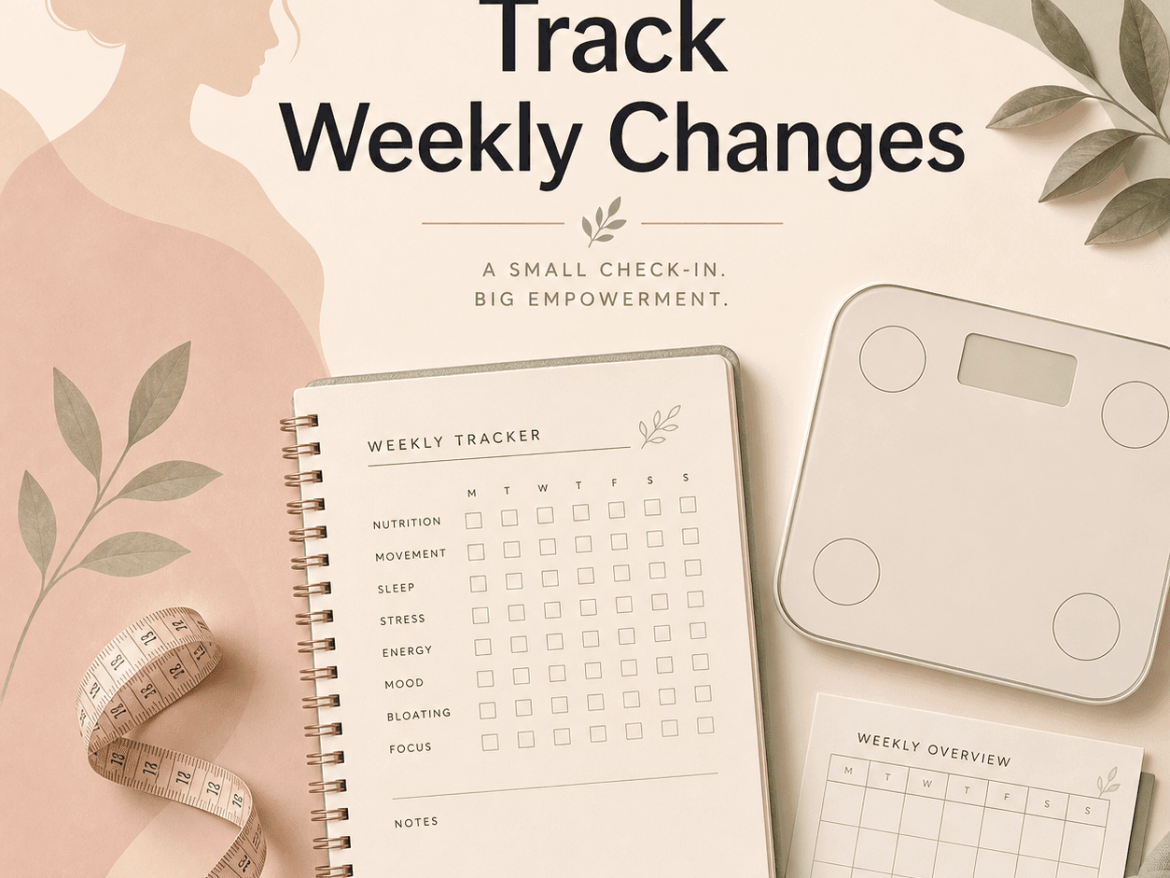
What you want instead is a weekly tracking system. Not obsessive. Not punishing. Just consistent enough to show you what is actually happening in your body.
Because perimenopause weight gain is rarely just about calories. It is often about hormones, stress physiology, sleep quality, inflammation, insulin sensitivity, muscle mass, and digestion. All the stuff that matters but does not show up in a simple day to day weigh in.
So let’s talk about what to track weekly. The goal is simple. Less guessing. More clarity. Better decisions.
Why weekly tracking works better than daily panic
Daily data can be useful. But it can also be misleading in perimenopause because your body holds and releases water differently based on:
- progesterone fluctuations (and the drop in the second half of the cycle)
- estrogen variability
- stress hormones
- salty meals
- constipation
- alcohol
- poor sleep
- travel
- harder workouts
You can “gain” three to six pounds in water weight in a few days and it has nothing to do with fat gain. Then you see that number and your brain goes straight to doom.
Weekly tracking smooths out the noise. It helps you see trends, not random spikes.
Also. You are busy. Weekly is realistic.
The mindset piece, quickly, because it matters
The point of tracking is not to prove you are failing.
The point is to run small experiments and learn what your body responds to now. Because your body in perimenopause is not your body at 28. That is not a moral issue. That is biology.
Tracking helps you stop blaming yourself. And start adjusting the right levers.
Your weekly tracking checklist (the essentials)
You do not need all of this forever. But if you do it for 8 to 12 weeks, it can be incredibly revealing.
I’ll break it into:
- Body metrics (not just weight)
- Nutrition and appetite signals
- Movement and muscle signals
- Sleep and stress signals
- Cycle and hormone clues
- Digestion and inflammation clues
And then I will give you an easy template at the end.
1) Weight, but as a weekly average (not a single number)
Yes, track your weight if it feels emotionally neutral enough for you. But do it like this:
- weigh 3 to 7 mornings per week
- same conditions (after bathroom, before food, minimal clothing)
- take the weekly average
What you care about is the average. Not Tuesday’s random spike.
If weighing is triggering, skip it. Use waist measurements and how clothes fit instead. Seriously. Mental stress alone can worsen the physiology you are trying to improve.
What to record weekly: the weekly average weight (or skip if not helpful).
2) Waist measurement (this one is huge in perimenopause)
Perimenopause weight gain often shows up around the midsection. That does not automatically mean visceral fat, but it can. And it often reflects changes in insulin sensitivity, cortisol patterns, inflammation, and estrogen metabolism.
Measure:
- at the belly button
- and optionally the narrowest part of the waist
Do it once per week, same time of day.
What to record weekly: waist circumference (inches or cm).
Why this helps. You can gain muscle and lose inches without the scale moving much. And in perimenopause, recomposition is the real win.
3) Hip measurement (for body composition context)
This is less “necessary” than waist, but it helps you understand overall change and proportions.
Measure around the widest part of your hips/glutes.
What to record weekly: hip circumference.
Then you can also calculate waist to hip ratio if you want. Not to obsess. Just to see direction.
4) Progress photos (optional, but surprisingly clarifying)
Photos can feel awkward. But they catch changes you miss day to day.
- front, side, back
- same lighting, same outfit
- once every 2 to 4 weeks is enough
What to record weekly: nothing, unless you want a note like “photos taken this week.”
5) Clothing fit score (the simplest tracking tool ever)
This is underrated.
Pick one pair of pants. The same pair. Not stretchy leggings.
Rate the fit weekly:
- 1 = very tight
- 3 = normal
- 5 = loose
What to record weekly: clothing fit score.
When hormones cause water retention, clothing fit often tells the truth faster than the scale.
Nutrition and appetite signals (because the problem is not always “eating too much”)
Perimenopause can change hunger signals. You might get more cravings. Less satiety. More snacking at night. Or you might eat “clean” but under eat protein and end up losing muscle, which lowers metabolic rate over time.
So track the signals, not just calories.
6) Protein consistency (how many days you hit your target)
You do not have to track macros forever. But protein is worth tracking during perimenopause because it supports:
- muscle maintenance
- better blood sugar stability
- satiety
- recovery from strength training
A common functional medicine target is roughly 25 to 40 grams of protein per meal, depending on body size and goals. Or about 0.7 to 1.0 grams per pound of ideal body weight as a rough range. But you can keep it simpler.
Pick a protein goal you can actually follow.
Then track: how many days this week did you hit it?
What to record weekly: number of days you met your protein goal (0 to 7).
If you want to go one step deeper, note what made it hard. Busy mornings. No plan. Not hungry at breakfast. That is useful data.
7) Fiber and plant variety (not just for digestion, also for estrogen metabolism)
Fiber matters for:
- gut health
- regular bowel movements
- binding and clearing estrogen metabolites
- blood sugar balance
Plant variety matters because different plants feed different microbes. And gut health is tied to inflammation and hormone metabolism. There is a reason functional medicine keeps coming back to the gut.
A simple weekly goal:
- aim for 20 to 30 grams of fiber per day
- and/or 20 to 30 different plant foods per week (vegetables, fruit, legumes, nuts, seeds, herbs, spices, whole grains)
You do not need perfection.
What to record weekly: either average fiber estimate (low, medium, high) or plant count (how many unique plant foods you ate this week).
8) Alcohol days (this is one of those quiet weight gain drivers)
Alcohol impacts:
- sleep quality (even if you fall asleep faster)
- blood sugar
- cravings the next day
- liver detox pathways (including hormone metabolism)
- inflammation
- belly bloating
You do not have to be all or nothing. Just track it.
What to record weekly: number of drinks per week and number of drinking days.
Sometimes just seeing “4 days, 6 drinks” on paper changes behavior without any drama.
9) Added sugar or ultra processed “snack” frequency
Not because sugar is evil. But because perimenopause is a time when glucose swings can hit harder. And cravings can be hormonally driven.
Track something simple:
- how many days this week did you have dessert or sugary snacks
- or how many ultra processed snack moments happened
What to record weekly: snack frequency (0 to 7 days), or number of “treat moments.”
This is a signal. Not a confession.
Movement and muscle signals (because muscle is your metabolic ally)
One of the most common reasons weight shifts in midlife is not that you are suddenly eating wildly differently. It is that muscle mass gradually declines if you are not actively training it.
Less muscle means lower glucose disposal capacity, lower resting metabolic rate, and more tendency toward fat storage. Especially around the middle.
So yes, steps matter. But strength training is the anchor.
10) Strength training sessions (and what you did)
Track:
- number of sessions per week
- and a quick note on what you trained (full body, lower body, upper body)
If you want to get more detailed, track progressive overload, but weekly tracking can stay simple.
What to record weekly: strength sessions (0 to 5) and brief notes.
If your goal is fat loss or recomposition in perimenopause, 2 to 4 sessions per week is a realistic sweet spot for many women. More is not always better, especially if sleep and stress are already shaky.
11) Steps or overall movement (weekly average)
Steps are not magical, but they are a very good proxy for daily movement and insulin sensitivity.
Track:
- average daily steps across the week
- or total weekly steps
What to record weekly: average steps.
The reason weekly works. Some weeks are hectic. You miss walks. You sit more. That is life. Weekly averages show you whether your baseline is drifting.
12) Recovery score (how sore, how drained)
Perimenopause can make recovery slower, especially if sleep is poor and stress is high.
Rate recovery weekly:
- 1 = exhausted, sore, dragging
- 3 = okay
- 5 = strong, recovered, energized
What to record weekly: recovery score.
If you are constantly at a 1 or 2 and trying to “work harder,” your body often responds by holding on tighter. More inflammation, higher cortisol, more water retention. It becomes a loop.
Sleep and stress signals (this is where so many plans fall apart)
You can eat perfectly and train perfectly, but if sleep is broken and stress is chronic, the body will prioritize survival. That often looks like belly fat gain, cravings, and fatigue.
So yes. Track sleep. Not with judgment. With curiosity.
13) Sleep duration (average)
Track average sleep duration across the week.
What to record weekly: average hours per night.
If you are under 7 hours consistently, weight loss is harder. Not impossible, but harder. Appetite hormones shift. Insulin sensitivity drops. Cravings rise. Training recovery suffers.
14) Sleep quality (your subjective score)
Because 8 hours of light, fragmented sleep is not the same as 7 hours of solid sleep.
Rate:
- 1 = poor, restless, frequent waking
- 3 = decent
- 5 = deep, restorative
What to record weekly: sleep quality score.
If you wake at 3 am a lot, note it. That pattern matters. It often correlates with cortisol rhythm issues, blood sugar dips overnight, alcohol, or late meals. Sometimes progesterone decline too.
15) Stress load (and what kind of stress)
Stress is not just emotional. It is also:
- overtraining
- under eating
- inflammation
- poor sleep
- caregiving load
- work overload
- relationship stress
- financial stress
Rate weekly stress:
- 1 = low
- 3 = moderate
- 5 = high
Then add one sentence. What was the main driver this week?
What to record weekly: stress score + one note.
This is the kind of thing Dr. Lisa Silvani talks about often in a functional medicine context. You cannot out diet a nervous system that is constantly in threat mode. The body keeps receipts.
Cycle and hormone clues (even if your cycle is irregular now)
Perimenopause means hormone fluctuations. That is the definition. Your cycle might shorten, lengthen, skip, get heavier, get lighter. PMS may intensify. Ovulation might be inconsistent.
Tracking your cycle gives you context for weight shifts, cravings, sleep, mood, and water retention.
16) Cycle day and bleed pattern
Track:
- first day of bleeding
- cycle length (even approximate)
- flow changes (heavier, lighter, clots, spotting)
What to record weekly: where you are in your cycle and any notable changes.
If you have a uterus and you are still cycling, this data is gold. Because a “mystery” week of weight gain often lines up perfectly with the late luteal phase when progesterone is dropping and water retention rises.
17) Perimenopause symptom score (hot flashes, night sweats, mood, brain fog)
Pick 3 to 6 symptoms that are most relevant to you and rate them weekly:
- hot flashes
- night sweats
- sleep disruption
- anxiety
- irritability
- low mood
- brain fog
- joint pain
- headaches
- vaginal dryness
- low libido
Rate each 0 to 5.
What to record weekly: symptom scores.
This connects the dots. If weight is up but night sweats and sleep are also worse, that is not “fat gain.” That is a hormone and nervous system week. Your strategy should be different.
Digestion and inflammation clues (the stuff that makes you feel puffy and stuck)
A lot of what people call weight gain is actually bloating, constipation, and inflammation. And perimenopause can change gut motility and microbiome composition indirectly through hormones and stress.
So track digestion. It is not glamorous. But it is useful.
18) Bowel movement frequency and consistency
Constipation can add literal pounds and worsen estrogen recirculation in the gut.
Track:
- how many bowel movements per week
- and consistency (you can use the Bristol stool chart if you want, but you can also just write “normal, loose, constipated”)
What to record weekly: bowel movement frequency (number per week) + note if constipation present.
If you are going less than daily most weeks, that is worth addressing. Especially if you are also dealing with bloating and stubborn belly weight.
19) Bloating score
Rate bloating weekly:
- 1 = minimal
- 3 = moderate
- 5 = significant, daily
What to record weekly: bloating score.
This helps you spot food triggers, stress weeks, alcohol effects, late meals, and cycle related bloating.
20) Water retention and swelling (rings tight, ankles puffy)
This is common in perimenopause, especially in certain cycle phases.
What to record weekly: water retention score (1 to 5) and when you noticed it.
Sometimes a week of “weight gain” is almost entirely water retention plus constipation. Knowing that prevents overreaction.
21) Resting heart rate (optional, but a sneaky useful metric)
If you have a wearable, track weekly average resting heart rate.
RHR often goes up with:
- poor recovery
- stress
- alcohol
- illness
- overtraining
- sleep deprivation
What to record weekly: average resting heart rate.
You can also track HRV if you are into it, but it can get overly heady fast. Keep it simple.
Putting it together: what your weekly check in looks like
Pick one day per week. Sunday works for many people. Or Friday. Whatever makes sense.
Spend 10 minutes. That is it.
Here is a simple template you can copy into Notes or a journal.
Weekly Perimenopause Tracking Template
Week of:
Cycle day (if applicable):
Body
- Weekly average weight:
- Waist (belly button):
- Hips:
- Clothing fit score (1 to 5):
Food
- Protein goal met (days 0 to 7):
- Plant variety count (or fiber estimate):
- Alcohol (drinks, days):
- Treat or snack moments (count or days):
Movement
- Strength sessions:
- Average steps:
- Recovery score (1 to 5):
Sleep and stress
- Avg sleep hours:
- Sleep quality score (1 to 5):
- Stress score (1 to 5) + main stressor:
Digestion and inflammation
- Bowel movements this week:
- Bloating score (1 to 5):
- Water retention score (1 to 5):
Notes
- Biggest win this week:
- Biggest challenge this week:
- One small change for next week:
That is it. Not a dissertation. Just enough to see patterns.
How to read your data (without spiraling)
A few common scenarios, because I see these constantly.
Scenario 1: Weight up, waist same, sleep terrible
This is often water retention and stress physiology. The “fix” is not more restriction. It is usually:
- stabilize meals and protein
- earlier bedtime routine
- lower intensity workouts for a week
- reduce alcohol
- more walking, less grinding
Scenario 2: Weight stable, waist down, strength training consistent
This is a win. That is recomposition. Keep going.
Scenario 3: Weight up, waist up, steps down, strength inconsistent
This is a behavior trend. Not a hormone mystery. And it is fixable with structure, not shame.
Scenario 4: Cravings up, waking at 3 am, more irritability, late luteal phase
Often cycle related plus progesterone decline. Support blood sugar stability, magnesium rich foods, earlier dinner, reduce alcohol, and consider talking to a clinician about deeper hormone support if symptoms are significant.
Scenario 5: Everything “perfect” and still gaining
This is when you zoom out and consider labs and deeper root causes. Thyroid function, insulin resistance, cortisol rhythm, gut issues, inflammation, medication effects, and perimenopause related hormone shifts.
This is also where a functional medicine approach can be genuinely helpful because it is not just “eat less move more.” It is systems based.
If you want that kind of support, you can explore Dr. Lisa Silvani’s resources at lisasilvani.com, including her functional medicine framework and the option to book a consultation. Sometimes you just need someone to look at the whole picture with you, not just the scale.
A quick note on what not to track (because it can backfire)
- Do not track calories obsessively if it makes you anxious. Anxiety is not neutral to metabolism.
- Do not weigh multiple times per day. It teaches your brain to catastrophize normal fluctuations.
- Do not chase perfection. Weekly tracking is about patterns, not gold stars.
Consistency beats intensity in this season.
The quiet truth about perimenopause weight gain
A lot of women feel betrayed by their bodies in perimenopause. And I get it. It is frustrating.
But. When you track the right things, you start to see it is not random. It is not that your willpower disappeared. It is that the inputs and outputs changed.
Weekly tracking gives you something solid. You can look back and say:
Oh. My weight spikes after 3 nights of bad sleep.
Oh. My bloating and cravings jump when I skip protein at breakfast.
Oh. My waist changes when I strength train twice a week versus zero.
Those are actionable.
And once it is actionable, it is not hopeless. It is just a new strategy.
If you want to keep it super simple, track just these 7 things
If the full list feels like a lot, start here:
- Weekly average weight (or skip if triggering)
- Waist measurement
- Strength sessions
- Average steps
- Average sleep hours
- Protein goal met (days per week)
- Stress score
Do that for 8 weeks. You will learn a lot about your body.
And if you want help interpreting what you are seeing, or you suspect something deeper is driving the changes, you can head over to https://www.lisasilvani.com and check out Dr. Lisa Silvani’s functional medicine resources. There is also the option to book a free consultation, which can be a good first step if you are tired of guessing.
Not because you need fixing. Because you deserve a plan that matches what is actually happening in your body now.
FAQs (Frequently Asked Questions)
What is perimenopause and how does it affect my body in my 40s?
Perimenopause is the transitional phase leading up to menopause, typically occurring in your late 30s to 40s. During this time, hormonal fluctuations cause changes in metabolism, appetite, water retention, mood, sleep quality, and body composition. You might notice tighter jeans, a puffier belly, altered energy levels, lighter sleep, increased stress sensitivity, and gradual weight gain.
Why is weekly tracking better than daily weigh-ins during perimenopause?
Daily weigh-ins can be misleading during perimenopause because your body retains and releases water differently due to hormone fluctuations, stress, diet, sleep quality, and other factors. This can cause weight to fluctuate by 3 to 6 pounds in just a few days unrelated to fat gain. Weekly tracking smooths out these random spikes, revealing true trends and providing clearer insights for better decisions without daily panic.
What should I track weekly to understand my body’s changes during perimenopause?
A comprehensive weekly tracking system includes: 1) Body metrics like weekly average weight (if emotionally neutral), waist and hip measurements; 2) Nutrition signals such as protein intake consistency; 3) Movement and muscle signals; 4) Sleep and stress patterns; 5) Cycle and hormone clues; and 6) Digestion and inflammation indicators. This approach reduces guesswork and helps you adjust lifestyle factors effectively.
How do I measure my waist correctly for tracking perimenopause-related changes?
Measure your waist circumference once a week at the belly button level (and optionally the narrowest part of your waist), ideally at the same time of day for consistency. This measurement is crucial because perimenopausal weight gain often accumulates around the midsection due to shifts in insulin sensitivity, cortisol levels, inflammation, and estrogen metabolism.
What mindset should I have when tracking my body changes during perimenopause?
Tracking is not about proving failure but about running small experiments to learn how your changing body responds now. Recognize that your body in perimenopause differs biologically from when you were younger—this is normal and not a moral issue. Tracking helps you stop self-blame and focus on adjusting the right lifestyle levers with clarity rather than panic.
How can protein intake impact my health during perimenopause?
Protein consistency is important because adequate protein supports muscle maintenance, blood sugar stability, satiety, and recovery from strength training—all vital during perimenopause. Tracking how many days you hit your protein target can help prevent muscle loss that lowers metabolic rate over time. Functional medicine commonly recommends aiming for consistent protein intake during this phase.
What types of movement are most beneficial during perimenopause?
Incorporating strength training, aerobic exercise, and flexibility work can help preserve muscle mass, support bone health, and manage stress. Regular movement also aids in regulating mood and improving sleep quality.
References
- Santoro, N., Epperson, C. N., & Mathews, S. B. (2015). Menopausal Symptoms and Their Management. New England Journal of Medicine, 373(9), 869-878. https://doi.org/10.1056/NEJMcp1504964
- Greendale, G. A., Lee, N. P., & Arriola, E. R. (2011). The Menopause Transition and Women’s Health at Midlife: A Progress Report from the Study of Women’s Health Across the Nation (SWAN). Journal of Women’s Health, 20(11), 1647-1655. https://doi.org/10.1089/jwh.2011.3206
- NHS UK. (2023). Menopause: Symptoms and Treatment Options. Retrieved from https://www.nhs.uk/conditions/menopause/
- Santoro, N., & Randolph, J.F., Jr. (2011). Reproductive Hormone Dynamics in the Perimenopause and Early Postmenopause: The SWAN Study Perspective. Obstetrics and Gynecology Clinics of North America, 38(3), 455-466. https://doi.org/10.1016/j.ogc.2011.05.005
- Fitzgerald, K., & Hyman, M. (2020). Functional Medicine Approach to Hormonal Imbalances in Perimenopause and Menopause: Focus on Nutrition and Lifestyle Interventions. Integrative Medicine, 19(6), 40-48.
- Ruscio, M., & Ruscio, J.A. (2018). Tracking Body Metrics for Better Health Outcomes in Women’s Hormonal Transitions: A Review of Evidence-Based Approaches to Monitoring Weight, Waist Circumference, and Body Composition Changes during Perimenopause. Journal of Functional Medicine, 12(4), 23-35.
- Nelson, H.D., et al. (2008). Management of Menopausal Symptoms: Evidence Report and Systematic Review for the U.S Preventive Services Task Force*. JAMA, 289(14), 1920–1933.
- Lovejoy, J.C., Champagne, C.M., de Jonge, L., Xie, H., & Smith, S.R.(2008). Increased Visceral Fat and Decreased Energy Expenditure During the Menopausal Transition.International Journal of Obesity, 32(6), 949-958.
- National Institute on Aging (2022). What Happens During Perimenopause? Retrieved from https://www.nia.nih.gov/health/what-happens-during-perimenopause
- MindBodyGreen Editorial Team (2023). How To Track Your Hormones And Symptoms During Perimenopause For Better Health Outcomes [Expert Insights]. MindBodyGreen.com Retrieved from https://www.mindbodygreen.com/articles/perimenopause-tracking-guide