
 dr. Lisa Silvani
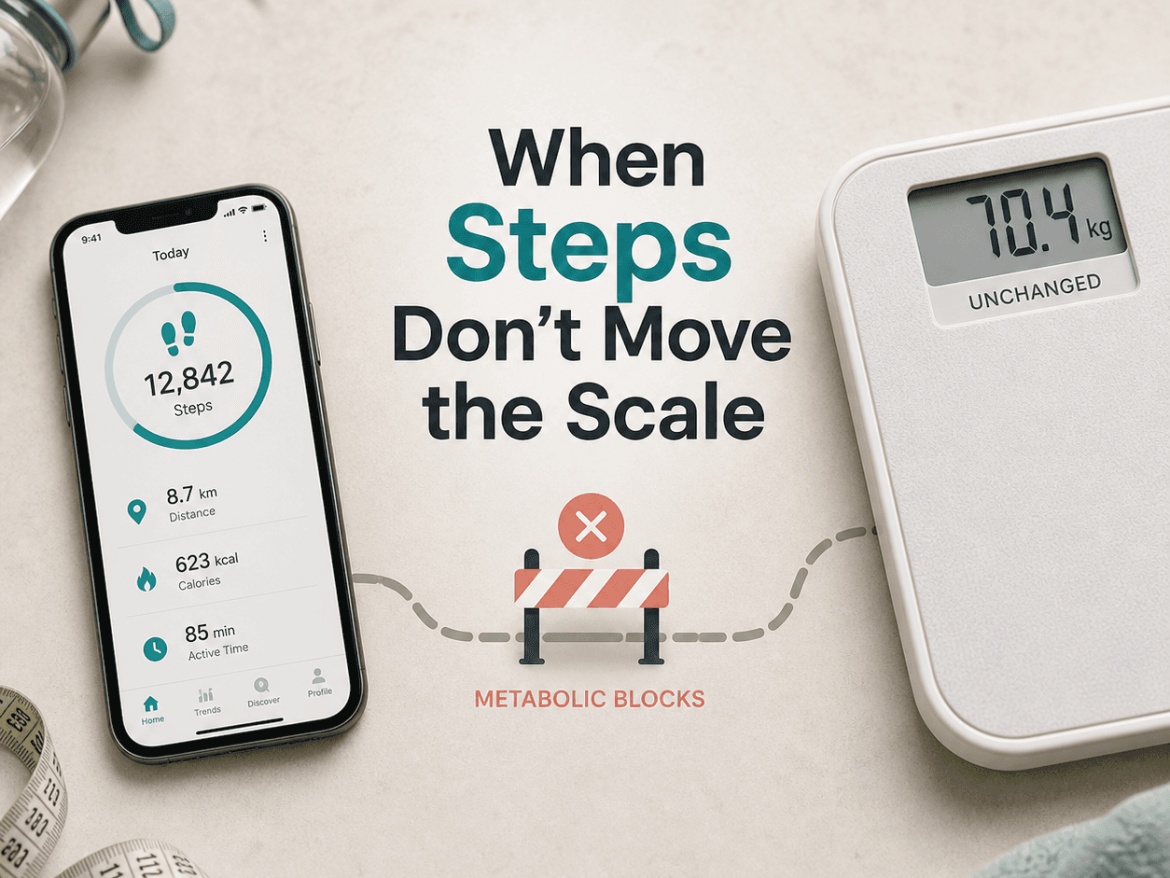
 If you have a step goal, and you hit it. Most days. And the scale still sits there like it is glued down.
Yeah. That is a real thing.
And before we blame willpower or “not trying hard enough”, I want to zoom out a bit. Because steps are not useless, not even close. Walking is one of the best health habits we have. But for weight loss, steps can get quietly cancelled out by metabolic blocks that have nothing to do with motivation.
This is especially common if you are tired all the time, wired at night, hungry in a weird way, or you feel like your body is “holding on” no matter what you do.
Let’s talk about what might be going on.
Steps help. But they are a small lever for fat loss
Walking increases daily energy expenditure. It improves insulin sensitivity. It supports lymph flow. It helps stress. It is great for appetite regulation for some people.
But.
A 20 to 40 minute walk often burns less than people think, and the body is very good at compensating when other systems are under pressure. You may move more and then unconsciously:
- Sit more the rest of the day (NEAT drops)
- Feel hungrier and snack a little extra
- Sleep worse (if stress hormones are already high)
- Hold more water (especially if inflammation is high)
Also, the scale is not only measuring fat. It is measuring water, glycogen, food volume, hormones, inflammation. All of it.
So if steps are going up and the scale is not budging, that does not automatically mean steps “aren’t working”. It can mean something else is overriding the signal.
That “something else” is usually metabolic, hormonal, or mitochondrial energy related.
Metabolic blocks: the big picture
When people say “my metabolism is broken”, it is often not literally broken. It is adaptive. It is responding to perceived stressors.
Common stressors include:
- Chronic under eating or yo yo dieting
- Poor sleep or sleep apnea
- High stress, caregiving, burnout
- Blood sugar swings
- Perimenopause or menopause shifts
- Thyroid issues (even borderline)
- Inflammation, gut issues, food intolerances
- Certain medications
- Low muscle mass
- Low protein, low micronutrients
- Low cellular energy output (mitochondrial strain)
Walking alone cannot always fix those. Sometimes it helps. Sometimes it is not enough.
Below are the most common metabolic blocks that make steps feel pointless.
1. You are compensating without realizing it (NEAT and appetite)
This one is sneaky.
You hit 10,000 steps, and later you “deserve” a little treat. Or you are just more snacky. Or you are tired and you crash on the couch the rest of the day. None of this is a moral failure. It is physiology.
Two things happen commonly:
NEAT drop
NEAT is non exercise activity thermogenesis. All the random movement. Standing, pacing, cleaning, fidgeting, taking stairs.
If your walk is new, the body may reduce NEAT later to preserve energy. So the net calorie burn is smaller than you think.
Appetite increase
Walking can improve appetite regulation long term, but in the short term, if you are already under fueled, stressed, or not eating enough protein, you may get hungrier and unintentionally erase the deficit.
What helps here is not more steps. It is tracking patterns for a week or two. Are you getting snacky after walks? Are you eating “healthy” but not enough protein? Are you saving calories all day then raiding at night?
You do not need perfection. You need data.
2. Stress hormones are driving water retention and fat storage signals
If you are living in constant go mode, cortisol is often elevated or dysregulated. Not always high all day, it can be high at the wrong times.
Chronic stress can lead to:
- More cravings for quick energy foods
- Poor sleep, which further worsens hunger hormones
- Higher water retention (scale won’t move)
- More abdominal fat storage signaling over time
- Impaired thyroid conversion (in some people)
- Increased inflammation
And here is the frustrating part. If cortisol is high, adding more exercise can backfire. Even if it is “just walking”, if you are pushing hard, doing long fasted walks, or walking late at night when your body should be winding down.
So the step goal becomes another stressor. Another box to tick. Another thing you fail at when you are exhausted.
A better approach sometimes is: keep walking, but change the intensity and the timing. More easy walks. Sunlight in the morning. Post meal walks. Gentle, consistent.
And also. Sleep. Which we are going to get to.
3. Poor sleep is basically a weight loss block all by itself
You can hit every step goal, eat clean, do everything right. And if you are sleeping 5 to 6 hours, or waking at 2 to 3 am, weight loss becomes an uphill battle.
Why?
Because sleep loss affects:
- Ghrelin (hunger goes up)
- Leptin (satiety goes down)
- Insulin sensitivity (worse glucose control)
- Cortisol (higher and more erratic)
- Cravings (especially for carbs and salty foods)
- Recovery (more inflammation, more water retention)
Also, tired brains make tired choices. Again, not willpower. Biology.
If fatigue is part of your story, I would take this seriously. Not in a scary way. In a practical way.
On Dr. Lisa Silvani’s site, Reviva Health and Wellbeing, the whole lens is basically “energy first”. Meaning, if your cellular energy is struggling, everything else is harder. Weight loss included. If you have not done it yet, the Fatigue Root Cause quiz on her website can be a useful starting point to see what might be draining your system. It is quick, and it helps you stop guessing.
4. Blood sugar swings can make steps irrelevant
When blood sugar is spiking and crashing, your body is on a rollercoaster. You feel hungry faster. You crave quick energy. You may feel shaky, anxious, foggy, or irritable.
And if insulin is elevated often, fat loss gets harder because insulin is a storage hormone. That does not mean insulin is “bad”. It means chronically high insulin can block access to stored fat.
Signs this might be you:
- You get sleepy after meals
- You crave sugar after lunch or dinner
- You wake up hungry at night
- You cannot go long between meals without getting edgy
- You are “good” all day then snack hard at night
Walking helps glucose control, especially 10 to 15 minutes after meals. That is one of the best uses of steps for weight loss.
But if meals are very carb heavy with low protein and low fiber, or you are doing long fasted walks and then overeating later, you can still be stuck.
A simple lever: build meals around protein first, then add fiber, then carbs and fats in a way that works for your body. You do not need to cut carbs to zero. You need steadier glucose.
5. You are under eating or dieting too aggressively (metabolic adaptation)
This is common in people who “do all the right things” but nothing happens.
If you have been in calorie restriction for a long time, or bouncing between strict dieting and overeating, the body adapts. It becomes more efficient. Thyroid signaling can downshift. NEAT drops. Hunger increases. Muscle loss can occur.
And your steps. Your steps become part of the burn that your body tries to offset.
This is why some people lose weight walking at first, then plateau hard. The body learns. It is not trying to sabotage you. It is trying to keep you alive.
Sometimes the best move is not “eat less and walk more”. It is:
- Increase protein
- Strength train to rebuild metabolic tissue
- Take breaks from dieting
- Improve sleep
- Reduce stress load
- Ensure micronutrients are sufficient (iron, B12, magnesium, iodine, selenium, zinc, etc)
Basically. Support the engine.
6. Low muscle mass: steps don’t build the tissue that raises your resting burn
Walking is amazing, but it does not build much muscle for most people. And muscle is not just about aesthetics. Muscle is metabolic. It is glucose storage. It is resilience. It is one of the strongest predictors of healthy aging.
If you are losing weight without strength work, you can lose muscle along with fat. That lowers resting metabolic rate and makes future weight loss harder.
If you are walking a lot and not seeing progress, adding 2 to 4 days of strength training per week often changes everything. Not instantly. But steadily.
Even simple stuff counts:
- Squats to a chair
- Step ups
- Rows
- Pushups on a counter
- Dead bug or planks
- Carrying groceries on purpose
You do not need to destroy yourself in the gym. You need progressive tension and consistency.
7. Hormone shifts in perimenopause and menopause change the rules
For many women, the “steps used to work” and then suddenly they don’t.
Perimenopause can bring:
- Lower estrogen and progesterone fluctuations
- More insulin resistance tendency
- More central fat storage
- Worse sleep
- Higher stress sensitivity
- Changes in appetite and recovery
So the old formula of lots of cardio and eating less may stall, or even worsen things.
What tends to work better here:
- Strength training becomes non negotiable
- Protein target goes up
- Alcohol tolerance often goes down (sleep and glucose get hit)
- Stress management matters more than ever
- Walking stays, but it is a support habit, not the main plan
If this is you, you are not imagining it.
8. Thyroid and nutrient issues: you can’t out walk low thyroid signaling
If thyroid function is low, even mildly, weight loss can be harder. Not impossible. Just harder. You may also feel cold, constipated, puffy, depressed, sluggish, losing hair, or your skin feels dry.
Also, nutrient deficiencies can mimic or worsen metabolic slowdown:
- Iron deficiency can cause fatigue and exercise intolerance
- Low B12 can cause low energy and nerve symptoms
- Low vitamin D is linked with metabolic dysfunction in many people
- Low magnesium affects sleep and glucose handling
This is where labs matter. Not random supplements. Real testing, interpreted in context.
If fatigue is present, it is worth exploring root causes. Again, that is a big theme on LisaSilvani.com, and it is honestly refreshing because so much weight loss advice ignores fatigue like it is just an inconvenience.
9. Inflammation and gut issues can keep the scale up even when fat is going down
You can be losing fat and not seeing it because inflammation is keeping water weight up.
Common drivers:
- Highly processed foods and seed oil heavy diets (for some people)
- Food sensitivities
- Alcohol
- Overtraining
- Poor sleep
- Chronic stress
- Constipation
- Gut dysbiosis
- Autoimmune conditions
Also, if your digestion is slow and you are constipated, the scale will not reflect progress.
This is why measurements, how clothes fit, and energy levels matter. The scale is only one tool.
10. You are walking, but you are not recovering (and your body stays in “hold” mode)
This is the fatigue piece again.
If your body’s energy system is strained, weight loss can feel like pushing a boulder. Because fat loss requires energy to mobilize fat, process it, and recover from the stress of a deficit.
If your mitochondria are struggling, you can see patterns like:
- You crash after exercise, even gentle
- You need caffeine to function
- You wake up tired
- You feel better at night (second wind)
- You have brain fog, headaches, low motivation
In those cases, the first win is not more steps. It is improving sleep quality, nutrient status, and stress resilience so your body feels safe enough to let go.
Dr. Lisa Silvani’s book Fatigue to Fit goes deep into this energy centered view, and if your weight loss struggle is tangled up with chronic fatigue, it is a solid resource to connect dots that most programs ignore.
So what should you do with your steps?
Keep them. Just use them smarter, and stop expecting them to carry everything.
Here is a practical way to troubleshoot without spiraling.
A simple checklist to unblock progress (without walking more)
1) Shift from “step goal” to “step rhythm”
Instead of one big walk, try:
- 5 to 15 minutes after meals (especially dinner)
- A short morning walk outside for light exposure
- Easy pace, nasal breathing if possible
This supports glucose and stress. Less wear and tear.
2) Hit a protein floor
Most people under eat protein. A lot.
A simple target many do well with is 25 to 40g per meal, depending on body size and goals. If that feels like too much math, start by adding a clear protein source at breakfast. That alone can reduce cravings later.
3) Strength train twice a week to start
Do not overcomplicate it. Full body. Basic moves. Progress slowly.
If you already walk, strength training is often the missing piece that changes body composition.
4) Improve sleep like it is your job
Pick one or two:
- Same wake time most days
- Morning sunlight in your eyes for 5 to 10 minutes
- Caffeine cutoff (try 10 am to start if sleep is bad)
- A boring wind down routine
- Dark, cool room
If you are waking at 2 to 3 am consistently, or snoring, or you suspect apnea, get evaluated. That alone can be the entire block.
5) Manage stress load, not just stress “feelings”
Sometimes you are not anxious. You are just doing too much.
Look at your week and ask: where can I remove one drain? One obligation. One late night. One extra workout. One scroll session that steals sleep.
Your physiology counts load, not intentions.
6) Consider labs if you have fatigue + plateau
Especially if you have symptoms. Thyroid panel, iron studies, B12, vitamin D, glucose and insulin markers, lipids, inflammation markers. Work with a clinician who will interpret patterns, not just flag “normal”.
The real takeaway
Steps are a great habit. They are not a complete plan.
If walking is not helping you lose weight, it is often because your body is dealing with a metabolic block. Stress hormones, poor sleep, blood sugar swings, low muscle, perimenopause shifts, thyroid or nutrient issues, inflammation, low cellular energy.
So the fix is not always “more steps”.
Sometimes the fix is finally supporting the engine.
If fatigue is part of your picture and you want a structured way to identify what is draining your energy and slowing progress, head to Reviva Health and Wellbeing (Dr. Lisa Silvani) at https://lisasilvani.com/ and check out the Fatigue Root Cause quiz. It is a good next step, and for once, it is actually about the root cause. Not just grinding harder.
FAQs (Frequently Asked Questions)
Why am I hitting my step goal daily but not losing weight?
Hitting your step goal is great for health, but weight loss involves more than just steps. Factors like metabolic blocks, hormonal imbalances, water retention, and compensatory behaviors such as increased appetite or reduced non-exercise activity (NEAT) can offset the calories burned through walking. The scale also reflects water, glycogen, inflammation, and more—not just fat.
How does compensating behavior affect weight loss despite walking?
When you walk more, your body might compensate by reducing other activities (NEAT) like standing or fidgeting, or by increasing appetite leading to extra snacking. These unconscious adjustments can negate the calorie deficit created by walking. Tracking your patterns around hunger and activity can help identify these compensations.
Can stress hormones like cortisol impact my weight loss efforts?
Yes. Chronic stress elevates cortisol levels which can increase cravings for quick energy foods, cause water retention (making the scale stay the same), promote abdominal fat storage, impair thyroid function, and increase inflammation. Excessive or poorly timed exercise can even worsen stress responses.
Why is poor sleep a major barrier to losing weight even if I walk regularly?
Poor sleep disrupts hunger hormones (increases ghrelin and decreases leptin), reduces insulin sensitivity leading to blood sugar issues, raises cortisol levels, increases cravings especially for carbs and salty foods, and hampers recovery causing inflammation and water retention. These effects make weight loss much harder regardless of physical activity.
How do blood sugar swings interfere with the effectiveness of walking for fat loss?
Frequent blood sugar spikes and crashes put your body on a rollercoaster that increases hunger faster and promotes fat storage signals. This undermines the calorie-burning benefits of walking because you may eat more in response to these swings.
What strategies can help overcome metabolic blocks when steps alone aren’t enough for weight loss?
Addressing metabolic blocks involves more than increasing steps: manage stress with gentle, consistent walks preferably in the morning; prioritize quality sleep; monitor nutrition ensuring adequate protein and micronutrients; avoid chronic under eating; consider underlying health issues like thyroid function; and track behaviors to reduce compensations like NEAT drop or increased snacking. Using tools like fatigue root cause quizzes can provide personalized insights.