 vanilis
 You train. You hit your steps. Your resting heart rate looks “fine”. Your blood work is usually not dramatic. You eat decently. You hydrate. You go to bed at a reasonable time. And yet.
You wake up tired. Not always, but often. You feel like your sleep did not “stick”. You need coffee to become a person. Your mood is a little thinner than it used to be. Your workouts are taking more from you than they give back. You start blaming stress. Or perimenopause. Or your phone. Or you assume, well, I’m busy, who isn’t?
Here is the thing nobody says loudly enough.
Sleep apnea does not only happen to older men in larger bodies.
It shows up in fit women too. And it often hides in plain sight because the signs do not look like the classic textbook version. Even worse, the wearables we rely on can miss it, or reassure you with pretty graphs while your physiology is quietly struggling all night.
So let’s talk about what sleep apnea can look like in fit women, why your tracker might not catch it, and the sneaky signs that should make you pause.
Not panic. Just pause and connect a few dots.
First, what sleep apnea actually is (in human language)
Sleep apnea is when your breathing repeatedly slows or stops during sleep.
The most common type is obstructive sleep apnea, where the airway narrows or collapses. You try to breathe, but airflow is limited. Your oxygen can dip. Your brain senses the problem and partially wakes you up just enough to reopen the airway.
Sometimes you do not fully “wake up” and remember it. But your sleep gets fragmented. Again and again.
There is also central sleep apnea, where the brain’s signals to breathe are inconsistent. Less common, different causes. But in everyday life, when people say sleep apnea, they usually mean obstructive.
The important part is this.
It is not just snoring. It is not just being tired. It is repeated stress physiology during the night. A loop of oxygen dips, micro arousals, adrenaline pulses, and disrupted deep sleep and REM.
Which can mess with energy in a way that looks like a hundred other things.
Why fit women get missed
A few reasons. And honestly, it is frustrating.
1. The “wrong body type” stereotype
Many clinicians and many women themselves still associate sleep apnea with higher body weight. Weight can be a risk factor, yes. But anatomy, hormones, airway shape, jaw position, nasal resistance, connective tissue tone, and fluid shifts can matter a lot too.
You can be lean and strong and still have a narrow airway or a collapsible one.
2. Women often have different symptoms
Men are more likely to report loud snoring and obvious witnessed apneas. Women may report insomnia, anxiety, unrefreshing sleep, morning headaches, fatigue, and mood changes.
Sometimes the main complaint is “I can’t stay asleep” or “I wake up at 3 am wired”.
That can be sleep apnea. Not always. But it can.
3. Hormones change airway stability
Progesterone has a respiratory stimulant effect and can help maintain airway tone. As hormones shift in perimenopause and menopause, risk goes up. That does not mean young fit women are immune. But it does mean that a woman who never had issues can suddenly develop symptoms in her 40s, even without changing her weight.
4. Fitness can mask it, until it doesn’t
If you have a strong cardiovascular system, you may compensate for a while. You can still perform. You can still look healthy. But the cost can show up as stubborn fatigue, plateaued training gains, and that feeling of running on stress hormones.
You know that “tired but wired” vibe. That.
The wearable problem: why your tracker can miss sleep apnea
Wearables are useful. I like them. Many of my patients like them. They can help you notice patterns.
But they are not diagnostic tools for sleep apnea.
Here is why.
They measure proxies, not airflow
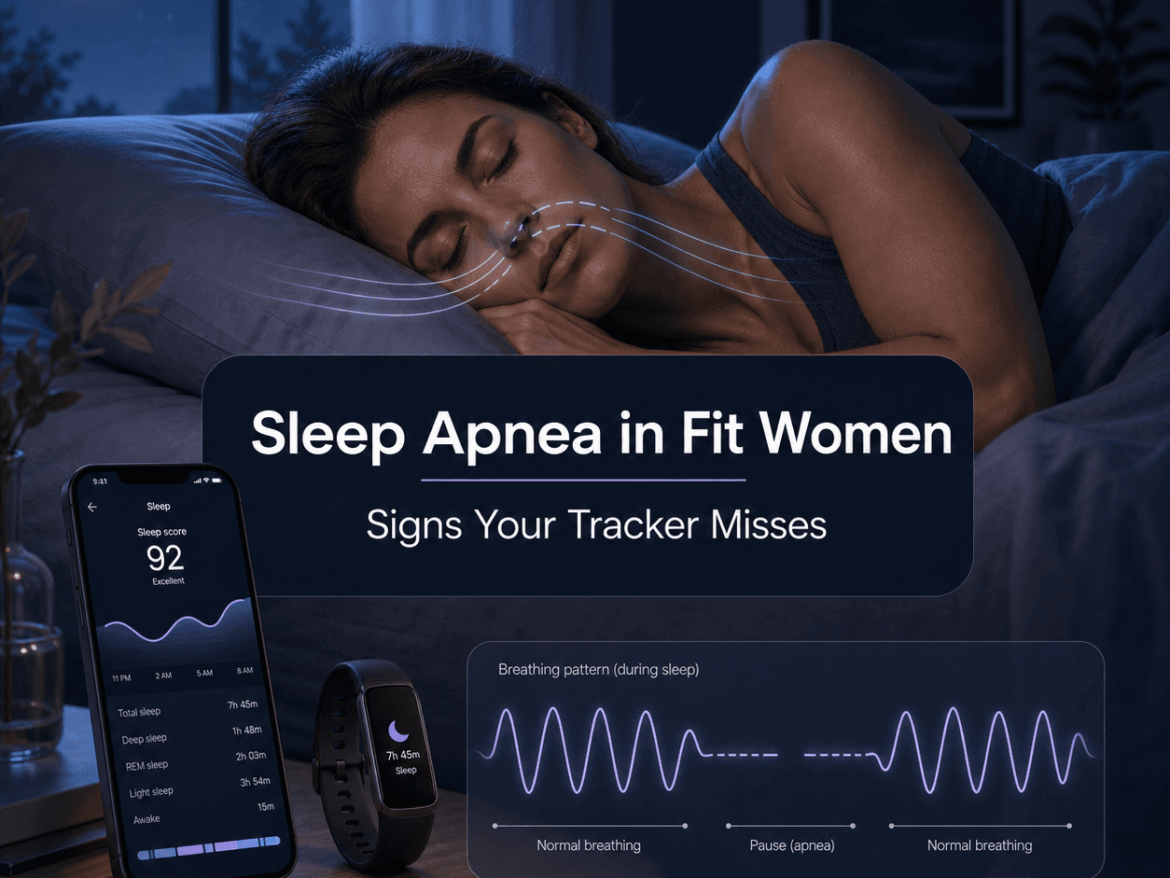
Most wearables do not measure breathing airflow at your nose and mouth, which is what you need to confirm an apnea or hypopnea event. They measure movement, heart rate, maybe skin temperature, sometimes SpO2 depending on the device.
But sleep apnea is about airflow limitation plus physiologic impact. You can have significant breathing disturbances without massive oxygen drops, especially in mild to moderate cases or in women who have more “flow limitation” and arousals than dramatic desaturations.
SpO2 on wearables is often averaged and smoothed
Even devices with oxygen tracking may sample intermittently, average values, or smooth out short drops. Apneas can cause brief dips that look like noise on a consumer sensor.
So you might see “95 to 98% all night” and think, great.
Meanwhile you had 20 micro arousals per hour. Oxygen may not have crashed, but sleep quality did.
Sleep staging is guesswork
Deep sleep and REM estimates are not the same as EEG measured sleep stages. If your tracker says you got “enough deep sleep”, it might still be wrong, especially if you have frequent arousals that do not involve big movements.
HRV can be confusing
HRV can drop with sleep apnea. But HRV also drops with stress, alcohol, under eating, overtraining, illness, late meals, travel, and a million other things.
A low HRV does not diagnose apnea. And a normal HRV does not rule it out.
In short, your tracker can be a clue, but it is not a gatekeeper. If symptoms fit, you do not ignore them because an app gave you a sleep score of 86.
The signs your tracker might not connect
This is the meat of it. The stuff that gets brushed off.
Not every sign means sleep apnea. But when several show up together, especially in a fit woman who “should” feel great, it is worth looking deeper.
1. You wake up tired even after a full night
You got 7 to 9 hours. You went to bed on time. You did all the good sleep hygiene things.
But you wake up feeling like you barely slept.
Unrefreshing sleep is one of the most common symptoms in women, and it is easy to mislabel as stress or insomnia.
2. Morning headaches or a heavy head feeling
Classic. Not always, but common.
It can be from carbon dioxide retention, sleep fragmentation, or poor oxygenation. Some women describe it as a pressure headache or “cotton head” rather than pain.
3. You wake up at night, often to pee
Nighttime urination is a sneaky one.
Sleep apnea can increase atrial natriuretic peptide and shift fluid handling, and the repeated arousals can also make you more aware of bladder signals. If you are waking to pee multiple times per week, and especially if it is more than once per night, do not just assume it is hydration or aging.
4. Anxiety that is worse in the morning
This one surprises people.
Sleep apnea can drive sympathetic activation. You can wake up with a racing mind, a sense of dread, or that weird internal buzz, even if nothing is “wrong” in your life.
If you feel calmer at night and more anxious in the morning, that pattern can be a clue.
5. You do not snore loudly, but you breathe “weird”
Many fit women do not have the dramatic, shaking-the-house snore.
Instead you might have:
- light snoring
- mouth breathing
- noisy breathing
- choking or gasping episodes (even rare)
- a partner who says you “stop breathing” sometimes, but you dismissed it because you are not the stereotypical patient
Also, some women sleep alone and have no idea what their breathing looks like.
6. Dry mouth, sore throat, or drooling
Mouth breathing at night can be a compensation for nasal resistance or airway issues.
A dry mouth on waking, or a sore throat that is not illness related, can be a flag. Not proof. A flag.
7. Bruxism (teeth grinding) or jaw tension
Grinding is often tied to arousals and airway effort. Your body does strange things to try to stabilize the airway. Clenching the jaw can be part of that.
If you have a night guard, TMJ symptoms, or you wake with jaw tension, put it on the list.
8. “I can’t lose fat like I used to” or “my cravings are wild”
Sleep fragmentation impacts hunger hormones, insulin sensitivity, and appetite regulation. If your nutrition has not changed much but your body composition is shifting, and you feel hungrier than your activity level should demand, sleep quality is worth investigating.
Sleep apnea is not the only cause. But it is a common overlooked one.
9. You’re fit but your blood pressure is creeping up
Especially diastolic blood pressure, or a pattern where your BP is borderline at the doctor but “fine at home”.
Sleep apnea is a known driver of hypertension. You do not need to be sedentary for this to happen.
10. Your training feels harder and recovery is worse
This one is huge for athletes and gym regulars.
Signs can look like:
- higher perceived exertion for the same workouts
- more soreness
- nagging injuries
- slower strength or endurance gains
- needing more stimulants to train
- feeling flat despite doing “everything right”
If your body is fighting for oxygen and waking itself repeatedly at night, recovery is going to suffer. Mitochondria do not love chronic stress signals. And this ties directly into what Reviva Health and Wellbeing focuses on: fatigue is often an energy problem at the cellular level, not a motivation problem.
11. Your tracker shows “good sleep” but your body disagrees
Maybe your sleep score is decent. Maybe your total sleep time looks fine.
But you feel wrecked.
That mismatch is a clue in itself. Wearables can be useful, but your lived experience still matters more than the dashboard.
12. GERD, reflux, or a burning throat at night
Reflux and sleep apnea often travel together. Negative pressure from struggling to breathe can pull acid up. And reflux can inflame the airway, worsening obstruction.
It becomes a loop.
13. You wake up suddenly, heart pounding
Sometimes it feels like a mini panic attack. Sometimes it feels like you “forgot to breathe”.
This can be apnea related. It can also be cortisol, blood sugar dips, nightmares, or anxiety.
But if it happens repeatedly, do not just label it anxiety and move on.
A quick note on “mild” sleep apnea
“Mild” on paper can still feel awful.
Because the apnea hypopnea index is just a count. It does not always reflect how disruptive the events are for your nervous system, or how sensitive you are to sleep fragmentation.
Some women have upper airway resistance syndrome, where airflow limitation causes frequent arousals without meeting the strict criteria for apneas. They can feel exhausted and still be told their test is “normal” or “borderline”.
So if you have symptoms and a test comes back reassuring but you still feel terrible, you keep going. You ask better questions. You find someone who understands female presentations.
What to do if this sounds like you
No dramatic overhauls. Start with a simple, practical path.
1. Get curious, not obsessive
Write down your symptoms for two weeks.
- morning energy (0 to 10)
- headaches
- nighttime waking
- bathroom trips
- dry mouth
- mood on waking
- training recovery
- any partner comments about breathing
Patterns matter more than one bad night.
2. Bring it up with your clinician, clearly
Instead of “I’m tired”, try:
- “I wake up unrefreshed most mornings despite 8 hours in bed.”
- “I wake with headaches and dry mouth.”
- “I wake up at night to pee 1 to 2 times.”
- “My partner has noticed pauses in breathing.”
- “I suspect sleep disordered breathing and would like testing.”
You are allowed to be specific. It helps.
3. Ask about a sleep study option that fits you
In many cases, a home sleep apnea test is a starting point. It can catch moderate to severe obstructive apnea pretty well.
But if symptoms are strong and a home test is negative, an in-lab polysomnogram can be more sensitive, and can evaluate other sleep issues too.
This is a conversation with your clinician or a sleep specialist. The goal is not to self diagnose. The goal is to get the right data.
4. Do not ignore nasal breathing
Even before testing, pay attention to nasal obstruction. Chronic congestion, a deviated septum, allergies, mouth breathing. These do not cause all sleep apnea, but they can worsen airflow and sleep quality.
If you cannot breathe well through your nose during the day, night breathing is not going to magically be perfect.
5. Look at the fatigue through a root cause lens
If you have been circling fatigue for months or years, sleep is one piece. Blood sugar, iron status, thyroid, mitochondrial function, nutrient sufficiency, stress physiology, and training load all interact.
This is where a root cause approach is honestly refreshing.
If you want a structured way to start connecting your fatigue patterns, Dr. Lisa Silvani has a solid set of tools on Reviva Health and Wellbeing at lisasilvani.com, including a Fatigue Root Cause quiz and practical resources that help you stop guessing and start narrowing things down.
Common myths that keep fit women stuck
A few quick ones, because they come up constantly.
“I don’t snore, so it’s not sleep apnea”
You can have sleep disordered breathing without loud snoring.
“My oxygen on my watch is normal”
Wearable SpO2 can miss brief dips, and many women have arousal based breathing disruption with less dramatic desaturation.
“I’m too young”
You can be young and still have airway anatomy or hormonal factors that contribute.
“I’m healthy, I exercise”
Exercise helps a lot of systems. It does not change your jaw structure or airway collapsibility on its own.
“It’s just stress”
Stress is real. But sometimes “stress” is the label we slap on a body that is repeatedly jolting awake at night.
The quiet cost: fatigue that looks like laziness (but isn’t)
This is the part that hits emotionally.
Fit women are used to being capable. So when sleep starts failing, they often assume they are doing something wrong. Not disciplined enough. Not resilient enough. Not grateful enough.
But if your airway is repeatedly narrowing at night, your body is not resting. It is working.
And over time, that can show up as:
- lower daytime energy
- mood changes
- stubborn weight changes
- higher inflammation signals
- impaired glucose handling
- reduced training adaptation
- burnout that feels like it came out of nowhere
This is not about scaring you. It is about giving you permission to take your fatigue seriously, even if you look “fine” on the outside and your tracker says you slept great.
Let’s wrap this up
Sleep apnea in fit women is real. It is underdiagnosed. And your tracker might miss it.
If you recognize yourself in the signs above, especially unrefreshing sleep, morning headaches, nighttime urination, dry mouth, jaw tension, “tired but wired” mornings, and worsening recovery despite good habits, it is worth investigating sleep disordered breathing with proper testing.
Not because you want another label.
Because you want your energy back. The real kind. The kind that feels like your cells are actually charged, not just your calendar being managed better.
And if you are in that phase of trying to connect the dots on fatigue from multiple angles, you can start with the resources at Reviva Health and Wellbeing (Dr. Lisa Silvani). The root cause approach is often what finally makes things make sense.
FAQs (Frequently Asked Questions)
What is sleep apnea and how does it affect fit women?
Sleep apnea is a condition where breathing repeatedly slows or stops during sleep, causing fragmented rest and stress physiology. While often associated with older men with larger bodies, fit women can also have sleep apnea, which may present differently and often goes unnoticed.
Why is sleep apnea often missed in fit women?
Sleep apnea in fit women is frequently missed due to stereotypes about body type, different symptom presentations like insomnia or mood changes rather than loud snoring, hormonal influences affecting airway stability, and the masking effects of high fitness levels that compensate until fatigue becomes evident.
How do hormonal changes influence sleep apnea risk in women?
Hormones like progesterone help maintain airway tone and stimulate respiration. During perimenopause and menopause, declining hormone levels can increase the risk of sleep apnea even in previously unaffected fit women, independent of weight changes.
Can wearable fitness trackers accurately detect sleep apnea in fit women?
Wearable trackers are useful for spotting patterns but are not diagnostic for sleep apnea. They measure proxies like movement and heart rate rather than airflow, may smooth oxygen saturation data missing brief dips, and estimate sleep stages without EEG, which can lead to missed or misleading signs of sleep apnea.
What symptoms might indicate sleep apnea in fit women despite normal wearable data?
Symptoms include waking up tired despite adequate sleep time, needing coffee to start the day, unrefreshing sleep, mood changes, morning headaches, insomnia, anxiety, fatigue that impacts workouts, and waking up feeling ‘wired’ at night—all signs that may not be captured by consumer trackers.
Why should fit women pay attention to subtle signs of sleep apnea even if their health metrics look fine?
Because fit women’s strong cardiovascular systems can mask early effects of sleep apnea, leading to hidden fatigue and plateaued training gains. Ignoring subtle symptoms risks ongoing disrupted sleep cycles that wear down energy and mood over time despite apparently normal resting heart rates or blood work.
References
- Peppard, P. E., Young, T., Barnet, J. H., Palta, M., Hagen, E. W., & Hla, K. M. (2013). Increased Prevalence of Sleep-Disordered Breathing in Adults. New England Journal of Medicine, 369(17), 1607–1614. https://doi.org/10.1056/NEJMoa1214926
- Heinzer, R., Vat, S., Marques-Vidal, P., Marti-Soler, H., Andries, D., Tobback, N., … & Swiss Sleep Cohort Study Group. (2015). Prevalence of sleep-disordered breathing in the general population: the HypnoLaus study. The Lancet Respiratory Medicine, 3(4), 310-318. https://doi.org/10.1016/S2213-2600(15)00043-0
- NHS UK. (2023). Sleep apnoea – Symptoms and causes. National Health Service. https://www.nhs.uk/conditions/sleep-apnoea/
- Linz, D., Woehrle, H., & Linz, B. (2020). Gender differences in obstructive sleep apnea: implications for diagnosis and therapy. European Respiratory Review, 29(157), 200011. https://doi.org/10.1183/16000617.0011-2020
- Mokhlesi, B., & Kryger, M.H. (2016). Impact of gender on obstructive sleep apnea: clinical and pathophysiologic considerations in women and men with OSA syndrome. Chest, 149(5), 1427-1435. https://doi.org/10.1016/j.chest.2016.03.038
- Choi, J., Lee, Y.-J., Lee, S.-H., & Lee, J.-H.. (2019). Hormonal influences on airway patency and sleep apnea risk across the lifespan: A review of evidence and mechanisms from human studies and animal models.Sleep Medicine Reviews, 44, 22-30. https://doi.org/10.1016/j.smrv.2018.11.003
- de Zambotti M., Baker F.C., Willoughby A.R., et al.(2018). Accuracy of wearable devices for estimating sleep stages and heart rate variability: Implications for assessment of sleep disorders including obstructive sleep apnea.Sleep, 41(12), zsy190 https://doi.org/10.1093/sleep/zsy190
- Mindell JA, Owens JA (2022). Sleep Disorders in Women: Understanding Gender Differences in Diagnosis and Treatment. MindBodyGreen Health Insights.
- Ruscio M.R., & Hyman M.A.. (2021). Clinical approach to diagnosing obstructive sleep apnea in patients with nondiagnostic home sleep monitor results: a review.Journal of Clinical Sleep Medicine, 17(2), 345–357.
- Fitzgerald K.C., & Mark Hyman M.D.. (2020). The role of inflammation and hormonal changes in female obstructive sleep apnea: a clinical perspective.BMC Pulmonary Medicine, 20(1), 272 https://doi.org/10.1186/s12890-020-01289-x
