 vanilis
 And still, nothing.
Or worse, the scale creeps up even though you’re moving more than you did in your 30s.
This is the moment a lot of smart, disciplined women start blaming themselves. Like they’re “not consistent enough” or they must be secretly overeating, or their body is just… broken.
But here’s the real issue.
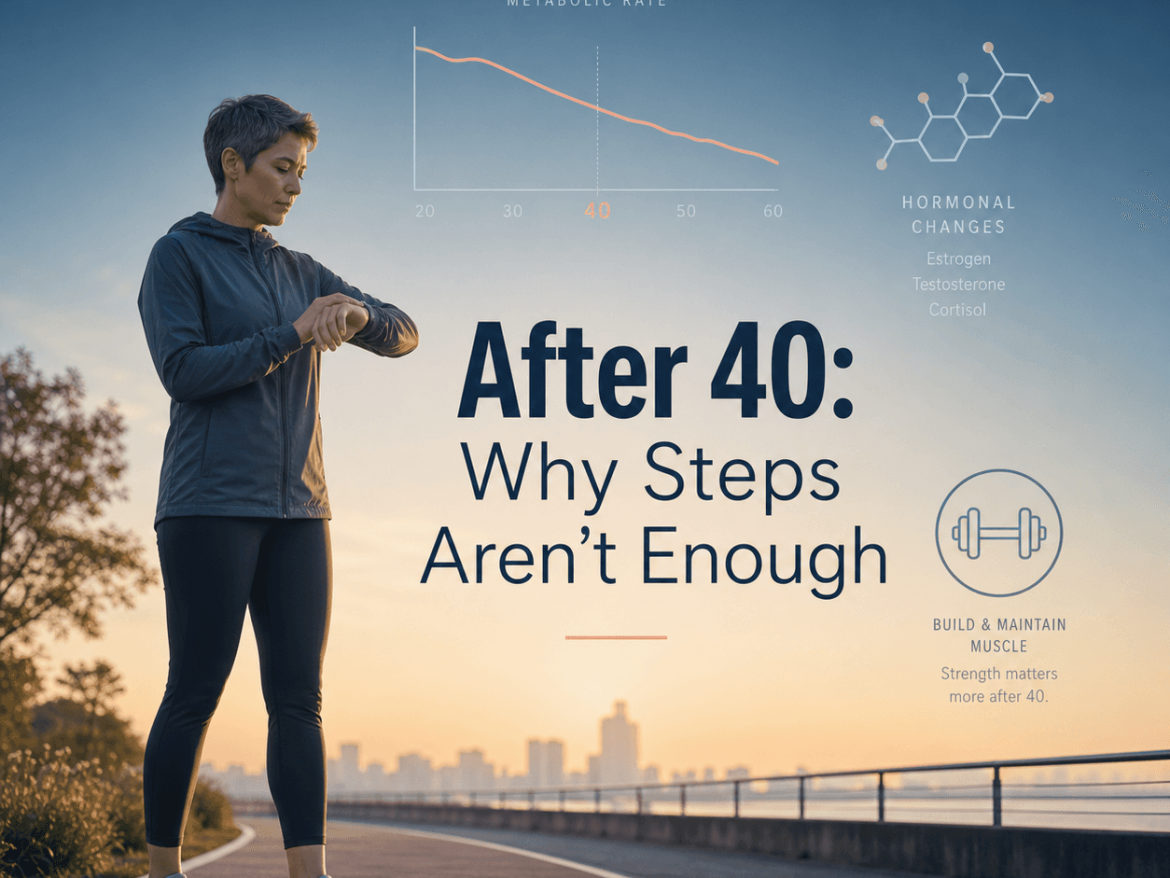
Steps are not a weight loss strategy. They’re a support tool. And after 40, your body has a few very specific reasons why “just walk more” stops working like it used to.
Let’s unpack it, in a way that actually makes sense and gives you a way forward.
The truth about steps (and why they used to work)
Walking is fantastic. I’m not anti steps. Not even close.
Steps help with blood sugar, circulation, lymph flow, mood, digestion, sleep. For a lot of people, they lower stress hormones, especially if it’s outdoors, gentle, and not rushed.
But walking burns fewer calories than most people think. And your body adapts quickly.
If you’ve been walking regularly for months or years, your system gets efficient. Which is good for survival. Not always great for fat loss.
It’s a bit like this.
If you keep doing the same 30 minute walk at the same pace every day, your body learns, “Cool, I can do this using less energy now.” The calorie burn goes down. The fat loss effect fades.
In your 20s or early 30s you could often “out walk” a lot of problems because hormones were more forgiving, muscle mass was higher, sleep debt didn’t hit as hard, stress didn’t spike cortisol as dramatically.
After 40, different game.
Why weight loss after 40 is not a “calories in calories out” issue (most of the time)
Yes, energy balance matters. But that phrase gets used like a weapon. As if your body is a simple calculator.
After 40, the “calories out” side of the equation is heavily influenced by things like:
- insulin sensitivity
- thyroid output and conversion
- cortisol patterns
- estrogen and progesterone shifts
- muscle mass and mitochondrial function
- inflammation and gut health
- sleep quality and circadian rhythm
- nutrient deficiencies that change appetite and cravings
So when someone says, “Just get more steps,” they’re basically saying, “Ignore all of that and hope for the best.”
Sometimes it works. Usually it doesn’t. Especially if you’re tired, stressed, under fueled, or not building muscle.
1) You’re walking more, but you’re also sitting more
This one is sneaky.
A lot of people start focusing on steps and unconsciously move less the rest of the day.
You hit your morning walk, crush 8k by 10am, feel proud. Then your body goes, “Great, we can conserve energy now.” And the rest of the day is low movement.
This is called compensatory behavior. It’s common.
And it’s why you can technically “exercise more” but burn the same total daily energy. Your body self regulates. Especially when stress is high or calories are low.
So yes, steps matter. But total daily movement matters more.
Not just a single walk.
2) Chronic stress turns steps into another stressor
After 40, stress hits differently. It’s not that you suddenly became weak. It’s that your nervous system has had decades of load.
Work, kids, caregiving, finances, perimenopause symptoms, poor sleep, inflammation. It stacks.
When cortisol is high or dysregulated, your body becomes more likely to:
- store abdominal fat
- break down muscle tissue
- crave sugar and refined carbs
- struggle with sleep (which increases hunger hormones)
- hold water and feel puffy, even if fat loss is happening slowly
Now here’s where steps can backfire.
If your walking is fast, intense, on low calories, paired with lots of coffee, done while you’re already exhausted, it’s not restorative movement anymore. It’s just more output.
And your body hears, “We are not safe. We should conserve.”
So you walk more. And lose less.
It’s frustrating because it feels unfair. But it’s also fixable.
3) You can’t step your way out of insulin resistance
This is a big one, and it’s common after 40.
Insulin is a storage hormone. When insulin is high, fat loss gets harder. Not impossible, but harder.
Insulin resistance often shows up as:
- stubborn belly fat
- energy crashes after meals
- waking up at 2 to 4am
- craving carbs at night
- “hanger” that feels intense
- triglycerides creeping up
- A1c inching higher even if you don’t eat much sugar
Walking helps insulin sensitivity, yes. Especially walking after meals.
But if your meals are spiking glucose all day, and you’re not building muscle, and you’re not sleeping well, and stress is high, then steps alone won’t create enough of a shift.
It’s like trying to drain a bathtub while the faucet is still blasting.
You need to work the whole system.
4) You’re not building muscle, and muscle is the metabolic engine
This is where many women get misled.
They focus on cardio and steps because it feels safe and doable. And it is. But walking doesn’t build significant muscle. Not enough to offset age related muscle loss.
After 40, we naturally lose muscle if we don’t actively train it. That loss has a name, sarcopenia. And it matters because:
- muscle improves insulin sensitivity
- muscle increases resting metabolic rate
- muscle helps stabilize blood sugar
- muscle improves joint health and posture
- muscle changes how you look, even if the scale doesn’t move much
If your only exercise is walking, your body may be getting “smaller capacity” over time. Less muscle means fewer places to store glucose safely, which can worsen insulin resistance, which then worsens fat storage.
So steps can keep you healthy, but strength training is what changes the metabolic story.
Not hours in the gym. Even two to three sessions a week, progressive, well planned, makes a difference.
5) You’re under eating (and your body is adapting)
This surprises people, because they assume the problem is overeating.
But a lot of women over 40 are doing some version of this:
- coffee for breakfast
- light lunch
- “healthy” dinner
- low protein overall
- lots of steps and maybe a workout
- then cravings at night
- then guilt
- then repeat
When calories and protein are too low for too long, your body adapts by:
- lowering thyroid output (or conversion of T4 to active T3)
- reducing non exercise movement
- increasing hunger hormones
- increasing obsession with food
- breaking down muscle for amino acids
- raising cortisol
So you can be “eating clean” and still be sending the signal of scarcity.
Which, again, after 40 tends to show up as belly fat, sleep issues, fatigue, and stalled weight loss.
Protein is usually the first fix. Not in a strict way. Just in a realistic way.
Most women need more protein than they think, spread across the day, not saved for dinner.
6) Perimenopause changes how your body partitions fat
Estrogen is not just a reproductive hormone. It affects insulin sensitivity, inflammation, muscle maintenance, and fat distribution.
As estrogen fluctuates and trends downward (often starting in your late 30s to mid 40s), many women notice:
- fat shifting toward the midsection
- less “forgiveness” with carbs and alcohol
- more inflammation and water retention
- more anxiety, sleep disruptions
- changes in recovery from workouts
So if you’re walking more and eating less and still gaining around the middle, you’re not imagining it.
It may not be a motivation issue. It may be a hormonal transition issue.
And that’s where anti aging and functional medicine can help because the goal is not just “burn calories.” The goal is to restore metabolic flexibility.
7) Gut issues can stall fat loss more than you expect
Here’s where the gut piece comes in, and I know it sounds like a trendy topic. But clinically, it’s real.
Your gut affects:
- inflammation levels
- how well you absorb nutrients
- cravings and appetite signaling
- estrogen metabolism (hello, estrogen dominance symptoms)
- insulin sensitivity
- even thyroid conversion in some cases
If you’re dealing with bloating, constipation, reflux, food sensitivities, acne, fatigue, or that “puffy” feeling, weight loss can become weirdly resistant.
And you can walk 15k steps a day and still be inflamed.
Sometimes, the body is holding on because it’s reacting to something. Food triggers. Dysbiosis. Hidden infections. Low stomach acid. Poor bile flow. Chronic stress shifting the gut microbiome.
This is why some people lose more weight improving digestion than they do adding workouts.
It’s not magic. It’s physiology.
If gut health has been a missing piece for you, you might like the educational resources over at Reviva Health and Wellbeing (Dr. Lisa Silvani). The practice focuses on root cause metabolic and chronic health issues, not just generic advice. You can start by exploring the site here: https://www.lisasilvani.com
Okay, so what should you do instead of just adding more steps?
Keep your steps. But stop expecting them to do a job they can’t do alone.
Here’s a more effective weight loss after 40 framework, without making your life miserable.
1) Walk smarter, not just more
Try:
- 10 to 15 minute walks after meals (especially after your biggest carb meal)
- zone 2 pace a few times per week (you can talk, but not sing)
- mix in a couple of brisk intervals if your stress and sleep are solid
And also. Keep “movement snacks” during the day.
A few minutes of mobility, a quick walk around the house, standing breaks. It adds up more than you think.
2) Strength train 2 to 4 times per week
You don’t need fancy workouts.
You do need progressive resistance. That means over time you lift slightly heavier, or do more reps, or use better form and control.
Focus on big movements:
- squats or sit to stands
- hinges (deadlift pattern)
- rows
- presses
- carries
- core stability
If you’re new, start simple. Even bodyweight and bands are fine, as long as you progress.
3) Eat enough protein, earlier in the day
A practical target many women do well with is roughly 25 to 35g protein per meal, depending on body size and goals.
Not perfect. Just consistent.
Protein at breakfast tends to reduce cravings later. It also supports muscle, which supports fat loss.
4) Address blood sugar like it’s the main character
Because for many women after 40, it is.
Basics that work:
- build meals around protein and fiber
- add healthy fats, but don’t rely on fats alone
- reduce liquid calories and “healthy snacks” that spike glucose
- consider a savory breakfast instead of sweet
- limit alcohol, even temporarily, if belly fat is stubborn
5) Take stress and sleep seriously (annoying but true)
If you’re waking at night, exhausted in the morning, wired at night, or relying on caffeine to function, the body is not in a fat loss friendly state.
Sometimes the best “fat loss plan” starts with:
- stabilizing bedtime and wake time
- morning light exposure
- magnesium glycinate (if appropriate)
- reducing late night screen time
- breathing work or a short wind down routine
- checking iron, B12, vitamin D, thyroid markers if fatigue is persistent
And if sleep is a mess because of perimenopause symptoms, hot flashes, anxiety, or histamine issues, that deserves support. Not willpower.
A quick reality check (because I know someone needs to hear it)
If you’re doing 8k to 12k steps a day and not losing weight, you are not lazy.
You’re probably under muscled, under recovered, inflamed, insulin resistant, hormonally shifting, or all of the above. And nobody told you that the plan needed to change after 40.
Walking is still one of the best habits you can have. Keep it. Seriously.
Just stop treating it like the whole solution.
When it’s time to get personalized
If you’ve been doing “all the right things” and nothing is moving, that’s usually a sign to stop guessing and start looking at data.
Functional and anti aging medicine tends to zoom out and ask:
- what is driving inflammation
- what is driving insulin resistance
- what is happening with cortisol rhythms
- are thyroid markers optimal or just “normal”
- is gut dysfunction contributing
- are nutrient deficiencies slowing progress
- what is your actual metabolic pattern, not just your calorie intake
If you want help figuring out your next best step, you can explore working with Dr. Lisa Silvani at Reviva Health and Wellbeing. There are virtual consults and structured programs that focus on fatigue, metabolic restoration, and sustainable longevity focused health. Start here: https://www.lisasilvani.com
Wrap up
Steps are helpful. They’re just not powerful enough to override what changes after 40.
If your steps aren’t helping weight loss anymore, it doesn’t mean you should walk harder.
It usually means you need a different lever.
Build muscle. Stabilize blood sugar. Eat enough protein. Support sleep and stress. Fix the gut inflammation if it’s there. Look at hormones with context, not vibes.
And then, suddenly, the steps you’re already doing start working again. Not because you forced it.
Because your body finally has the conditions it needs to let go.
FAQs (Frequently Asked Questions)
Why am I not losing weight despite walking 10,000 steps daily after 40?
Walking is beneficial for overall health but burns fewer calories than many expect. After 40, your body adapts and becomes more efficient, reducing calorie burn from the same activity. Additionally, hormonal changes, muscle loss, stress, and other factors make relying solely on steps insufficient for weight loss.
How does aging affect the effectiveness of walking for fat loss?
As you age past 40, hormonal shifts such as changes in estrogen, progesterone, insulin sensitivity, and cortisol patterns impact metabolism. Muscle mass naturally declines (sarcopenia), reducing metabolic rate. These factors mean that the same walking routine that once helped with fat loss may no longer be enough.
Can increasing daily steps alone help overcome insulin resistance after 40?
While walking improves insulin sensitivity, steps alone often aren’t enough to counteract insulin resistance common after 40. Managing insulin resistance effectively requires a comprehensive approach including balanced nutrition, muscle building exercises, stress management, and quality sleep alongside regular movement.
Why might walking more lead to compensatory behaviors that reduce total daily energy expenditure?
When you increase your step count early in the day or during exercise sessions, your body may subconsciously conserve energy by reducing movement later—this is known as compensatory behavior. Especially under stress or calorie restriction, this can result in no net increase in daily calorie burn despite higher step counts.
How does chronic stress impact weight loss efforts involving walking after 40?
Chronic stress elevates cortisol levels which promotes abdominal fat storage, muscle breakdown, sugar cravings, poor sleep, and water retention. If walking is done intensely on low energy or high stress states without recovery, it can add to the stress load rather than relieve it, hindering fat loss.
Why is building muscle important for weight management after 40 compared to just increasing steps?
Muscle acts as a metabolic engine improving insulin sensitivity and increasing resting energy expenditure. Walking doesn’t build significant muscle mass needed to counteract age-related muscle loss (sarcopenia). Incorporating strength training helps maintain muscle mass and supports more effective fat loss after 40.
References
- Fleg, J. L., & Lakatta, E. G. (1988). Role of muscle loss in the age-associated reduction in VO2 max. Journal of Applied Physiology, 65(3), 1147-1151. https://doi.org/10.1152/jappl.1988.65.3.1147
- Lustig, R. H. (2011). Insulin resistance and obesity: The role of stress and cortisol. New England Journal of Medicine, 364(24), 2345-2346. https://doi.org/10.1056/NEJMc1012124
- Evans, W. J., & Campbell, W. W. (1993). Sarcopenia and age-related changes in body composition and functional capacity. Journal of Nutrition, 123(2 Suppl), 465-468. https://doi.org/10.1093/jn/123.suppl_2.465
- National Health Service (NHS) UK. (2020). Muscle-strengthening exercises: How to do them safely as you get older. Retrieved from https://www.nhs.uk/live-well/exercise/muscle-strengthening-exercises/
- Herman, C., & Polivy, J. (2010). Psychological stress and eating behavior: A review and hypothesis about the role of chronic stress in obesity development after midlife. BMC Public Health, 10(1), 450. https://doi.org/10.1186/1471-2458-10-450
- Mauvais-Jarvis, F., Merz, N., Barnes-Pelletier, M., et al. (2017). Menopause and metabolic syndrome: Hormonal and body composition changes influencing cardio-metabolic risk after midlife in women – a review from Nature Reviews Endocrinology, 13(9), 452-464. https://doi.org/10.1038/nrendo.2017.60
- DeFronzo, R.A., & Tripathy, D. (2009). Skeletal muscle insulin resistance is the primary defect in type 2 diabetes mellitus: implications for therapy from Science Direct’s Diabetes Care journal, 32(12), 2084–2090.
- Fitzgerald, K., & Hyman, M.S., Ruscio, M.G., et al., Integrative approaches to managing insulin resistance and weight management after age 40 – Clinical research summaries from MindBodyGreen with evidence-based insights.
- Spiegelman, B.M., & Flier J.S., (2001). Obesity and the regulation of energy balance: Insights from Springer Elsevier’s Annual Review of Medicine, 52:239-251.
- Van Cauter E., Leproult R., Plat L., (2000). Age-related changes in slow wave sleep and REM sleep and relationship with growth hormone secretion: Implications for aging-related metabolic disorders from NEJM 343(17):1184-1192.
