
 vanilis
 You cut the “bad stuff.” You start reading labels. You swap “real food” for “processed.” You’re doing all the right things, right?
And yet… your energy tanks.
Not the normal tired after a long day kind of tired. I mean that flat, heavy, slow fatigue. The kind where coffee barely touches it. The kind where your workouts feel harder, your mood gets thinner, and your brain feels like it is running on one bar of signal.
This is one of the most common patterns I see when people genuinely try to eat healthier.
Healthy eating doesn’t usually backfire because vegetables are secretly evil. It backfires because a lot of “healthy eating” advice quietly turns into under-eating. Or under-fueling. Or both. And your body, especially your energy system, notices.
Let’s talk about what that looks like, why it happens, and how to fix it without swinging into chaos or “forget it, I’ll just eat whatever.”
The sneaky difference between eating “clean” and eating enough
Most people don’t wake up and decide to starve themselves. It’s subtler than that.
It starts with rules.
No sugar. No bread. No snacks. No eating after 7 pm. Only salads for lunch. “Just protein and veggies.” “Carbs make me tired.” “I’m being good.”
And suddenly your food choices get narrower and narrower. Portions shrink. Meals get delayed. You avoid hunger instead of responding to it.
You might still be eating nutrient-dense food. But you’re not necessarily eating enough total energy, or enough of the right kind of energy for your body.
Under-fueling is not only about calories, either. It can be:
- Too little total food for your daily output
- Too little carbohydrate for your activity level and brain demands
- Too little fat because “fat is high calorie”
- Too little protein spread across the day
- Too little micronutrition because the diet is repetitive
- Too little overall, plus stress, plus caffeine. That combo is loud
The body can compensate for a while. Until it can’t. And the first thing most people notice is fatigue.
What fatigue from under-fueling actually feels like
Some people assume under-eating would feel like hunger and stomach growls.
Sometimes it does. But often it doesn’t.
Chronic under-fueling can show up as:
- Waking up tired, even after a full night of sleep
- Mid-morning crash, then needing caffeine to function
- Afternoon slump that feels non negotiable
- Feeling “tired but wired” at night
- Cold hands and feet, feeling chilly when others are fine
- Brain fog, forgetfulness, low motivation
- Irritability, anxiety, low mood. Short fuse energy
- Workouts feeling harder, slower recovery, more soreness
- Decreased performance, plateau, or feeling weaker
- Strong cravings at night, especially for sweets or crunchy carbs
- Lightheadedness when standing up
- Hair shedding, brittle nails, dry skin
- For women, changes in cycle, shorter cycles, skipped periods, worse PMS
- For men, lower drive, lower morning energy, poorer training response
And here’s the weird part.
Some people don’t feel hungry at all. Appetite can downshift when stress hormones rise, when you rely on caffeine, or when you get used to ignoring hunger signals.
So you can be under-fueled and still feel like you “eat plenty.” Especially if your meals look virtuous.
Why under-fueling causes fatigue (the energy lens)
Your body’s job is survival. Not aesthetics. Not macros. Not diet trends.
When fuel is consistently low, your body adapts by conserving energy. That is not a character flaw. That is biology.
A few key things happen.
1. Your metabolic “budget” tightens
Think of energy like money. When income drops, you cut expenses.
Your body will downshift “non essential” spending first.
That can look like:
- Lower spontaneous movement (less fidgeting, less drive to move)
- Reduced thyroid conversion and metabolic rate in some people
- Lower reproductive hormone signaling
- Lower body temperature
- Slower digestion
- Less robust recovery and immune function
You still have to get through the day, so stress hormones can rise to keep blood sugar stable and keep you functioning. That helps short term. But it can feel awful.
2. Blood sugar becomes harder to stabilize
When meals are too small or too far apart, blood glucose can dip. Your body responds by releasing cortisol and adrenaline to bring it back up.
That “rescue” can feel like:
- Jitters, anxiety, heart pounding
- Sudden irritability
- Shaky hands
- Waking at 2 to 4 am
- A crash that makes you feel like lying on the floor
Many people label this as “I’m sensitive to carbs” or “I have adrenal fatigue” or “I just have anxiety.”
Sometimes it is simply not enough consistent fuel.
3. Mitochondria need more than vitamins. They need substrate
On Dr. Lisa Silvani’s website, fatigue is framed through a root-cause and energy centered lens, including mitochondrial function. I love that because it stops the endless symptom chasing.
Your mitochondria are your cell’s energy generators. They turn fuel into ATP. But they can’t do that well if fuel is inconsistent, too low, or missing key building blocks.
Yes, micronutrients matter. B vitamins, magnesium, iron, CoQ10, carnitine, and more. But you also need actual energy coming in, reliably.
No amount of supplements makes up for chronically not eating enough food.
The “healthy” patterns that most often lead to under-fueling
Let’s call them out gently, because a lot of these start with good intentions.
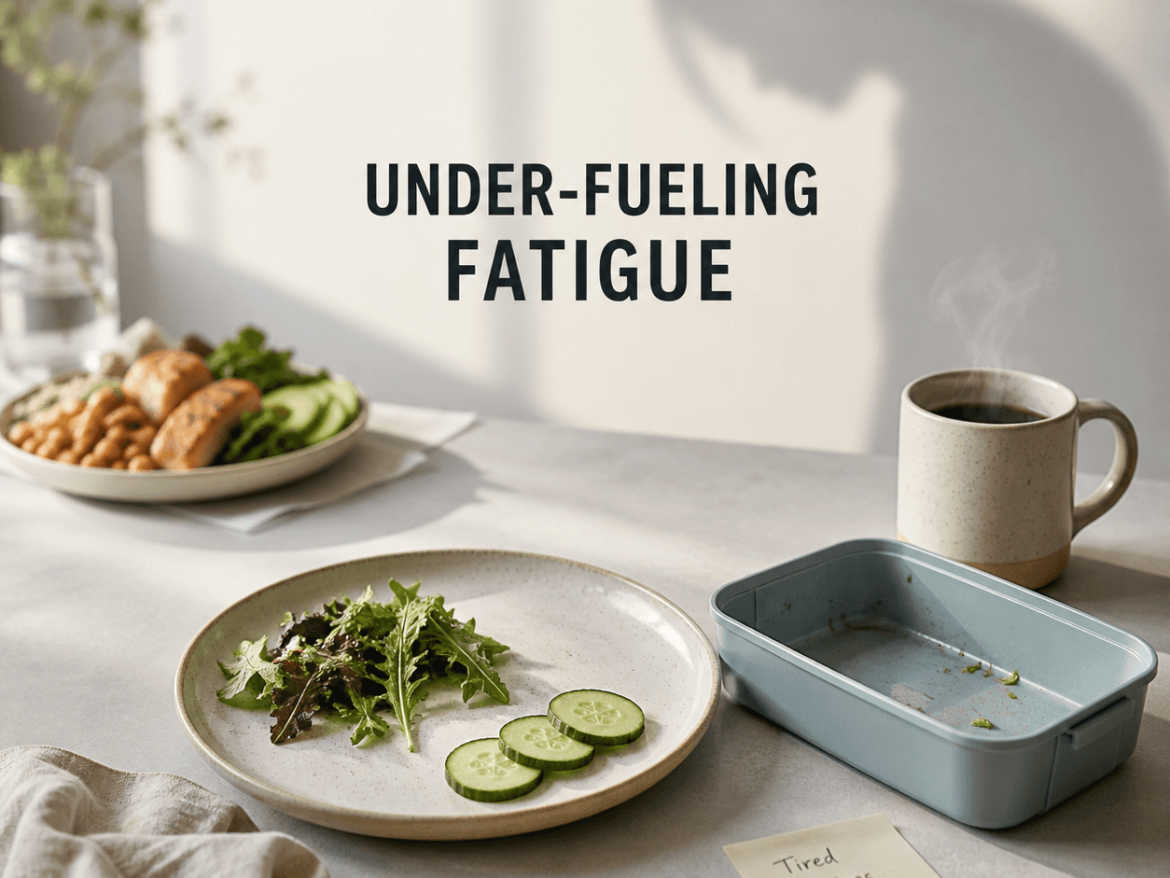
The endless salad lunch
Salad can be a great meal. But many salads are basically: lettuce, cucumber, tomatoes, and maybe a few chickpeas.
That is a side dish.
If your lunch is low calorie and low carbohydrate and low fat, you might feel decent for an hour, then slowly fade.
A fatigue friendly salad usually needs:
- A real protein portion
- A meaningful carb source if you are active or mentally taxed
- Enough fat to slow digestion and keep you satisfied
Otherwise it is just a bowl of air with vitamins.
“I cut carbs and I feel lighter”
Some people feel less bloated when they cut carbs, especially if they were eating lots of ultra processed carbs.
But “lighter” is not the same as “energized.”
Carbohydrates are not optional for the brain. And they are extremely helpful for thyroid conversion, sleep, exercise performance, and nervous system stability in many bodies.
If you go low carb and your energy improves, great. But if you go low carb and you start crashing, waking at night, feeling wired, losing your period, or feeling depressed… that is data.
Intermittent fasting done on top of stress
Fasting can work for some people, at some times.
But a lot of people stack fasting on top of:
- High stress jobs
- Poor sleep
- High intensity workouts
- A strong desire to lose weight quickly
- Already low intake during the eating window
That is when fatigue shows up fast.
If you are skipping breakfast and running on cortisol until noon, that is not resilience. That is stress chemistry doing overtime.
“I’m eating healthy, so I don’t need much”
This one is common in people who eat very whole foods.
They eat chicken, vegetables, Greek yogurt, berries, nuts. All good things.
But whole foods are often less calorie dense than processed foods. So your portions have to be bigger than you think. Or you need to intentionally add energy with carbs and fats.
A handful of almonds is not a meal. A yogurt cup is not a full breakfast for everyone. An apple is not “fuel” if you are training hard and working a demanding job.
Over-training plus “good” eating
If you are working out 5 to 6 days a week, especially with HIIT, running, spinning, CrossFit, or heavy lifting, your energy needs go up.
Many people respond by eating even cleaner. Which often means even less.
Then the body starts to push back:
- workouts feel harder
- recovery worsens
- sleep gets lighter
- hunger becomes chaotic
- energy drops
And the person thinks they need more discipline.
They usually need more fuel. And often more rest.
How to tell if you are under-fueling (quick self check)
You don’t need to track calories forever. But you do need honesty.
Ask yourself:
- Do I regularly feel better after I eat, like noticeably calmer or clearer?
- Do I rely on caffeine to feel normal?
- Do I get shaky, irritable, or foggy if meals are delayed?
- Do I “forget to eat” until late afternoon?
- Do I avoid carbs most of the day and then crave them at night?
- Did my fatigue worsen after I cleaned up my diet?
- Did my sleep get worse after I started fasting or dieting?
- Am I training hard but eating like I am sedentary?
- For women: did my cycle change after dietary changes?
If several are yes, under-fueling is worth considering.
Also, important: fatigue has many root causes. Iron deficiency, sleep apnea, thyroid disease, depression, chronic infections, medications, perimenopause, insulin resistance, and more. So please don’t self diagnose everything as “just eat more.”
But under-fueling is common. And it is fixable.
The “fix” is not junk food. It is consistent, adequate fuel
This is where people get stuck.
They hear “eat more” and imagine it means: eat cookies and pasta all day. No.
You can correct under-fueling with very normal food. The goal is to give your body enough energy and enough building blocks, consistently, so it stops running emergency programs.
Here are practical ways to start.
1. Build meals that actually count
A simple structure that works for many people:
- Protein
- Carbohydrate
- Color (vegetables or fruit)
- Fat
Not rigid. Just grounding.
Examples:
Breakfast ideas:
- Eggs plus sourdough or oats, plus fruit
- Greek yogurt plus granola or honey, plus berries, plus nuts
- Smoothie with milk or yogurt, fruit, and added oats or chia, plus protein
Lunch ideas:
- Big salad with chicken or tofu, quinoa or potatoes, olive oil dressing, maybe avocado
- Rice bowl with salmon, roasted vegetables, and a sauce
- Sandwich with turkey and cheese, plus soup or fruit
Dinner ideas:
- Meat or beans, roasted vegetables, and a real carb like rice, pasta, bread, or potatoes
- Stir fry with noodles or rice
- Tacos with beans or meat, plus salsa, guac, and a side
If you notice your plate is mostly vegetables and lean protein, that is often where fatigue begins for active or stressed people.
2. Stop going so long between meals (at least for now)
If you are crashing, waking at night, or feeling anxious and tired, experiment with regular meal timing.
Maybe:
- breakfast within 1 to 2 hours of waking
- lunch
- afternoon snack if dinner is later
- dinner
It does not have to be perfect. But long gaps can push your nervous system into a stress response.
And if you wake at 2 to 4 am hungry or wired, a small bedtime snack with carbs plus protein can be surprisingly helpful for some people. Not forever. Just as a bridge.
3. Add carbs strategically, not fearfully
If carbs have been demonized in your world, start small.
Add one carbohydrate you tolerate well, consistently, and see what happens.
Options that work for many people:
- oats
- rice
- potatoes or sweet potatoes
- quinoa
- fruit
- sourdough bread
- beans and lentils
If you are training, carbs around workouts often improve performance and recovery.
If your brain work is intense, carbs earlier in the day may help mood and focus.
4. Watch the “health halo” foods that keep you under-fed
A few common ones:
- just a smoothie that is mostly fruit and water (no protein, no fat)
- just a protein bar (too small, too processed, not satisfying)
- veggie soup with no starch or protein
- snack plates that never become a meal
These foods can be part of a good diet. But they can also keep you in a constant nibbling state where your body never gets a full replenishment.
5. Consider the deeper root cause picture (especially if fatigue is persistent)
Sometimes people correct their intake and still feel exhausted. That is where a root cause approach matters.
If you want a structured way to think through fatigue, Dr. Lisa Silvani has resources on her site including a Fatigue Root Cause quiz and practical education around energy production and mitochondria. It can help you stop guessing and start connecting patterns.
You can find that at https://lisasilvani.com/ and explore from there.
A quick note on weight loss, because it always comes up
If your main goal is fat loss, under-fueling might look like “it is working” at first.
But long term, aggressive restriction often leads to:
- fatigue
- sleep disruption
- cravings
- binge cycles
- reduced training capacity
- stagnation
Sometimes the most effective path is to stabilize energy first. Eat adequately. Support sleep. Build muscle. Then, if weight loss is still appropriate, create a modest deficit that does not wreck your life.
Your body should not feel like it is in a constant emergency just so you can fit into a number.
When to get checked (do not skip this)
If you have ongoing fatigue, especially with any red flags, talk to a clinician.
Red flags include:
- fainting, chest pain, shortness of breath
- rapid unexplained weight loss
- persistent fever, night sweats
- severe depression
- heavy menstrual bleeding or sudden cycle changes
- symptoms of anemia (shortness of breath on exertion, dizziness, paleness)
- fatigue that is worsening despite rest and adequate food
Basic labs that are often relevant (ask your provider): CBC, ferritin, iron studies, B12, folate, TSH and free T4, vitamin D, CMP, fasting glucose, A1c. Your situation may warrant more.
Bringing it home
Healthy eating is supposed to give you more life. More energy to do things. Not less.
If your “clean diet” has you dragging yourself through the day, staring at the clock for your next coffee, and feeling oddly proud that you can ignore hunger, it might be time to reassess.
Under-fueling is not discipline. It is a stressor.
Start with the basics. Eat enough. Eat consistently. Include carbs if your body is asking for them. Make meals that count.
And if you want a more organized way to figure out what is driving your fatigue, take a look at Dr. Lisa Silvani’s fatigue education and tools at https://lisasilvani.com/. Sometimes the missing piece is not motivation. It is clarity.
FAQs (Frequently Asked Questions)
Why do I feel extreme fatigue even after switching to a healthier diet?
Feeling extreme fatigue despite eating healthier often happens because of under-fueling. When you cut out ‘bad stuff’ and processed foods but don’t eat enough total energy or the right balance of nutrients, your body doesn’t get the fuel it needs. This leads to heavy, slow fatigue that coffee can’t fix, making workouts harder and affecting mood and brain function.
What is the difference between eating ‘clean’ and eating enough to fuel my body?
Eating ‘clean’ usually means choosing nutrient-dense foods like vegetables and lean proteins and avoiding sugar, bread, and processed snacks. However, this can unintentionally narrow your food choices and reduce portion sizes too much, leading to under-eating or under-fueling. Eating enough means consuming sufficient total calories, balanced carbs, fats, proteins, and micronutrients to meet your daily energy demands.
What are common signs that I am under-fueled despite eating healthy foods?
Under-fueling signs include waking up tired after full sleep, mid-morning crashes needing caffeine, afternoon slumps, feeling ‘tired but wired’ at night, cold extremities, brain fog, irritability, harder workouts with slower recovery, cravings for sweets or carbs at night, lightheadedness when standing up, hair shedding, brittle nails, dry skin, and hormonal changes such as irregular cycles in women or low drive in men.
How does under-fueling cause fatigue from an energy perspective?
When fuel intake is consistently low, your body conserves energy by lowering metabolic rate and reducing non-essential functions like reproductive hormone signaling and immune function. Blood sugar becomes unstable due to small or infrequent meals causing cortisol release for rescue. Also, mitochondria—the cell’s energy generators—lack sufficient fuel substrates to produce ATP efficiently. All these factors combine to cause persistent fatigue.
Can under-fueling affect my mood and mental performance?
Yes. Chronic under-fueling can lead to brain fog, forgetfulness, low motivation, irritability, anxiety, and low mood due to insufficient energy supply for brain function and imbalanced blood sugar levels. Stress hormones released during low fuel states can further worsen mood and cognitive clarity.
How can I avoid under-fueling while trying to eat healthier?
To avoid under-fueling when eating healthier: listen to your hunger cues rather than imposing strict rules; ensure you consume enough total calories appropriate for your activity level; include balanced amounts of carbohydrates for brain and activity demands; don’t fear healthy fats as they provide essential energy; spread protein intake throughout the day; diversify your diet to cover micronutrient needs; manage stress and moderate caffeine intake; and avoid overly restrictive patterns that narrow food choices excessively.
References
- Ludwig, D.S., & Friedman, M.I. (2014). Increasing adiposity: consequences for metabolism and behavior. The New England Journal of Medicine, 370(15), 1425-1434. https://doi.org/10.1056/NEJMra1305199
- Speakman, J.R., & Selman, C. (2011). The under-fueling paradox: metabolic adaptations to caloric restriction and their impact on fatigue and health. BMC Medicine, 9, 61. https://doi.org/10.1186/1741-7015-9-61
- NHS UK. (2023). Fatigue: Why am I so tired? Retrieved from https://www.nhs.uk/conditions/fatigue/
- Wallace, D.C., & Fan, W. (2010). The energetic basis of mitochondrial dysfunction in fatigue syndromes and chronic illness. Nature Reviews Molecular Cell Biology, 11(10), 749-760. https://doi.org/10.1038/nrm2996
- Felig, P., & Wahren, J. (2016). Blood glucose regulation and energy metabolism in health and disease states: role of carbohydrate intake and exercise. Springer Handbook of Nutrition and Exercise, 45-68.
- Lustig, R.H., et al. (2020). Carbohydrate restriction as a strategy to improve energy balance and reduce fatigue in metabolic disorders: a clinical review. Elsevier’s Clinical Nutrition, 39(2), 373-385.
- Ruscio, M.G., & Ruscio, J.E. (2018). Optimizing brain energy metabolism through dietary strategies to combat fatigue and cognitive decline: clinical perspectives from functional medicine. ScienceDirect – Functional Neurology Reviews, 33(4), 245-259.
- Fitzgerald, K., & Hyman, M.D. (2021). Nutritional approaches to combat chronic fatigue: balancing macronutrients for optimal mitochondrial function and mental clarity. MindBodyGreen. Retrieved from https://www.mindbodygreen.com/articles/nutrition-for-fatigue
- Mayo Clinic Staff (2022). Intermittent fasting: Can it improve health? Mayo Clinic Proceedings. https://doi.org/10.1016/j.mayocp.2022.03.003
- Mark Hyman, M.D., (2019). The hidden dangers of under-fueling: how “healthy” eating can lead to unexpected fatigue and mental fog – a practical guide for clinicians and patients alike.DrMarkHyman.com. Retrieved from https://drhyman.com/blog/2019/08/12/the-hidden-dangers-of-under-fueling/

