 dr. Lisa Silvani
 It gets tossed around like it’s a diagnosis. Like there’s some specific look that only comes from GLP 1 medications, and you either have it or you don’t.
But when people say “Ozempic face,” what they’re usually reacting to is something more basic than a medication side effect.
It’s rapid fat loss. In the face. Often on top of normal aging. Sometimes on top of inflammation finally coming down. Sometimes on top of dehydration. Sometimes it’s just… lighting and anxiety and a dramatic before and after photo.
So let’s slow it down and talk about what’s actually happening.
This is going to be a little longer than the average post because the nuance matters here. And because a lot of people feel genuinely scared. Or embarrassed. Or they’re doing something that helps their blood sugar and weight and health markers, and then they look in the mirror and think, wait. Did I make a mistake?
You didn’t necessarily. But you do need to understand the mechanism so you can respond in a smart way.
What people mean when they say “Ozempic face”
“Ozempic face” is not a medical term. There’s no official diagnostic criteria. No lab value for it.
It’s basically a label for a cluster of changes that can happen when someone loses weight quickly, especially after age 35 or 40, and especially if they lose a meaningful amount of subcutaneous fat in the midface.
Common descriptions:
- The cheeks look flatter or more hollow
- The nasolabial folds look deeper
- Under eye hollows look more obvious
- Skin looks looser or more crepey
- The face looks more tired or older, even if the body looks “healthier”
And it can be jarring because it’s one of the first places people notice weight change.
Also, the face is where we read “vitality.” Fullness, color, hydration, a little lift. When that shifts quickly, it can read as aging even if you’re improving metabolically.
So is it Ozempic, or is it just… aging?
It’s usually both. But not in the way people think.
Here’s the core idea:
GLP 1 medications like Ozempic, Wegovy, Mounjaro, Zepbound do not selectively “melt” facial fat. They reduce appetite and change glucose regulation, and you lose weight systemically. Your body decides where it comes off first. And the face is a common early spot.
Now layer in normal aging.
Aging includes:
- Gradual loss of collagen and elastin
- Bone remodeling (yes, facial bones change over time)
- Redistribution and descent of facial fat pads
- Slower skin turnover
- Higher likelihood of chronic low grade inflammation
- More cumulative sun exposure and oxidative stress
So if you were already on the edge of noticing soft tissue changes, and then you lose 15, 25, 40 pounds quickly, the “support” under the skin changes fast.
The result can look like accelerated aging.
But it’s not that the medication aged you overnight. It’s that you removed volume that was masking age related structural changes.
That can happen from any rapid weight loss approach.
Bariatric surgery. Very low calorie diets. Illness. Stress. Postpartum. Even intense training blocks.
Ozempic gets blamed because it’s the headline.
Why rapid weight loss changes the face more than slow weight loss
There are a few reasons rapid loss tends to look harsher, especially in the face.
1. Skin needs time to adapt
Skin is living tissue. It responds to mechanical stretching and relaxation over time. When volume drops quickly, the skin may not “snap back” at the same rate, especially if:
- you’re over 35
- you have a history of sun damage
- you’ve had multiple weight cycles (yo yo dieting)
- you’re under eating protein
- you’re not strength training
- you’re low in micronutrients needed for collagen formation
Slow weight loss gives your skin time to remodel.
Fast loss can create a lag. Not always permanent, but noticeable.
2. You lose fat and you may also lose muscle
This is a big one, and it’s not talked about enough.
Any weight loss plan can reduce lean mass unless you actively protect it. With GLP 1s, it can be harder because appetite is down, and people accidentally under eat protein and total calories.
If you lose muscle in addition to fat, you can look more “deflated.” In the body and in the face. Facial muscles matter for tone. Neck tone too.
3. Hydration and glycogen shifts can make you look different fast
Early weight loss often includes changes in glycogen and water retention. When inflammation and insulin are lower, people can drop water weight and puffiness quickly.
That can be great for blood pressure and joint pain.
But it can also reveal under eye hollows or cheek structure you weren’t seeing before. Some of what people call “Ozempic face” in the first month or two is a fluid shift, not just fat.
4. Nutrient intake can quietly drop
Again, not because GLP 1s “cause nutrient deficiencies” automatically. But because if you’re eating much less, it’s easier to fall short on nutrients that support skin and connective tissue.
Think:
- protein and amino acids (glycine, proline, lysine)
- vitamin C
- zinc
- copper
- omega 3 fats
- iron, B12, folate if intake is low
- overall calories needed for tissue repair
If your diet becomes “two bites of whatever,” the face may show it.
What about people who swear Ozempic specifically made their face look older?
I believe them. But I interpret it differently.
Most of the time, one of these is happening:
- They lost weight quickly and their face was a primary loss area
- They lost more lean mass than expected
- They were already low collagen or high inflammation, and the transition exposed it
- They’re dehydrated or not eating enough protein
- They’re comparing photos taken in different lighting, angles, and emotional states
- (This matters more than we want to admit.)
There’s also something psychological here.
When you make a deliberate change to your body, you pay more attention. You scrutinize. You look for evidence you did the right thing or the wrong thing. That alone can make normal aging feel sudden.
But, yes, there are scenarios where GLP 1 use can indirectly contribute to a more aged look. Indirectly. Not as a unique facial side effect, but via the pathway of rapid loss, low intake, lean mass loss, dehydration.
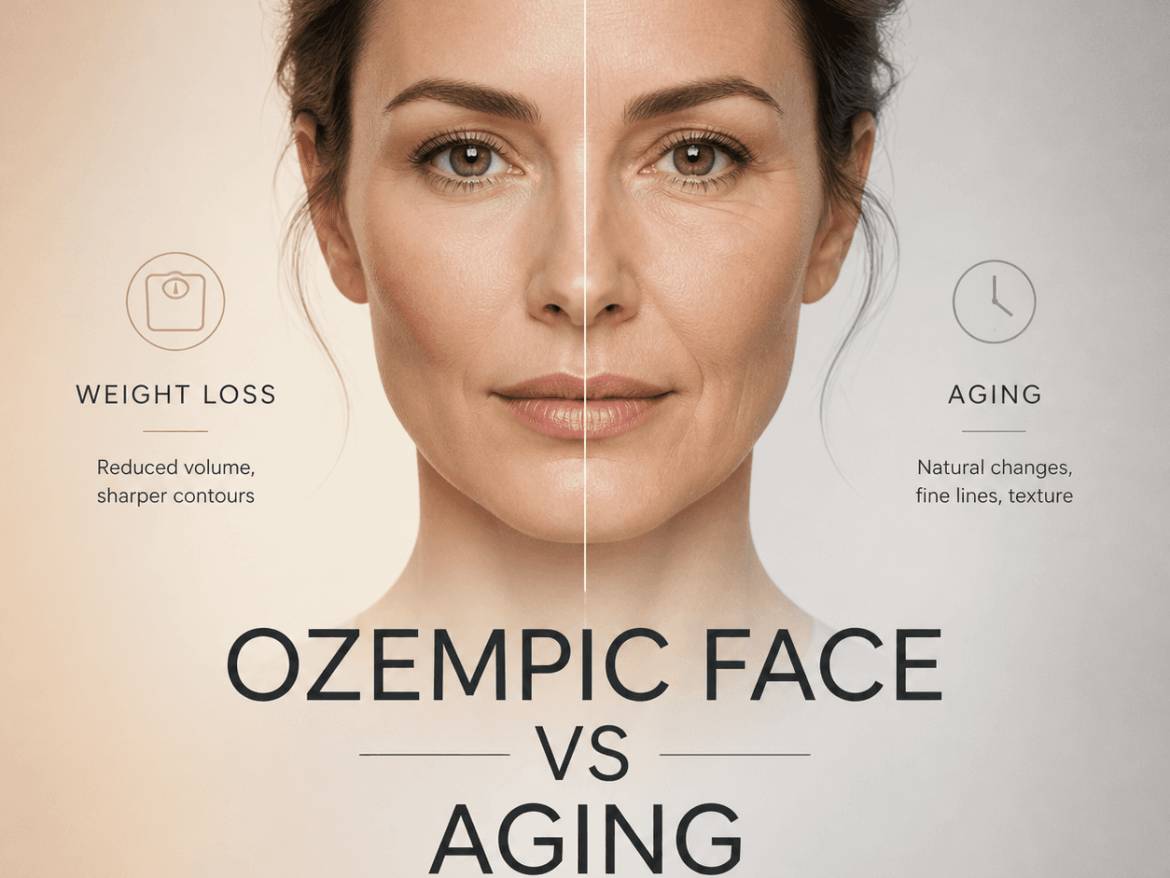
Ozempic face vs normal aging: a quick comparison
This is not perfect, but it helps.
Normal aging tends to be:
- gradual over years
- more symmetric and slow
- associated with fine lines, texture changes, sun spots
- subtle volume loss over time in midface and temples
- skin laxity that progresses slowly
“Ozempic face” changes tend to be:
- noticeable over weeks to months
- associated with faster volume loss
- hollowing in cheeks and under eyes that seems sudden
- looser skin that looks like it “arrived” early
- sometimes a tired look that improves once nutrition stabilizes
In other words, the timeline is the tell.
If you look back at photos from two years ago and the change is gradual, that’s aging.
If you look back at photos from eight weeks ago and the change is dramatic, that’s weight loss dynamics.
Often both.
The facial fat pads matter, and they’re not just “extra fat”
This is where the conversation gets interesting.
Not all facial fat is the same. You have distinct fat compartments that support the structure and youthful proportions of the face.
Midface fullness, especially, contributes to:
- a softer transition from lower eyelid to cheek
- a lifted look
- less prominence of folds and shadows
When midface fat pads shrink, the face can look more angular and less supported.
Some people love that. They look sharper, more sculpted.
Others feel like they look older.
Neither is wrong. It’s preference and baseline anatomy.
But the point is, facial fat is not always “bad.” It’s part of the aesthetic scaffolding.
When weight loss is the goal for metabolic health, you may still want to preserve the look of healthy support in the face. That’s where strategy comes in.
Is “Ozempic face” reversible?
Sometimes yes, sometimes partially, sometimes no. It depends on what’s driving it.
Here are the buckets.
If it’s mostly dehydration and low intake
This is the most reversible scenario.
When people:
- increase protein
- increase overall nutrient density
- hydrate properly with electrolytes as needed
- stop unintentionally under eating for months
They often see the face look less drawn out and less tired within weeks.
If it’s mostly rapid fat loss volume change
Some of this can stabilize as your weight stabilizes. Your body finds a new set point, inflammation balances out, skin has time to remodel.
But if you’re truly missing volume that you liked having, your options are:
- accept the new facial structure
- regain a small amount of weight (not always desirable, but it happens)
- use cosmetic approaches (fillers, biostimulators, fat transfer, etc)
- focus on skin quality and muscle tone so the face looks “healthy” even with less volume
If it’s mostly skin laxity with low collagen support
This is trickier.
Skin laxity can improve some with:
- protein and collagen support
- resistance training (systemic effect, posture, neck support)
- sleep and stress reduction
- addressing inflammation and gut health
- topical retinoids, vitamin C
- in office treatments that stimulate collagen
But there’s a limit, especially depending on age and genetics and how much volume was lost.
The part nobody wants to say out loud: inflammation can make you look “younger” temporarily
This is not me encouraging inflammation. Obviously not.
But some people had a slightly fuller face because of:
- higher insulin
- higher sodium intake
- chronic inflammation
- poor sleep
- alcohol
- gut issues and fluid retention
- hormonal imbalance
When they clean things up and lose weight, their face de puffs.
That can look older at first because the “soft fullness” is gone.
But metabolically, it’s often a sign of improvement.
The goal is to keep the healthier metabolism and rebuild the supportive parts: muscle, collagen, skin quality, micronutrients.
How to prevent “Ozempic face” while using GLP 1s (practical, not perfect)
If you’re using Ozempic or a similar medication, the goal is not to stop losing weight because you’re scared of your face.
The goal is to lose weight in a way that preserves lean mass and supports tissue health.
Here are the big levers.
1. Do not let protein intake collapse
This is the most important thing you can control.
A lot of people on GLP 1s are barely hungry, so they graze. A few crackers, a coffee, a bite of salad, half a yogurt.
That’s when you lose muscle and your skin looks dull.
General targets vary, but a common clinical range for weight loss with lean mass protection is roughly 1.2 to 1.6 grams of protein per kilogram of target body weight per day, sometimes higher depending on age and activity.
You do not need to obsess. But you do need a plan.
Also, distribute it. Protein works better when it’s not all at dinner.
Simple approach:
- protein first at every meal
- have at least one “anchor meal” that reliably hits 30 to 40 grams
- use shakes if chewing feels impossible
2. Strength train. Yes, even lightly
You don’t need to become a bodybuilder.
But you do need resistance training to tell your body: keep the muscle.
Two to four sessions a week can make a huge difference. Even 20 to 30 minutes. Even at home.
Strength training supports:
- lean mass retention
- posture (which changes how your face and neck look)
- insulin sensitivity
- skin perfusion and overall “tone” appearance
And honestly, it helps the mind too. It gives you a sense of agency when appetite is being pharmacologically quieted.
3. Don’t chase the fastest possible loss
This is where medical supervision matters.
A slower rate of loss often means:
- better adherence
- less gallbladder risk compared to very rapid loss
- better nutrient intake
- better skin adaptation
Sometimes dose titration can be adjusted. Sometimes you can pause escalation. Sometimes you can stabilize for a month.
This is a conversation to have with your prescribing clinician.
4. Support skin from the inside: vitamin C, zinc, omega 3s, collagen building nutrients
No supplement is going to “fix” sagging skin by itself.
But if your intake is low, your skin will show it.
Food first, ideally:
- citrus, berries, peppers for vitamin C
- seafood, pumpkin seeds, meat for zinc
- fatty fish, chia, flax for omega 3s
- gelatin rich cuts, bone broth, collagen peptides if tolerated (optional)
And if you suspect you’re falling short because you’re barely eating, that’s when functional labs and individualized support can be helpful.
5. Sleep and stress are not fluff here
Sleep deprivation raises cortisol. Cortisol affects collagen, fluid balance, inflammation, and facial appearance.
Stress also changes how you hold tension in your face. Jaw, brows, neck. You can look older when you’re bracing all day.
So yes, boring advice, but it’s real:
- prioritize sleep
- walk daily
- manage caffeine if appetite is low
- support nervous system regulation
6. Hydration and electrolytes matter more than you think
When appetite is down, thirst cues can be down too. Some people also experience GI side effects and get mildly dehydrated.
Dehydration shows up in:
- under eye hollows
- dullness
- fine lines looking sharper
- lips looking thinner
Hydrate, and consider electrolytes if you’re not eating much or you’re losing water weight quickly.
When facial changes are a sign you’re under nourished (red flags)
A little change is normal with weight loss.
But if you notice these, it’s worth reassessing quickly:
- hair shedding increasing
- persistent fatigue or weakness
- dizziness, especially on standing
- persistent constipation or nausea limiting food intake
- rapid weight loss beyond what your clinician intended
- worsening anxiety, insomnia
- bruising easily, poor wound healing
Those can signal you need more calories, more protein, more micronutrients, or a dose adjustment, or all of the above.
Cosmetic options, if you want them (and no, it’s not vain)
I’m going to say this plainly.
Wanting to look like yourself is not vanity. It’s identity. It’s confidence. It’s social ease. It matters.
Some people are thrilled with facial slimming. Others are not.
If you’re in the not thrilled group, there are options. These are typically handled by dermatology or aesthetic medicine professionals:
- hyaluronic acid fillers for midface support (with conservative technique)
- biostimulators that encourage collagen production
- skin tightening devices (results vary, depends on laxity)
- microneedling, RF microneedling in some cases
- laser treatments for texture and collagen support
- fat transfer in select cases
The best results tend to happen when you stabilize your weight first. Otherwise you’re chasing a moving target.
Also, if you’re early in your weight loss and you’re panicking, sometimes the right move is to wait 8 to 12 weeks, improve protein and hydration, and reassess.
The functional medicine angle: why some people age “faster looking” during weight loss
This is where my lens shifts a bit, because on Dr. Lisa Silvani’s site, the focus is not just weight loss. It’s systems.
In functional and integrative medicine, we’re asking:
- Is the gut absorbing nutrients?
- Are detox pathways supported?
- Are hormones balanced?
- Is inflammation coming down?
- Is thyroid function optimal?
- Is sleep actually restorative?
- Are you losing weight in a way your body can sustain?
Because two people can lose the same amount of weight, and one looks vibrant, and the other looks exhausted.
Often, the difference is not willpower.
It’s physiology.
A few examples of what can influence the “aged” look during weight loss:
- Gut dysfunction: poor absorption of protein, iron, B vitamins, zinc
- Thyroid issues: low thyroid can affect skin texture, hair, and facial puffiness patterns
- High cortisol: breaks down tissue, worsens sleep, increases fluid shifts
- Low estrogen (peri menopause): collagen drops, skin gets thinner, volume shifts are more noticeable
- Insulin resistance history: big early water shifts can change the face dramatically
If you suspect your weight loss is happening alongside fatigue, insomnia, digestive changes, mood shifts, or stubborn plateaus, that’s usually a sign to look deeper than calories.
If you want a structured way to start, you can check out the resources on https://www.lisasilvani.com, including the Metabolizm quiz and the option to book a free consultation. Even just getting clarity on what system is out of balance can change how you approach weight loss, and how you feel while doing it.
Common questions (because everyone asks these)
Does Ozempic cause collagen loss?
There’s no strong evidence that Ozempic directly degrades collagen as a direct drug effect.
What can happen is indirect: reduced intake of protein and nutrients, dehydration, and rapid volume changes. Those can make collagen issues show up faster.
If I stop Ozempic, will my face go back?
Not automatically.
If you regain weight, some facial volume may return, yes. But if you stop and maintain the lower weight, your face may stay leaner.
Also, stopping GLP 1 therapy can lead to weight regain for many people if the underlying drivers aren’t addressed. So it’s not a cosmetic decision. It’s a health strategy decision.
Is “Ozempic face” worse in older adults?
Often, yes, because skin elasticity and collagen are lower, and facial bone and fat pad changes are already in motion.
But older adults can still lose weight beautifully without looking gaunt if lean mass and nutrition are protected.
Can I target fat loss away from my face?
Not really. Spot reduction is not a thing in the way people wish it was.
But you can influence how you look by:
- slowing the rate of loss
- preserving muscle
- improving skin quality
- maintaining hydration
- addressing inflammation and nutrient status
Is it better to lose weight slowly?
In many cases, yes. Especially if you’re concerned about skin laxity and facial changes.
But “slow” does not mean ineffective. It means sustainable and tissue friendly.
The simplest way to think about it
“Ozempic face” is mostly not a mysterious side effect.
It’s the visual result of:
- less facial volume
- less water retention
- sometimes less muscle
- sometimes less nutrition
- plus normal aging that was already happening
And the solution is not panic.
It’s strategy.
Protect lean mass. Eat enough protein. Support collagen building nutrients. Hydrate. Strength train. Adjust the pace if needed. And if aesthetics matter to you, it’s okay to explore cosmetic support once your weight stabilizes.
Because health and appearance don’t have to be enemies. They can work together. It just takes a little more intention than the internet makes it seem.
If you’re navigating GLP 1 weight loss and also dealing with fatigue, digestive issues, sleep problems, hormone shifts, or that “why do I feel off” feeling, it may be time to zoom out and look at the full picture. You can explore Dr. Lisa Silvani’s functional medicine approach and resources at https://www.lisasilvani.com, and book a free consultation if you want guidance that’s actually individualized.
FAQs (Frequently Asked Questions)
What does the term ‘Ozempic face’ mean?
“Ozempic face” is an informal term used to describe a cluster of facial changes that can occur with rapid weight loss, especially after age 35 or 40. These changes include flatter or hollow cheeks, deeper nasolabial folds, more obvious under-eye hollows, looser or crepey skin, and a face that appears more tired or older. It’s not a medical diagnosis but rather a way people describe how quick fat loss in the face can affect appearance.
Is ‘Ozempic face’ caused directly by Ozempic or GLP-1 medications?
No, GLP-1 medications like Ozempic do not selectively melt facial fat. They reduce appetite and improve glucose regulation leading to systemic weight loss. The face often shows early fat loss because the body decides where fat comes off first. The facial changes often attributed to “Ozempic face” are actually due to rapid weight loss combined with normal aging processes.
Why does rapid weight loss affect facial appearance more noticeably than slow weight loss?
Rapid weight loss can cause the skin to lag behind as it adapts slowly to volume changes, especially in those over 35 or with sun damage. Additionally, rapid loss often includes muscle loss if protein intake isn’t sufficient, which reduces facial tone. Early weight loss also involves shifts in hydration and glycogen stores, revealing features like under-eye hollows. Nutrient deficiencies from eating less can further impact skin and connective tissue health.
How does normal aging contribute to changes seen in ‘Ozempic face’?
Aging naturally causes gradual loss of collagen and elastin, bone remodeling, redistribution and descent of facial fat pads, slower skin turnover, increased inflammation, and cumulative sun damage. When rapid weight loss removes fat volume that was masking these age-related structural changes, the face may appear older or more hollow even though metabolic health is improving.
Can lifestyle factors influence how my face looks during weight loss on GLP-1 medications?
Yes. Factors such as adequate protein intake, strength training to preserve muscle mass, maintaining good hydration, consuming nutrients essential for collagen formation (like vitamin C, zinc, copper), and protecting skin from sun damage can help mitigate some of the facial changes associated with rapid weight loss while on GLP-1 medications.
Should I be worried if I notice facial changes while using Ozempic for weight loss?
Not necessarily. Facial changes during rapid weight loss are common and often reflect underlying fat and muscle volume reduction combined with aging processes rather than harm from the medication itself. Understanding this mechanism helps you respond smartly—by focusing on nutrition, hydration, and skin care—to support your overall health while achieving your metabolic goals.
References
- Apovian, C.M., Aronne, L.J., Bessesen, D.H., et al. (2022). Pharmacological Management of Obesity: An Endocrine Society Clinical Practice Guideline. The Journal of Clinical Endocrinology & Metabolism, 107(3), 631–660. https://doi.org/10.1210/clinem/dgab188
- Mechanick, J.I., Apovian, C., Brethauer, S., et al. (2020). Clinical Practice Guidelines for the Perioperative Nutrition, Metabolic, and Nonsurgical Support of Patients Undergoing Bariatric Procedures – 2019 Update: Cosponsored by American Association of Clinical Endocrinologists/American College of Endocrinology, The Obesity Society, American Society for Metabolic & Bariatric Surgery, Obesity Medicine Association, and American Society of Anesthesiologists. Obesity, 28(4), O1–O58. https://doi.org/10.1002/oby.22761
- Fenske, C.D., Luebberding, S., Kerscher, M. (2021). Skin Changes Associated with Aging in Different Ethnicities and Phototypes: A Review with Focus on Asian Skin. Clinical, Cosmetic and Investigational Dermatology, 14, 137–151. https://doi.org/10.2147/CCID.S291069
- Traylor, J.I., Schilling, L.R., Janney, C.A., et al. (2023). Nutritional Considerations in Weight Loss: Protein Intake and Preservation of Lean Mass During Caloric Restriction. Nutrition Reviews, 81(5), 478–493. https://doi.org/10.1093/nutrit/nuad012
- Kleinert, M., Clemmensen, C., Hofmann, S.M., et al. (2018). Animal Models of Obesity and Diabetes Mellitus for Translational Research: From Mechanisms to Therapeutics. Nature Reviews Endocrinology, 14(3), 140–162. https://doi.org/10.1038/nrendo.2017.161
- Schäfer, M., Werner, S. (2015). Oxidative Stress in Normal and Impaired Wound Repair: Role of Antioxidants and Oxidative Damage in Skin Aging and Disease Pathogenesis—A Review from the Pharmacological Perspective on Collagen Remodeling and Skin Health.Journal of Dermatological Science, 88(3), 209-218. https://doi.org/10.1016/j.jdermsci.2017.02.001
- Weststrate, J.A., Kruijshoop-Westrate J.C.T.M., et al. (2021). Effects of Omega-3 Fatty Acids on Skin Health Through Modulation of Inflammation and Collagen Production in Humans: A Systematic Review.Advances in Nutrition, 12(6), 2259–2270. https://doi.org/10.1093/advances/nmab112
- NHS UK (2023). Healthy Weight Loss: How to Lose Weight Safely and Sustainably – Advice from NHS Choices.NHS.UK. Retrieved from https://www.nhs.uk/live-well/healthy-weight/start-the-nhs-weight-loss-plan/
- Bowe, W.P., Loganathan-Bhatia V.K., et al.(2020). The Impact of Rapid Weight Loss on Skin Aging: A Review of Mechanisms Involving Collagen Degradation and Tissue Remodeling.Dermatologic Therapy, 33(5), e13938 https://doi.org/10.1111/dth.13938